

Home
Class 12
PHYSICS
A ray of light travelling in air is inci...

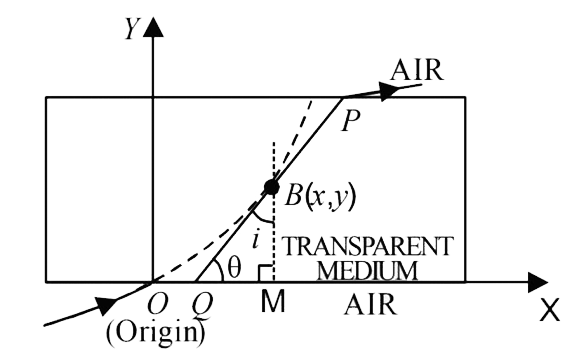
A ray of light travelling in air is incident at grazing angle (incident angle=`90^(@))` on a long rectangular slab of a transparent medium of thickness `t=1.0` (see figure). The point of incidence is the origin `A(O,O)` .The medium has a variable index of refraction n(y) given by :`n(y)=[ky^(3//2)+1]^(1//2)` ,where k=`1.0m^(-3//2)`.the refractive index of air is 1.0`

(i) Obtain a relation between the slope of the trajectory of the ray at a point `B(x,y)`in the medium and the incident angle at that point
(ii) obtain an equation for the trajectory `y(x)`of the ray in the medium.
(ii) Determine the coordinates (`x_(1),y_(1))` of the point `P`.where the ray the ray intersects upper surface of the slab -air boundary.
Indicate the path of the ray subsequently.

Text Solution

Verified by Experts

The correct Answer is:
A, B, C, D


(a) SLOPE AT P
To find the slope at B, we draw a tangent to the trajectory at B. The trajectory is such that as the ray passes through the rectangular transparent medium, the ray continuously deviates towards the normal. The tangent at B makes an angle `theta` with the x-axis. Therefore, the slope at point B is `tantheta=(dy)/(dx)....(i)
i is the angle of incidence at B then according to `triangle`BQM
`i+theta+(pi)/(2)=pi`....(ii)
Substituting the value of `theta` form (ii) in (i)
`((pi)/(2)-i)=(dy)/(dx)implies(dy)/(dx)=coti` ...(iii)
(b) EQUATION OF TRAJECTORY
According to snell's law, when light propagates through a series of parallel layers of different media, then `nsini=constant`
Let us consider the rectangular state to be made up of parallel layers such that as we move in the +Y direction, the refractive index increases as given by the relationship
`n(y)=[ky^((3)/(2))+1]^((1)/(2))` ,,,(iv)
Applying Snell's law at B, we get `nsini=const.=1(from above equation)`
`:'``n=(1)/(sini)=coseci=sqrt(1+cot^(2)i)=sqrt(1+((dy)/(dx))^(2))`,
`sqrt(ky^((3)/(2))+1)=sqrt(1+((dy)/(dx))^(2))` from (iv) `implies``=(dy)/(dx)=[ky^((3)/(2))]^((1)/(2))implies(dy)/(y^((3)/(4)))=k^((1)/(2))dx=dx` (`:"`k=1)`
`impliesint(dy)/(y^((3)/(4)))=intdx`
`implies` y^((1)/(4))=x+C` where C is an integration constant. But at `x=0`,`y=0`
`:'` `C=0` `:'` `4y((1)/(4))=x=impliesy=((x)/(4))^(4)`
(c) CO-ORDINATES `(x_1,y_1)` OF THE POINT P
At P,y=1m `:'``x=4y_((1)/(4))=4`
The coordinates of P are `(4m,1m)`
(d) The refractive index P
`n_p=[ky^((3)/(2))]^((1)/(2))=[1(1)^((3)/(2))+1]^((1)/(2))=sqrt2`
if `i_p` is angle of incidence at P then accordint to Snell's law,
`n_(p)sini_(p)=1impliessini_p=(1)/(sqrt2)`
Also by Snell's law, `n_(air)sinr_p=n_(p)sini_(p)`
`1sinr_(p)=sqrt2xx(1)/(sqrt2)impliessinr_(p)=1impliesr_(p)=(pi)/(2)` `implies` After emerging from the rectangular glass slab, the light tay becomes parallel to slab length.
Promotional Banner

Topper's Solved these Questions

  • MOVING CHARGES AND MAGNETISM

    SUNIL BATRA (41 YEARS IITJEE PHYSICS)|Exercise MCQs(d )|1 Videos

Similar Questions

Explore conceptually related problems

A ray of light travelling in air is incident at 45^(@) on a medium of refractive index sqrt(2) . The angle of refractive in the medium is

A ray of light is incident at an angle of incidence 45^@ on an equilateral prism and emerge at an angle 45^@ then the refractive index of the medium of the prism is:

A ray of light is incident at an angle of 60^(@) on one face of a rectangular glass slab of thickness 0.1 m , and refractive index 1.5 .Calculate the lateral shift produced.

A ray of light is incident on a glass slab at grazing incidence. The refractive index of the material of the slab is given by mu =sqrt(1+sqrty) . If the thickness of the slab is d, determine the equation ofthe trajectory of the ray inside the slab and the coordinates of the point where the ray exits from the slab. Take the origin to be at the point of entry of the ray.

A ray of light travelling in air is incident at grazing incidence on a slab with variable refractive index, n (y) = [ky^(3//2) + 1 ]^(1//2) where k=1 m^(-3//2) and follows path as shown in the figure. What is the total deviation produced by slab when the ray comes out.

SUNIL BATRA (41 YEARS IITJEE PHYSICS)-RAY AND WAVE OPTICS-JEE Main And Advanced
  1. In figure S is a monochromatic point source emitting light of waveleng...

    Text Solution

    |

  2. An image Y is formed of a point object x by a lens whose optic axis is...

    Text Solution

    |

  3. A ray of light travelling in air is incident at grazing angle (incide...

    Text Solution

    |

  4. A right angles prism (45^(@),90^(@), 45^(@)) of refractive index n ha...

    Text Solution

    |

  5. A double slit apparatus is immersed in a liquid of refractive index 1....

    Text Solution

    |

  6. A thin plano-convex lens of focal length f is split into two halves. O...

    Text Solution

    |

  7. In Young's experiment the upper slit is covered by a thin glass plate ...

    Text Solution

    |

  8. A prism of refractive index n(1) & another prism of reactive index n(2...

    Text Solution

    |

  9. A coherent parallel beam of microwaves of wavelength lambda = 0.5 mm f...

    Text Solution

    |

  10. The young's double slit experiment is done in a medium of refractive i...

    Text Solution

    |

  11. The XY plane is the boundary between two tranparednt media. Medium 1 w...

    Text Solution

    |

  12. A quarter cylinder of radius R and refractive index 1.5 is placed on a...

    Text Solution

    |

  13. A convex lens of focal length 15 cm and a concave mirror of focal leng...

    Text Solution

    |

  14. The refractive indices of the crown glass for violet and red lights ar...

    Text Solution

    |

  15. A vessel ABCD of 10 cm width has two small slits S(1) and S(2) sealed ...

    Text Solution

    |

  16. A thin equiconvex lens of refractive index 3//2 is placed on a horizon...

    Text Solution

    |

  17. A point sources S emitting light of wavelength 600nm is placed at a ve...

    Text Solution

    |

  18. Find the focal length of the lens shown in Fig . The radii of curvatur...

    Text Solution

    |

  19. A prism (mu(P)=sqrt(3)) has an angle of prism A=30^(@).A thin film (mu...

    Text Solution

    |

  20. Figure shows an irregular block of material of refractive indec sqrt(2...

    Text Solution

    |