Home
Class 12
PHYSICS
A prism (mu(P)=sqrt(3)) has an angle of ...

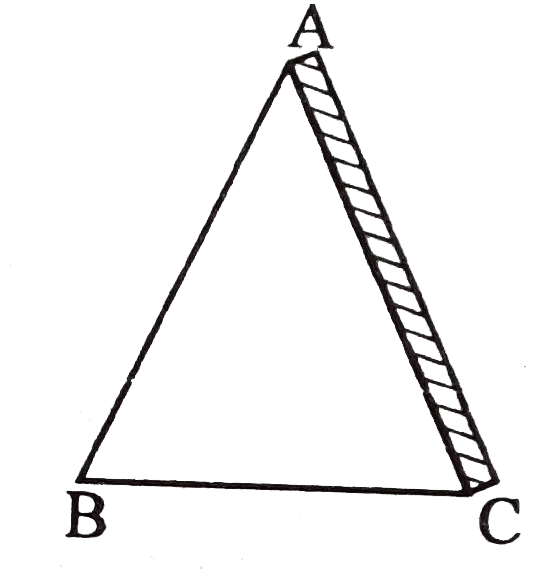
A prism `(mu_(P)=sqrt(3))` has an angle of prism `A=30^(@)`.A thin film `(mu_(f)=2.2)` is coated on face `AC` as shown in the figure.Light of wavelength `550nm` is incident on the face `AB`at`60^(@)`angle of incidence,find
(I)the angle of its emergence from the face`AC`and

(ii)the minimum thickness (in mn) of the film for which the emerging light is of maximum possible intensity.

Text Solution

Verified by Experts

The correct Answer is:
A, B


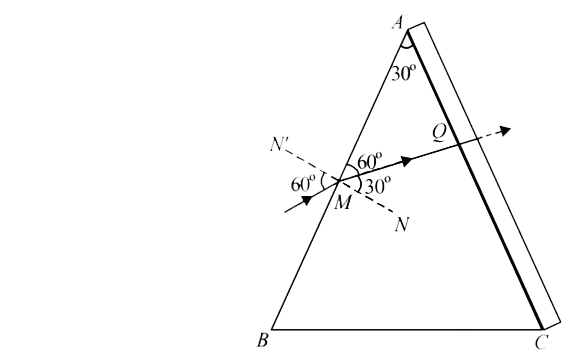
(a) Using Snell's law at surface AB
`mu_(air)sin60^circ=mu_(p)sinrimplies(sqrt3)/(2)=sqrt3sinrimpliesr30^circ`
Now, `NN^(`)` is the normal to surface AB.
`:'``angleAMN=90^circ`
But `angle QMN=30^circimpliesangleAMQ=60^circ`
In `triangleAMQ`
``angleAQM=180^circ-(60^circ+30^circ)=90^circ`
The refracted ray inside the prism hits the other face `90^circ`, hence deviation produced by this face is zero andhence angle of emergence is zero.
(b) Multiple reflections occur in the film for minimum thickness.
The intensity of emergent ray will be maximum if transmitted waves undergo constructive interference. `:'` For minimum thickness,
`trianglex=lamda`
`impliesx=2mut=lamda`,
Where `t=thickness `implies``t=(lamda)/(2mu)=125nm`
Promotional Banner

Topper's Solved these Questions

  • MOVING CHARGES AND MAGNETISM

    SUNIL BATRA (41 YEARS IITJEE PHYSICS)|Exercise MCQs(d )|1 Videos

Similar Questions

Explore conceptually related problems

Light falls at normal incidence on one face of a glass prism of refractive index sqrt(2) . Then the angle of emergence when the angle of the prism is 45^@

In the above example, find the angle of incidence at face AB , so that emergent ray grazes along the face AC' .

A ray of light the face AB of a glass prism of refractive index mu at an angle of incidence i . Find the value of i such that no ray emerges from the face AC of the prism. Given angle of prism is A .

A ray of light enters the face AB of a glass prism of refractive index mu at an angle of incidence i . Find the value of i such that no ray emerges from the face AC of the prism, given angle of prism is A .

Light ray is incident on a prism of angle A=60^(@) are refractive index mu=sqrt(2) . The angle of incidence which the emergent rays grazes the surface is given

Light ray is incident on a prism of angle A=60^(@) and refractive index mu=sqrt(2) .the angle of incidence at which the emergent ray grazes the surface is given by

A beam of monochromatic light is incident at i= 50^(@) on one face of an equilateral prism, the angle of emergence is 40^(@) , then the angle of minimum deviation is :

SUNIL BATRA (41 YEARS IITJEE PHYSICS)-RAY AND WAVE OPTICS-JEE Main And Advanced
  1. A point sources S emitting light of wavelength 600nm is placed at a ve...

    Text Solution

    |

  2. Find the focal length of the lens shown in Fig . The radii of curvatur...

    Text Solution

    |

  3. A prism (mu(P)=sqrt(3)) has an angle of prism A=30^(@).A thin film (mu...

    Text Solution

    |

  4. Figure shows an irregular block of material of refractive indec sqrt(2...

    Text Solution

    |

  5. In YDSE, two wavelengths of 500 nm and 700 nm are used. What is the mi...

    Text Solution

    |

  6. An object is approaching a convex lens of focal length 0.3m with a spe...

    Text Solution

    |

  7. What willl be the minimum angle of incidence such that the total inter...

    Text Solution

    |

  8. Two identical prism of index sqrt3 are kept as shown in the figure. A ...

    Text Solution

    |

  9. Fig. shows a surface XY separating two transparent media, medium 1 and...

    Text Solution

    |

  10. Fig. shows a surface XY separating two transparent media, medium 1 and...

    Text Solution

    |

  11. Fig. shows a surface XY separating two transparent media, medium 1 and...

    Text Solution

    |

  12. Most materials have the refractive index, n gt 1. So, when a light ray...

    Text Solution

    |

  13. Most materials have the refractive index, n gt 1. So, when a light ray...

    Text Solution

    |

  14. Light guidance in an optical fibre can be understood by considering a ...

    Text Solution

    |

  15. Light guidance in an optical fibre can be understood by considering a ...

    Text Solution

    |

  16. In each of the questions, assertion(A) is given by corresponding state...

    Text Solution

    |

  17. The focal length of a thin biconvex lens is 20 cm. When an object is m...

    Text Solution

    |

  18. A large glass slabe (mu=5//3) of thickness 8cm is placed over a point ...

    Text Solution

    |

  19. Image of an object approaching a convex mirror of radius of curvature ...

    Text Solution

    |

  20. Water (with refractive index = 4/3) in a tank is 18 cm deep. Oil of re...

    Text Solution

    |

