Home
Class 12
PHYSICS
Most materials have the refractive index...

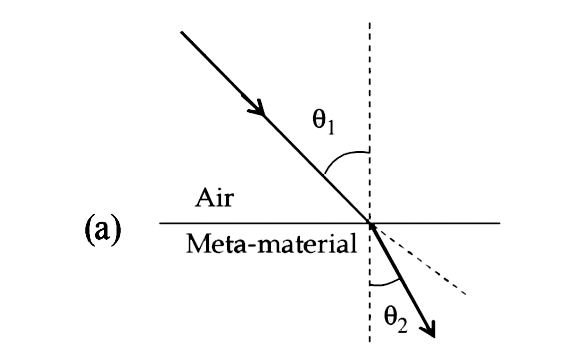
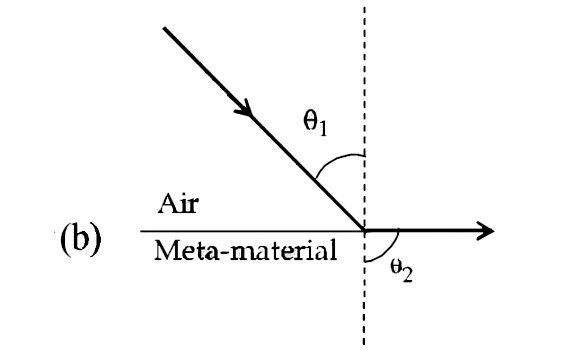
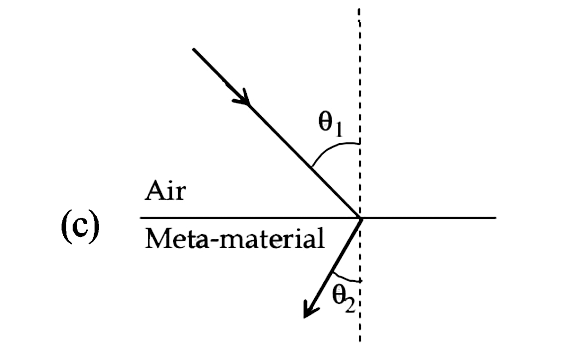
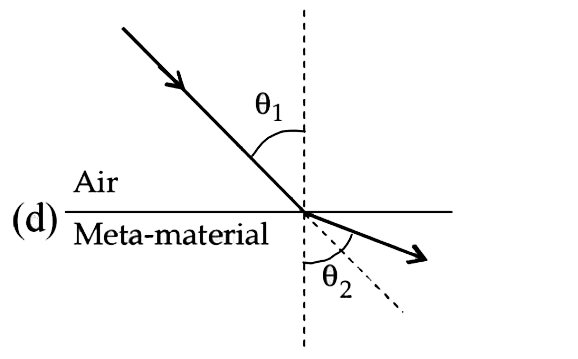
Most materials have the refractive index, `n gt 1`. So, when a light ray from air enters a naturally occuring material, then by Snell's law, `(sin theta_(1))/(sin theta_(2)) = (n_(1))/(n_(2))`, it is understood that the refracted ray bends towards the normal. But it never emerges on the same side of the normal as the incident ray. According to electromagnetism, the refractive index of the medium is given by the relation, `n = (c // v) = +- sqrt(epsilon_(r ), mu_(r ))`, where `c` is the speed of the electromagnetic waves in vacuum, `v` its speed in the medium, `epsilon_( r)` and `mu_( r)` are negative, one must choose the negative root of `n`. Such negative refractive index materials can now be artifically prepared and are called meta-materials. They exhibit significantly different optical behaviour, without violating any physical laws. Since `n` is negative, it results in a change in the direction of propagation of the refracted light. However, similar to normal materials, the frequency of light remains unchanged upon refraction even in meta-materials.
Answer the following questions :
For light incident from air on a meta-material, the appropriate ray diagram is

A

B

C

D

Text Solution

Verified by Experts

The correct Answer is:

C

As n is negative, therefore direction charges `n_1sintheta_1=n_2sintheta_2`
Promotional Banner

Topper's Solved these Questions

  • MOVING CHARGES AND MAGNETISM

    SUNIL BATRA (41 YEARS IITJEE PHYSICS)|Exercise MCQs(d )|1 Videos

Similar Questions

Explore conceptually related problems

Most materials have the refractive index, n gt 1 . So, when a light ray from air enters a naturally occuring material, then by Snell's law, (sin theta_(1))/(sin theta_(2)) = (n_(1))/(n_(2)) , it is understood that the refracted ray bends towards the normal. But it never emerges on the same side of the normal as the incident ray. According to electromagnetism, the refractive index of the medium is given by the relation, n = (c // v) = +- sqrt(epsilon_(r ), mu_(r )) , where c is the speed of the electromagnetic waves in vacuum, v its speed in the medium, epsilon_( r) and mu_( r) are negative, one must choose the negative root of n . Such negative refractive index materials can now be artifically prepared and are called meta-materials. They exhibit significantly different optical behaviour, without violating any physical laws. Since n is negative, it results in a change in the direction of propagation of the refracted light. However, similar to normal materials, the frequency of light remains unchanged upon refraction even in meta-materials. Answer the following questions : Choose the correct statement.

The first law of refraction states that the incident and refracted rays are in the same ____as the normal.

When a ray of light is incident normally on one refracting surface of an equilateral prism (Refractive index of the material of the prism =1.5

A ray of light falls on a material body at an incident angle of 30^(@) and refracted at angle 60^(@) . What is the refractive index of the material?

A ray of light falls on a material body at an incident angle 60^(@) and refracted at angle 30^(@) . What is the refractive index of the material?

SUNIL BATRA (41 YEARS IITJEE PHYSICS)-RAY AND WAVE OPTICS-JEE Main And Advanced
  1. Fig. shows a surface XY separating two transparent media, medium 1 and...

    Text Solution

    |

  2. Fig. shows a surface XY separating two transparent media, medium 1 and...

    Text Solution

    |

  3. Most materials have the refractive index, n gt 1. So, when a light ray...

    Text Solution

    |

  4. Most materials have the refractive index, n gt 1. So, when a light ray...

    Text Solution

    |

  5. Light guidance in an optical fibre can be understood by considering a ...

    Text Solution

    |

  6. Light guidance in an optical fibre can be understood by considering a ...

    Text Solution

    |

  7. In each of the questions, assertion(A) is given by corresponding state...

    Text Solution

    |

  8. The focal length of a thin biconvex lens is 20 cm. When an object is m...

    Text Solution

    |

  9. A large glass slabe (mu=5//3) of thickness 8cm is placed over a point ...

    Text Solution

    |

  10. Image of an object approaching a convex mirror of radius of curvature ...

    Text Solution

    |

  11. Water (with refractive index = 4/3) in a tank is 18 cm deep. Oil of re...

    Text Solution

    |

  12. A Young's double slit interference arrangement with slits S(1) and S(2...

    Text Solution

    |

  13. Consider a concave mirror and a convex lens (refractive index 1.5) of ...

    Text Solution

    |

  14. A monochromatic beam of light is incident at 60^@ on one face of an eq...

    Text Solution

    |

  15. An astronomical telescope has large apeture to

    Text Solution

    |

  16. If two mirrors are keps at 60^circ to each other, then the number of i...

    Text Solution

    |

  17. Electrimagnetic waves are transverse is nature is evident by

    Text Solution

    |

  18. Wavelength of ligh used in an optical instrument are lamda=4000A and l...

    Text Solution

    |

  19. Which of the following is used in optical fibres?

    Text Solution

    |

  20. Consider telecommunication through optical fibres. Which of the follow...

    Text Solution

    |
