A gas of identical hydrogen-like atoms has some atoms in the lowest in lower (ground) energy level `A` and some atoms in a partical upper (excited) energy level `B` and there are no atoms in any other energy level.The atoms of the gas make transition to higher energy level by absorbing monochromatic light of photon energy `2.7 e V`.
Subsequenty , the atom emit radiation of only six different photon energies. Some of the emitted photons have energy `2.7 e V` some have energy more , and some have less than `2.7 e V`.
a Find the principal quantum number of the intially excited level `B`
b Find the ionization energy for the gas atoms.
c Find the maximum and the minimum energies of the emitted photons.
A gas of identical hydrogen-like atoms has some atoms in the lowest in lower (ground) energy level `A` and some atoms in a partical upper (excited) energy level `B` and there are no atoms in any other energy level.The atoms of the gas make transition to higher energy level by absorbing monochromatic light of photon energy `2.7 e V`.
Subsequenty , the atom emit radiation of only six different photon energies. Some of the emitted photons have energy `2.7 e V` some have energy more , and some have less than `2.7 e V`.
a Find the principal quantum number of the intially excited level `B`
b Find the ionization energy for the gas atoms.
c Find the maximum and the minimum energies of the emitted photons.
Subsequenty , the atom emit radiation of only six different photon energies. Some of the emitted photons have energy `2.7 e V` some have energy more , and some have less than `2.7 e V`.
a Find the principal quantum number of the intially excited level `B`
b Find the ionization energy for the gas atoms.
c Find the maximum and the minimum energies of the emitted photons.
Text Solution
Verified by Experts
The correct Answer is:
A, B, C, D
The transition state of six different photon energies are shown
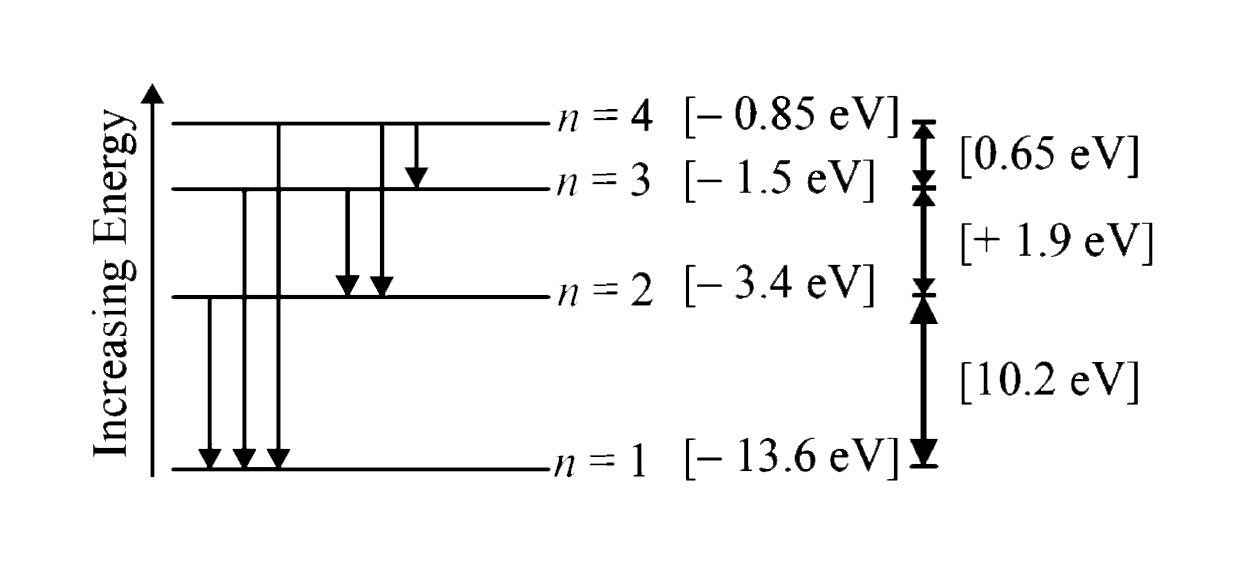
Since after absorbing monochronatic light , same of the emitted photons have less then `2.7 eV` , this indicates that the excited level `B` is the excited level then energy less then `2.7 eV` (this is because if `n = 3` the excited level then energy less then `2.7 eV` is not possible)
(ii) for hydrogen like atoms we have
`E_(n) = (- 13.6)/(n^(2))Z^(2) eV atom`
`E_(1) - `E_(2) (-13.6)/(16)Z^(2) eV = ((-13.6)/(9)Z^(2) = 2.7`
`rArr Z^(2)= (2.7)/(13.6) xx(4 xx 16)/(12) rArr I.E.= 13.6Z^(2)((1)/(l^(2)) - (1)/(prop^(2)))`
`= 13.6 xx (2.7)/(13.6) xx (4 xx 16)/(12) = 13.5 eV `
(iii) Max energy
E_(4) - `E_(3) = -13.6Z^(2)((1)/(4^(2)) - (1)/(3^(2)))`
`= 13.6 xx (2.7)/(13.6)xx (4 xx16)/(12) xx(7)/(9 xx 16) = 0.7 eV`
Since after absorbing monochronatic light , same of the emitted photons have less then `2.7 eV` , this indicates that the excited level `B` is the excited level then energy less then `2.7 eV` (this is because if `n = 3` the excited level then energy less then `2.7 eV` is not possible)
(ii) for hydrogen like atoms we have
`E_(n) = (- 13.6)/(n^(2))Z^(2) eV atom`
`E_(1) - `E_(2) (-13.6)/(16)Z^(2) eV = ((-13.6)/(9)Z^(2) = 2.7`
`rArr Z^(2)= (2.7)/(13.6) xx(4 xx 16)/(12) rArr I.E.= 13.6Z^(2)((1)/(l^(2)) - (1)/(prop^(2)))`
`= 13.6 xx (2.7)/(13.6) xx (4 xx 16)/(12) = 13.5 eV `
(iii) Max energy
E_(4) - `E_(3) = -13.6Z^(2)((1)/(4^(2)) - (1)/(3^(2)))`
`= 13.6 xx (2.7)/(13.6)xx (4 xx16)/(12) xx(7)/(9 xx 16) = 0.7 eV`



Topper's Solved these Questions
Similar Questions
Explore conceptually related problems
A gas of identical hydrogen like atomos has some atoms in ground state and some atoms in a particular exceited state and dthere are no atoms in any other energy level. The atoms of the gas make transition to a higher energy stte by absrobing monochromatic light of wavelenght 304 overset(@)A . Subsequencly, the atoms emit radiation of only six different photon energies. Some of emitted photons have wavelenght 304 overset(@)A , some wavelength more and some have less that 304 overeset(@)A (Take he=12420eV -overset(@)A ) Find the principal quantum number of the initially excicted state.
A gas of identical hydrogen like atomos has some atoms in ground state and some atoms in a particular exceited state and dthere are no atoms in any other energy level. The atoms of the gas make transition to a higher energy stte by absrobing monochromatic light of wavelenght 304 overset(@)A . Subsequencly, the atoms emit radiation of only six different photon energies. Some of emitted photons have wavelenght 304 overset(@)A , some wavelength more and some have less that 304 overeset(@)A (Take he=12420eV -overset(@)A ) Identify the gas (Z=?)
A gas of identical hydrogen like atomos has some atoms in ground state and some atoms in a particular exceited state and dthere are no atoms in any other energy level. The atoms of the gas make transition to a higher energy stte by absrobing monochromatic light of wavelenght 304 overset(@)A . Subsequencly, the atoms emit radiation of only six different photon energies. Some of emitted photons have wavelenght 304 overset(@)A , some wavelength more and some have less that 304 overeset(@)A (Take he=12420eV -overset(@)A ) Find the maximum and minimum energies of emitted photosn (in eV)
Energy Level Of Hydrogen Atoms
Find the excitation energy of n = 3 level of He atom
In a sample of hydrogen atoms, all the atoms exist in two energy levels A and B. A is the ground level and B is some higher energy level. These atoms absorb photons of energy 2.7 eV and attain a higher energy level C.After this, these atoms emit photons of six different energies. Some of these photon energies are higher than 2.7 eV, some equal to 2.7 eV and some are loss than 2.7 eV. The principal quantum number corresponding to energy level B is
In a sample of hydrogen atoms, all the atoms exist in two energy levels A and B. A is the ground level and B is some higher energy level. These atoms absorb photons of energy 2.7 eV and attain a higher energy level C.After this, these atoms emit photons of six different energies. Some of these photon energies are higher than 2.7 eV, some equal to 2.7 eV and some are loss than 2.7 eV. The principal quantum number corresponding to energy level C is
In a sample of hydrogen atoms, all the atoms exist in two energy levels A and B. A is the ground level and B is some higher energy level. These atoms absorb photons of energy 2.7 eV and attain a higher energy level C.After this, these atoms emit photons of six different energies. Some of these photon energies are higher than 2.7 eV, some equal to 2.7 eV and some are loss than 2.7 eV. The atomic number of these atoms is
An electron in hydrogen atom is in the n=4 energy level. When it makes a transition to some lower energy level, to which series the wavelength of emitted photon belong?