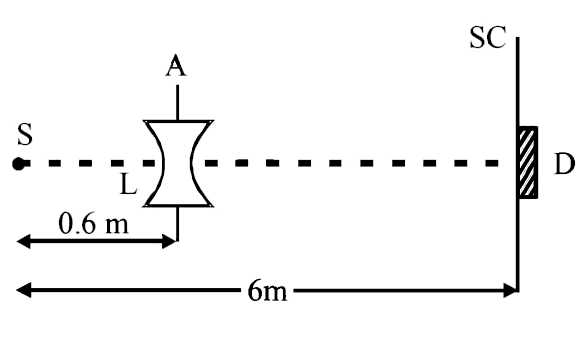
Energy of one photon, `E= (hc)/(lambda) = ((6.6 xx 10^(-34)) (3.0 xx 10^(8))/(6000 xx 10^(-10)) `
`= 3.3 xx 10^(-19) J`
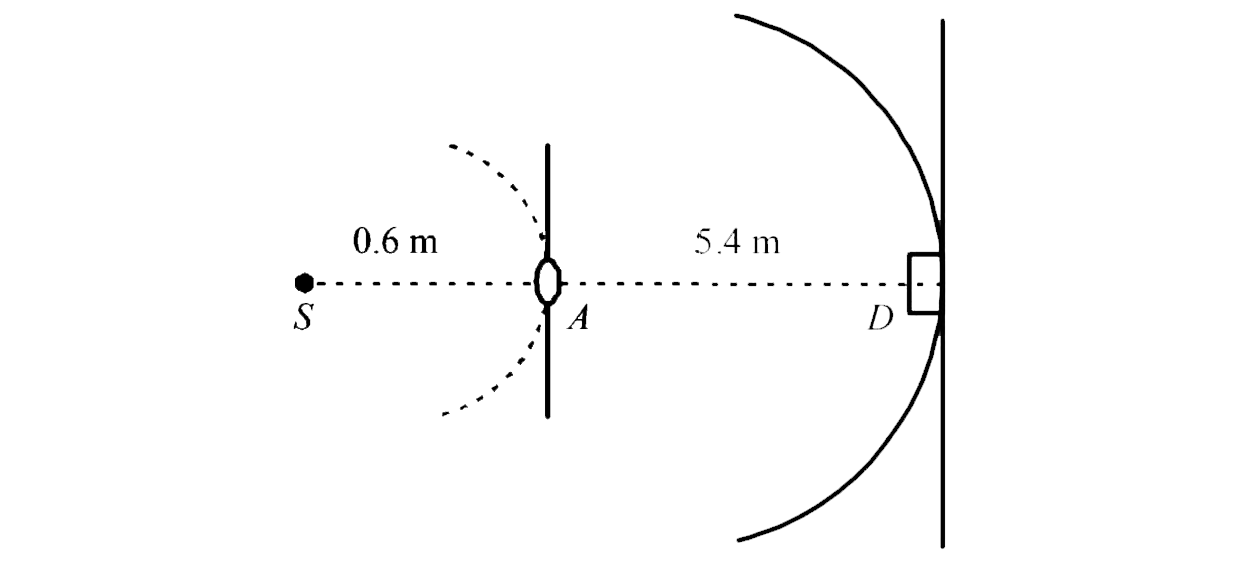
power of the source is `2 W or 2 J//s` therefore number of photons emitted per second
`n_(1) = (2)/(3.3 xx 10^(-19)) = 6.06 xx 10^(18) //s`
As distance `0.6 m ` number of photon incident per area per unit time
`n_(2) = (n_(1))/(4 pi (0.6)^(2)) = 1.34 xx 10^(18) //m^(2) //s`
Area of aperture is ,
`S_(1) = (pi)/(4)d^(2) = (pi)/(4) (0.1)^(2) = 7.85 xx 10^(-3)m^(2)`
`:.` Total number of photons incident per unit time on the aperture
`n_(3) = n_(2) s_(1)= (1.34 xx 10^(18) ) (7.85 xx 10^(-3)) //s`
The aperture will because new source of light
Now these photon are further distributed is all directions
Heance at thr location of detector, photons incident per unit area per unit time
`n_(4) = (n_(3))/(4 pi (6.0)^(2)) = (1.052 xx 10^(16))/(4 pi (5.4)^(2)) `
`= 2.87 xx 10^(13 )s^(-1) m^(-2)`
This is the photon this at the centre of the Area of detector is `0.5 cm^(2) or 0.5 xx 10^(-4)m^(2)` therefore , total number of photonelectrons gmerated per unit time
`n_(6) = 0.9n_(2) = 1.2915 xx 10^(8)s^(-1)`
or, photocurrect in the detectir
`i = (e) n_(6) = (1.6 xx 10^(-19)) (1.2915 xx 10^(9)) = 2.07 xx 10^(-10)A`
(b) using the lens formula
`(1)/(v) - (1)/(-0.6) = (1)/(-0.6) or v = - 0.33 m`
i,e, image of souece (say S, is formed at `0.3m ` from the lens)
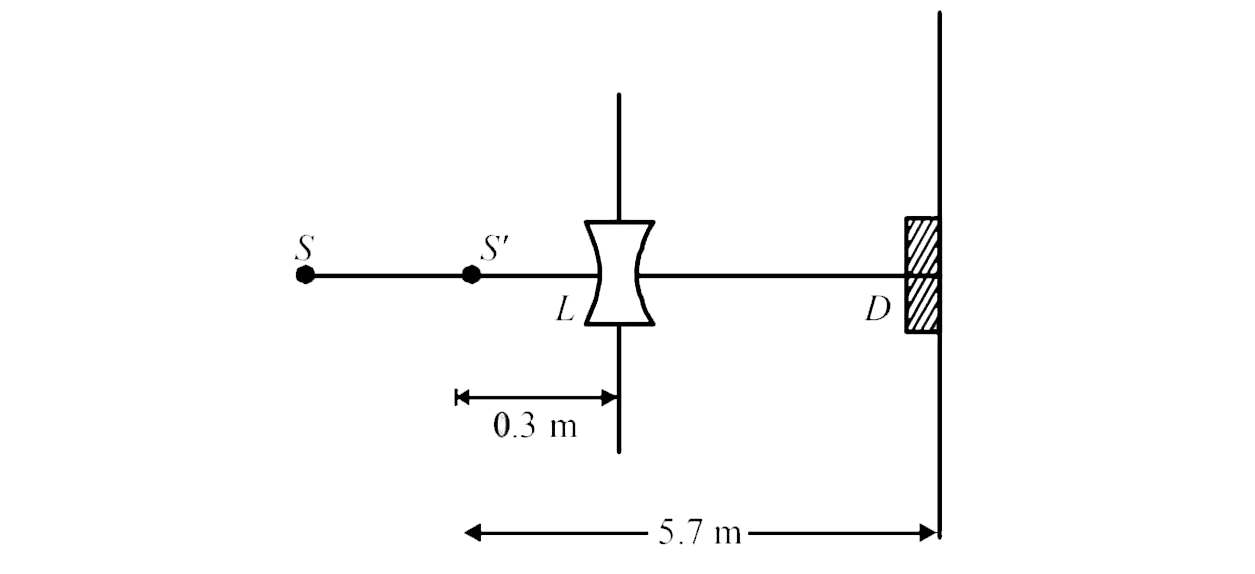
Total number of incident per unit on the lens are still `n_(2) or 1.052 xx 10^(16) //s` of it transmits to secound medum .Therefore , at a distance of `5.7`m from `S` number of be photon incident per unit time will be
`n_(7) = ((80 //100) (1.05 xx 10^(16)))/((4 pi)(5.7)^(2)) = 2.06 xx 10^(13) s^(-1) m^(-2)`
for stopping potential
`(hc)/(lambda) = (E_(lambda)) _(max) + W = eV_(0) + W`
`:. eV_(0) = (hc)/(lambda) - W = (3.315 xx 10^(-19))/(1.6 xx 10^(-19)) - 1 = 1.07 Volt`