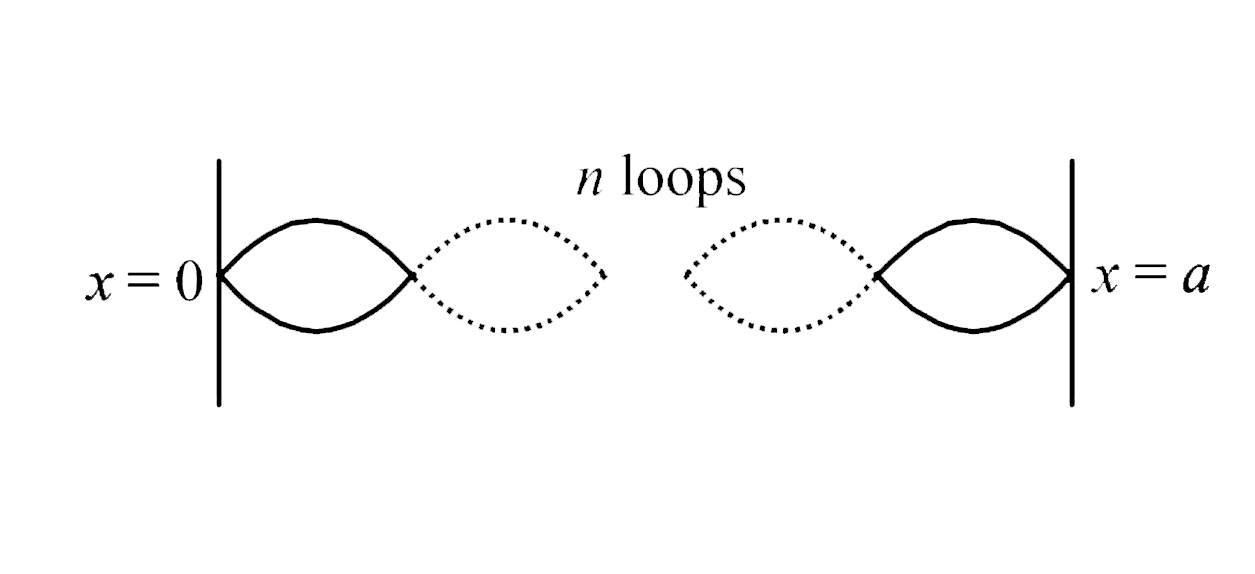
When a particle is restricted to move along x- axis between `x = 0 and x = 4 ` whwre a is opf nanometer demension , its energy can take only certain spscfic values . The allowed energies of the particles only in such a restiricted regain , correspond to the formation of standing wave with nodes at its end ` x = 0 and x = a `.The wavelength of this standing wave is related to the linear momentum p of the paarticle according to the de Broglie relation .The energy of the particle of mass `m` is reated to its linear momentum as
`E = (p^(2))/(2m)` . thus , the energy of the particle can be denoted by a quantum number `n` taking value `1,``2,``3,``...``(n= 1,` called the ground state) corresponding to the number of loops in the standing wave use the model described above to answer the following there question for a particle moving in the line ` x = 0` to `x = a` Take `h = 6.6 xx 10^(-34)` J s and `e = 1.6 xx 10^(-19)C`
The allowed energy for the particle for a particular value of `n` is proportional to
When a particle is restricted to move along x- axis between `x = 0 and x = 4 ` whwre a is opf nanometer demension , its energy can take only certain spscfic values . The allowed energies of the particles only in such a restiricted regain , correspond to the formation of standing wave with nodes at its end ` x = 0 and x = a `.The wavelength of this standing wave is related to the linear momentum p of the paarticle according to the de Broglie relation .The energy of the particle of mass `m` is reated to its linear momentum as
`E = (p^(2))/(2m)` . thus , the energy of the particle can be denoted by a quantum number `n` taking value `1,``2,``3,``...``(n= 1,` called the ground state) corresponding to the number of loops in the standing wave use the model described above to answer the following there question for a particle moving in the line ` x = 0` to `x = a` Take `h = 6.6 xx 10^(-34)` J s and `e = 1.6 xx 10^(-19)C`
The allowed energy for the particle for a particular value of `n` is proportional to
`E = (p^(2))/(2m)` . thus , the energy of the particle can be denoted by a quantum number `n` taking value `1,``2,``3,``...``(n= 1,` called the ground state) corresponding to the number of loops in the standing wave use the model described above to answer the following there question for a particle moving in the line ` x = 0` to `x = a` Take `h = 6.6 xx 10^(-34)` J s and `e = 1.6 xx 10^(-19)C`
The allowed energy for the particle for a particular value of `n` is proportional to
A
`a^(-2)`
B
`a^(-3//2)`
C
`a^(-1)`
D
`a^(2)`
Text Solution
Verified by Experts
The correct Answer is:
A
` lambda = (h)/(p) and E = (p^(2))/(2 m)`
rArr E = (h^(2))/(2m lambda^(2))`
The length in which the particle is restricted is move is a This length is a multiple of `(lambda)/(2)`
Now , `n(lambda)/(2) = u rArr lambda = (2a)/(n)`
`rArr E = ((h^(2) n^(2))/(2 m xx 4a^(2)) = (n^(2) h^(2))/(8 ma^(2))` rArr E prop a^(-2)` for a particular value of `n`
rArr E = (h^(2))/(2m lambda^(2))`
The length in which the particle is restricted is move is a This length is a multiple of `(lambda)/(2)`
Now , `n(lambda)/(2) = u rArr lambda = (2a)/(n)`
`rArr E = ((h^(2) n^(2))/(2 m xx 4a^(2)) = (n^(2) h^(2))/(8 ma^(2))` rArr E prop a^(-2)` for a particular value of `n`



Topper's Solved these Questions
Similar Questions
Explore conceptually related problems
When a particle is restricted to move along x- axis between x = 0 and x = 4 whwre a is opf nanometer demension , its energy can take only certain spscfic values . The allowed energies of the particles only in such a restiricted regain , correspond to the formation of standing wave with nodes at its end x = 0 and x = a .The wavelength of this standing wave is related to the linear momentum p of the paarticle according to the de Broglie relation .The energy of the particle of mass m is reated to its linear momentum as E = (p^(2))/(2m) . thus , the energy of the particle can be denoted by a quantum number n taking value 1,2,3,....(n= 1, called the ground state) corresponding to the number of loops in the standing wave use the model described above to answer the following there question for a particle moving in the line x = 0 to x = a Take h = 6.6 xx 10^(-34) J s and e = 1.6 xx 10^(-19)C The speed of the particle , that can take discrete values, is propotional to
When a particle is restricted to move aong x axis between x =0 and x = a , where a is of nanometer dimension. Its energy can take only certain specific values. The allowed energies of the particle moving in such a restricted region, correspond to the formation of standing waves with nodes at its ends x = 0 and x = a . The wavelength of this standing wave is realated to the linear momentum p of the particle according to the de Breogile relation. The energy of the particl e of mass m is reelated to its linear momentum as E = (p^(2))/(2m) . Thus, the energy of the particle can be denoted by a quantum number 'n' taking values 1,2,3,"......." ( n=1 , called the ground state) corresponding to the number of loop in the standing wave. Use the model decribed above to answer the following three questions for a particle moving in the line x = 0 to x =a . Take h = 6.6 xx 10^(-34) J s and e = 1.6 xx 10^(-19) C . The allowed energy for the particle for a particular value of n is proportional to
When a particle is restricted to move along x- axis between x = 0 and x = 4 whwre a is opf nanometer demension , its energy can take only certain spscfic values . The allowed energies of the particles only in such a restiricted regain , correspond to the formation of standing wave with nodes at its end x = 0 and x = a .The wavelength of this standing wave is related to the linear momentum p of the paarticle according to the de Broglie relation .The energy of the particle of mass m is reated to its linear momentum as E = (p^(2))/(2m) . thus , the energy of the particle can be denoted by a quantum number n taking value 1,2,3,....(n= 1, called the ground state) corresponding to the number of loops in the standing wave use the model described above to answer the following there question for a particle moving in the line x = 0 to x = a Take h = 6.6 xx 10^(-34) J s and e = 1.6 xx 10^(-19)C If the mass of the particle is m = 1.0 xx 10^(-30) kg and a= 6.6 nm the energyof the particle in its ground state is closest to
When a particle is restricted to move along x-axis between x=0 and x=a , where alpha if of nenometer dimension, its energy can take only certain specific values. The allowed energies of the particle moving in such a restricted region, correspond to the formation of standing waves with nodes at its ends x=0 and x=a . The wavelength of this standing wave is related to the linear momentum p of the particle according to the de Broglie relation. The energy of the particle of mass m is related to its linear momentum as E=(p^2)/(2m) . Thus the energy of the particle can be denoted by a quantum number n taking values 1,2,3, ...( n=1 , called the ground state) corresponding to the number of loops in the standing wave. Use the model described above to answer the following three questions for a particle moving along the line from x=0 to x=alpha . Take h=6.6xx10^(-34)Js and e=1.6xx10^(-19) C. Q. The allowed energy for the particle for a particular value of n is proportional to
When a particle is restricted to move aong x axis between x =0 and x = a , where a is of nanometer dimension. Its energy can take only certain specific values. The allowed energies of the particle moving in such a restricted region, correspond to the formation of standing waves with nodes at its ends x = 0 and x = a . The wavelength of this standing wave is realated to the linear momentum p of the particle according to the de Breogile relation. The energy of the particl e of mass m is reelated to its linear momentum as E = (p^(2))/(2m) . Thus, the energy of the particle can be denoted by a quantum number 'n' taking values 1,2,3,"......." ( n=1 , called the ground state) corresponding to the number of loop in the standing wave. Use the model decribed above to answer the following three questions for a particle moving in the line x = 0 to x =a . Take h = 6.6 xx 10^(-34) J s and e = 1.6 xx 10^(-19) C . The speed of the particle, that can take disrete values, is proportional to
When a particle is restricted to move along x-axis between x=0 and x=a , where alpha if of nenometer dimension, its energy can take only certain specific values. The allowed energies of the particle moving in such a restricted region, correspond to the formation of standing waves with nodes at its ends x=0 and x=a . The wavelength of this standing wave is related to the linear momentum p of the particle according to the de Broglie relation. The energy of the particle of mass m is related to its linear momentum as E=(p^2)/(2m) . Thus the energy of the particle can be denoted by a quantum number n taking values 1,2,3, ...( n=1 , called the ground state) corresponding to the number of loops in the standing wave. Use the model described above to answer the following three questions for a particle moving along the line from x=0 to x=alpha . Take h=6.6xx10^(-34)Js and e=1.6xx10^(-19) C Q. The speed of the particle that can take discrete values is proportional to
When a particle is restricted to move aong x axis between x =0 and x = a , where a is of nanometer dimension. Its energy can take only certain specific values. The allowed energies of the particle moving in such a restricted region, correspond to the formation of standing waves with nodes at its ends x = 0 and x = a . The wavelength of this standing wave is realated to the linear momentum p of the particle according to the de Breogile relation. The energy of the particl e of mass m is reelated to its linear momentum as E = (p^(2))/(2m) . Thus, the energy of the particle can be denoted by a quantum number 'n' taking values 1,2,3,"......." ( n=1 , called the ground state) corresponding to the number of loop in the standing wave. Use the model decribed above to answer the following three questions for a particle moving in the line x = 0 to x =a . Take h = 6.6 xx 10^(-34) J s and e = 1.6 xx 10^(-19) C . If the mass of the particle is m = 1.0 xx 10^(-30) kg and a = 6.6 nm , the energy of the particle in its ground state is closet to
When a particle is restricted to move along x-axis between x=0 and x=a , where alpha if of nenometer dimension, its energy can take only certain specific values. The allowed energies of the particle moving in such a restricted region, correspond to the formation of standing waves with nodes at its ends x=0 and x=a . The wavelength of this standing wave is related to the linear momentum p of the particle according to the de Broglie relation. The energy of the particle of mass m is related to its linear momentum as E=(p^2)/(2m) . Thus the energy of the particle can be denoted by a quantum number n taking values 1,2,3, ...( n=1 , called the ground state) corresponding to the number of loops in the standing wave. Use the model described above to answer the following three questions for a particle moving along the line from x=0 to x=alpha . Take h=6.6xx10^(-34)Js and e=1.6xx10^(-19) C. Q. If the mass of the particle is m=1.0xx10^(-30) kg and alpha=6.6nm , the energy of the particle in its ground state is closest to
The position of a particle moving along x- axis is given by x=x_0 cos^2(omegat) . Its when it is at mean position is
The displacement of a particle along the x- axis it given by x = a sin^(2) omega t The motion of the particle corresponds to