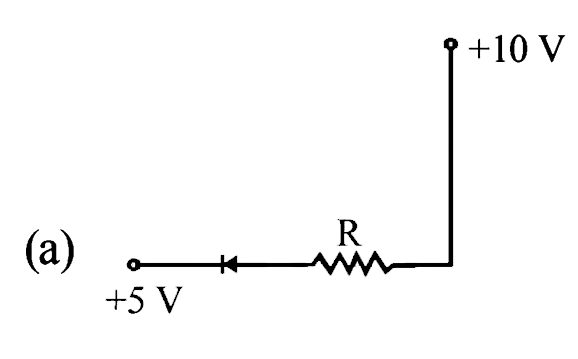
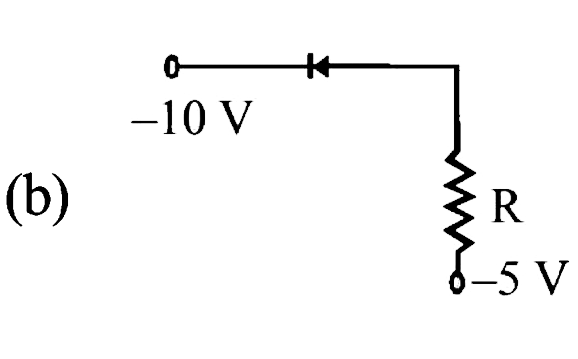
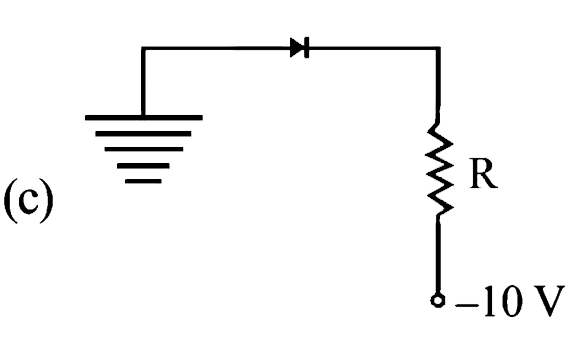
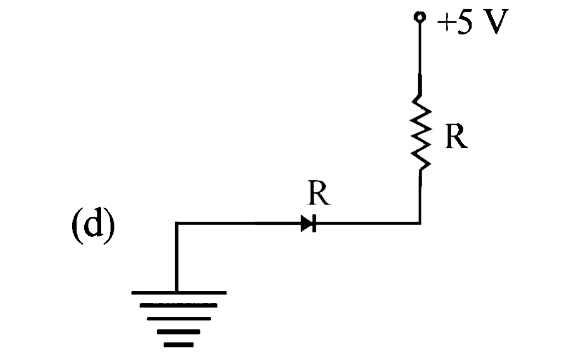
If the following which one of the diodes reverse biased?
A
B
C
D
Text Solution
AI Generated Solution
The correct Answer is:
To determine which diode is reverse biased among the given options, we need to analyze the connections of the p-n junction diodes in each case.
### Step-by-Step Solution:
1. **Understand Diode Biasing**: A diode is considered forward biased when the p-side (anode) is at a higher potential than the n-side (cathode). Conversely, it is reverse biased when the p-side is at a lower potential than the n-side.
2. **Analyze Each Diode**:
- **Diode A**: The p-side is connected to +10V and the n-side is connected to a lower potential. Since +10V is higher than the n-side potential, this diode is forward biased.
- **Diode B**: The p-side is connected to -5V and the n-side to -10V. Since -5V is higher than -10V, this diode is also forward biased.
- **Diode C**: The p-side is at 0V and the n-side is at -10V. Here, 0V is higher than -10V, which means this diode is forward biased as well.
- **Diode D**: The p-side is connected to 0V and the n-side to +5V. In this case, 0V is lower than +5V, indicating that the p-side is at a lower potential than the n-side. Therefore, this diode is reverse biased.
3. **Conclusion**: Among the four diodes analyzed, Diode D is the one that is reverse biased.
### Final Answer:
The diode that is reverse biased is **Diode D**.
To determine which diode is reverse biased among the given options, we need to analyze the connections of the p-n junction diodes in each case.
### Step-by-Step Solution:
1. **Understand Diode Biasing**: A diode is considered forward biased when the p-side (anode) is at a higher potential than the n-side (cathode). Conversely, it is reverse biased when the p-side is at a lower potential than the n-side.
2. **Analyze Each Diode**:
- **Diode A**: The p-side is connected to +10V and the n-side is connected to a lower potential. Since +10V is higher than the n-side potential, this diode is forward biased.
...