Home
Class 12
PHYSICS
Wavelengths of two notes in air are ((90...

Wavelengths of two notes in air are `((90)/(175))` m and `((90)/(173))` m. Each note produces four beats per second with a third note of a fixed frequency. Calculate the velocity of sound in air.

Text Solution

Verified by Experts
The lowest allowed frequency of vibration (fundamental ) of a bounded medium and all its integral multiples are called harmonics.
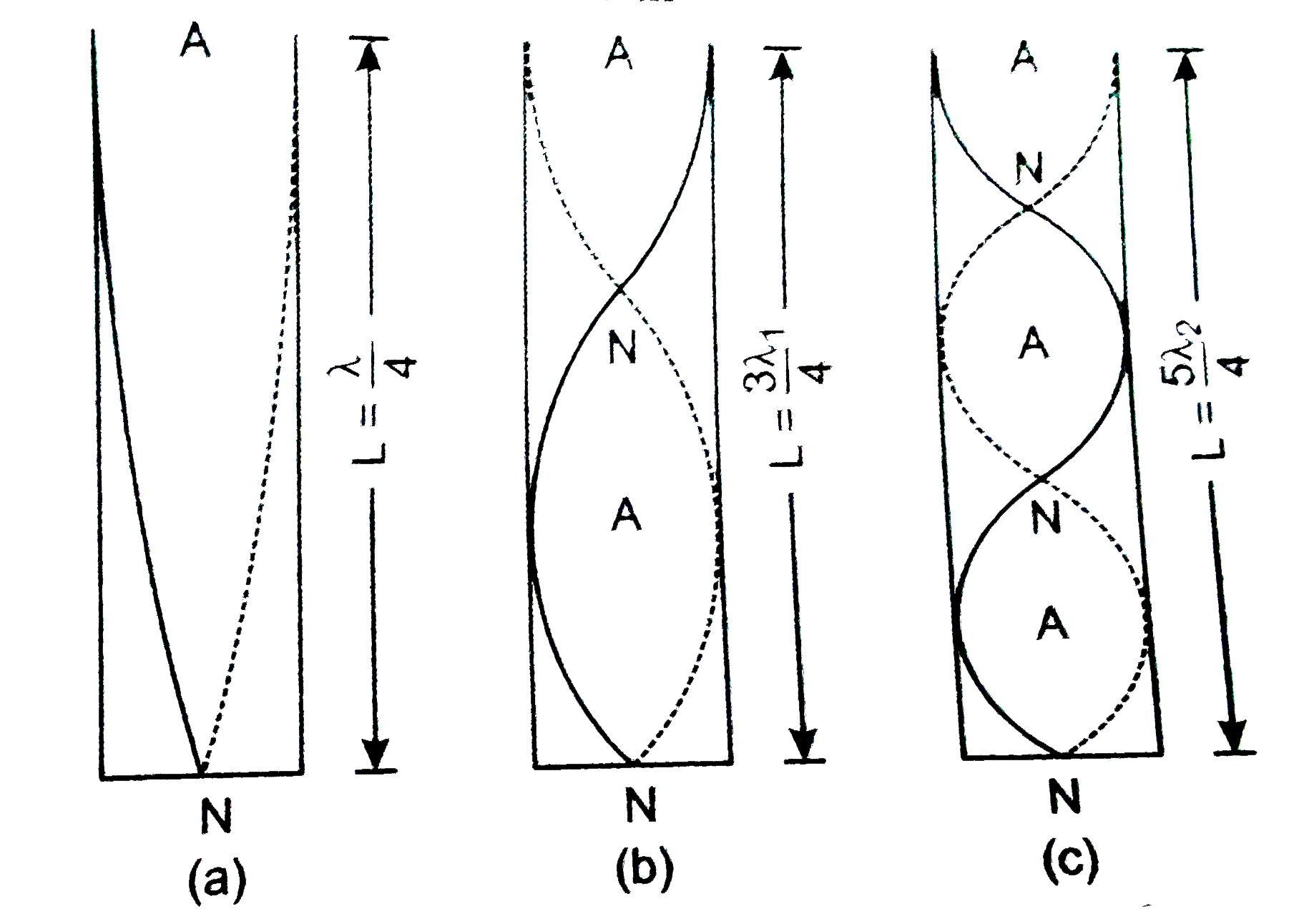
The stationary wave in the air column are subject to two boundary condition that there must be a node at the closed end and an antinode at the open end. In the following we shall ignore the end correction.

Let, v be speed of sound of sound in air, In the simplest mode of vibration as shown in the figure.
(a) There is a one node at the closed end and an antinode at the open end. The distance between a node and a constructive antinode is `lambda//4`, where `lambda` is the wavelength of sound. The corresponding wavelength `lambda` and frequency `eta` are
`lambda=4L and n=(v)/(lambda)=(v)/(4L) " " ` ...(i)
This gives the fundamental frequency of vibration, the first overtone, two nodes and two antinodes are formed as shown in the figure (b). The corresponding wavelength `lambda_(1)` and frequency `n_(1)` are
`lambda_(1)=(4L)/(3) and n_(1)=(v)/(lambda_(1))=(3v)/(4L)=3n " " `...(ii)
Therefore, the frequency in the first overtone is three times the fundamental frequency i.e., the first overtone is the third harmonic.
(c ) In the second ovetone, three nodes and three antinodes are formed as shown in the figure (c ).
The corresponding wavelength `lambda_(2)` and frequency `n_(2)` are
`lambda_(2)=(4L)/(5) and n_(2)=(v)/(lambda_(2))=(5v)/(4L)=5n " " `....(iii)
which is the fifth harmonic.
Therefore, in general the frequency of the `p^(th)` overtone (p = 1, 2, 3, ......) is
`n_(p)=(2p+1)n " " `...(iv)
i.e., the `p^(th)` overtone is the `(2p+1)^(th)`
harmonic.
Equation (i), (ii) and (iii) show that allowed frequencies in an air column is a pipe closed at one end are `n, 3n, 5n ....... .`
That is only odd harmonics are present as overtones.
Nomerical :
Given : `lambda_(1)=(81)/(173)m, lambda_(2)=(81)/(170)m.`
Let, `n_(1) and n_(2)` be the corresponding frequencies.
`therefore v=n_(1)lambda_(1)=n_(2)lambda_(2)`
where, v is the speed of sound in air.
`therefore n_(1)=(v)/(lambda_(1)) and n_(2)=(v)/(lambda_(2)) " " ` ...(i)
But `lambda_(2) gt lambda_(1)`
`therefore n_(2) lt n_(1)`
` therefore n_(1)-n_(2)=10`
`(v)/(lambda_(1))-(v)/(lambda_(2))=10`
`v[(1)/(lambda_(1))-(1)/(lambda_(2))=10`
`v[(173)/(81)-(170)/(81)]=10`
`v[(3)/(81)]=10`
`v=(10xx81)/(3)=270 m//s.`
Promotional Banner

Topper's Solved these Questions

  • FEBRUARY 2018

    GURUKUL PUBLICATION - MAHARASHTRA PREVIOUS YEAR PAPERS|Exercise SECTION-II|21 Videos
  • FEBRUARY 2016

    GURUKUL PUBLICATION - MAHARASHTRA PREVIOUS YEAR PAPERS|Exercise SECTION-II|21 Videos
  • FEBRUARY 2019

    GURUKUL PUBLICATION - MAHARASHTRA PREVIOUS YEAR PAPERS|Exercise SECTION-D|6 Videos

Similar Questions

Explore conceptually related problems

Wavelengths of two notes in the air are ((70)/(153))m and ((70)/(157))m . Each of these notes produces 8 beats per second with a tuning fork of fixed frequency . Find the velocity of sound in the air and frequency . Find the velocity of sound in the air and frequency of the tuning fork.

Wavelength of two musical motes in air are 18/35 m and (90/173)m . Each note produces four beats per second with a third note of frequency f_(0) . Calculate the frequency f_(0) .

Wavelength of two notes in air are 1 m and 1(1)/(164) m. Each note produces 1 beats/s with a third note of a fixed frequency. The speed of sound in air is

Wavelengths of two sound notes in air are (80)/(177) m and (80)/(175)m respectively. Each note of a fixed frequency. What is the velocity of sound in air?

Two sound waves of wavelengths 85/133 m and 85/137 m when sounded together produce 8 beats/s with a third note of fixed frequency then the frequency of third note will be

Prove the law of conservation of energy for a particle performing simple harmonic motion. Hence graphically show the variation of kinetic energy and potential energy w.r.t. instantaneous displacement. Two sound notes have wavelengths (83)/(170)m and (83)/(172)m in the air. These notes when sounded together produce 8 beats per second. Calculate the velocity of sound in the air and frequencies of the two notes.

GURUKUL PUBLICATION - MAHARASHTRA PREVIOUS YEAR PAPERS- FEBRUARY 2018-SECTION-II
  1. Wavelengths of two notes in air are ((90)/(175)) m and ((90)/(173)) ...

    Text Solution

    |

  2. The reflected waves from on ionsphere are ………..

    Text Solution

    |

  3. In interference pattern, using two coherent sources of light, the fri...

    Text Solution

    |

  4. The electric field at a distance r from a long wire having charge per ...

    Text Solution

    |

  5. S.I. unit of potential gradient is

    Text Solution

    |

  6. The momentum associated with photon is given by ….. .

    Text Solution

    |

  7. A pure semiconductor

    Text Solution

    |

  8. If a glass plate refractive index is 1.732 is to be used as a polarise...

    Text Solution

    |

  9. State the conditions for constructive and destructive inter-ference of...

    Text Solution

    |

  10. State and explain Ampere's law.

    Text Solution

    |

  11. Draw a neat and labelled block diagram of a receiver.

    Text Solution

    |

  12. Define magnetization. Write its S.I. unit and dimensions.

    Text Solution

    |

  13. The electron in the hydrogen atom is moving with a speed of 2.5 xx 10^...

    Text Solution

    |

  14. A capacitor of capacitance 0.5 muF is connected to a source of alterna...

    Text Solution

    |

  15. Calculate the de-Broglie wavelength of an electron moving with one fif...

    Text Solution

    |

  16. In cyclotron, magnetic field of 1.4 Wb//m^(2) is used. To accelerate ...

    Text Solution

    |

  17. Draw a circuit diagram of a meter bridge used to determine the unknown...

    Text Solution

    |

  18. What is Zener diode? How is it used as voltage regulator?

    Text Solution

    |

  19. In a biprism experiment, light of wavelength 5200 Å is used to get an ...

    Text Solution

    |

  20. The refractive indices of water and diamond are (4)/(3) and 2.42 respe...

    Text Solution

    |

  21. Prove theoretically the relation between e.m.f. induced in a coil and ...

    Text Solution

    |

