Home
Class 12
BIOLOGY
Explain semiconservative mode of DNA rep...

Explain semiconservative mode of DNA replication.

Text Solution

Verified by Experts
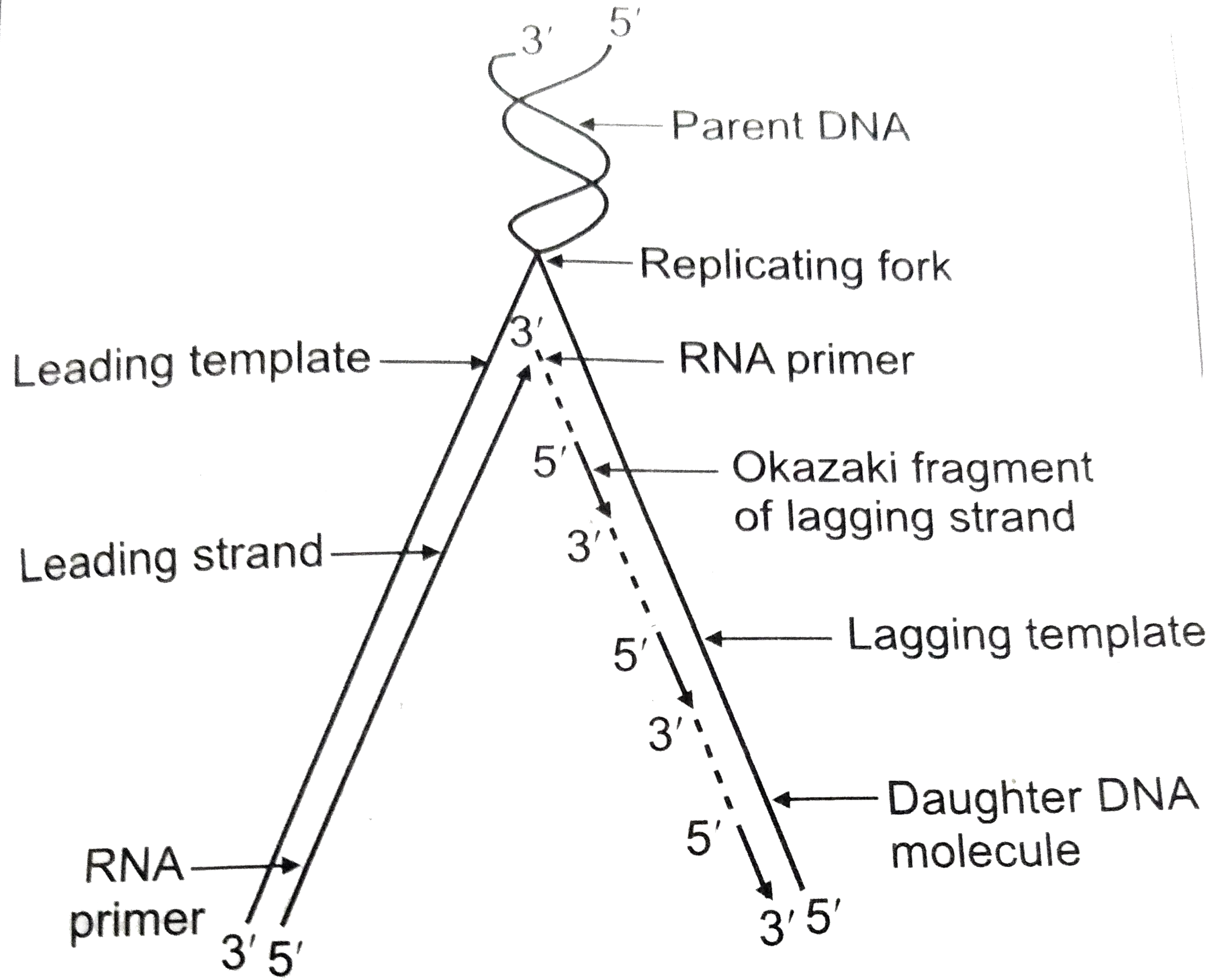
Replication of eukaryotic DNA: In eukaryotes, it takes place inside the nucleus in following steps:
Activation of molecules: All four types of DNA nucleotides are found. They are activated into d ATP, d GTP, d TTP and d CTP using ATP, it takes place with the help of the enzymes phosphorylase.
Origin or initiation point: It starts at a certain specific site knonw as origin or initiation points. In activity of initiations proteins by formation of an incision in the origin. In initiates breaking of H bonds between two strands (unzipping).
Unwinding of DNA strang: After initiation, DNA strands are free but not seperated. DNA unwindinig proteins (helicase enzymes) helps in unwinding. Now DNA molecules appears as inverted 'Y' shaped structure called replication fork.

Synthesis of new strands: Each separated strand acts as a template to synthesis complementary new strand with the help of small RNA primer with the help of RNA primase, RNA primer attracts complementary nucleotides.
Formation of leading and lagging strand: DNA polymerase catalyses polymerisation in one direction `(5' to 3')`. So in one strand, replication is continuous in other stand it is discontinuous. The strand which opens from `(3' to 5')` is called leading template and the complementary strand is the leading strand. The other strand whch opens from `(5' to 3')` is called lagging tempalte and the complementary strand is lagging strand, which is arranged in small framgments known as Okazaki fragments.
Formation of daughter DNA molecules: For each old strand, a new complementary strand is constructed which coil again and two identical daughter DNA molecules are formed. This type of replication where 50% part of mother molecule is retained and one strand is new and one is old is known as semi-conservative replication of DNA.
Promotional Banner

Topper's Solved these Questions

  • OCTOBER 2015

    GURUKUL PUBLICATION - MAHARASHTRA PREVIOUS YEAR PAPERS|Exercise Section-II (Zoology)|7 Videos
  • OCTOBER 2015

    GURUKUL PUBLICATION - MAHARASHTRA PREVIOUS YEAR PAPERS|Exercise Section-II (Zoology) (Answer the following in one sentence each)|7 Videos
  • OCTOBER 2015

    GURUKUL PUBLICATION - MAHARASHTRA PREVIOUS YEAR PAPERS|Exercise Section - I (Botany) (Answer each questions in one sentense each:|6 Videos
  • OCTOBER 2014

    GURUKUL PUBLICATION - MAHARASHTRA PREVIOUS YEAR PAPERS|Exercise SECTION-II|24 Videos

Similar Questions

Explore conceptually related problems

Which property of DNA double helix led Watson and Crick to hypothesise semiconservative mode of DNA replication? Explain.

Who gave semiconservative mode of DNA replication for the first time in E. coli with the help of .^(15) N heavy nitrogen isotope ?

Which property of DNA double helix led Watson and Crick to hypothesis semi-conservative mode of DNA replication ? Explain.

Who among the following did not provido experimental proof for the semiconservative model of DNA replication

The proof for semiconservative mode of DNA replication was first provided by

The experimental proof for semiconservative mode of DNA replication was first shown in a bacterium, by

The proof for semiconservative mode of DNA replication was First provided by Matthew Meselson and Franklin Stahl. Escherichia coli were the first organism to be used for this experiment and then it was done in with higher organisms such as plants and human cells. The process of DNA replication in terms of energy is a very expensive process. It involves the formation of a replication fork. Given below is a graph showing the percentage of Adenine in two different double stranded DNA. Helicase helps in:

