Home
Class 12
PHYSICS
For an object starting from rest with un...

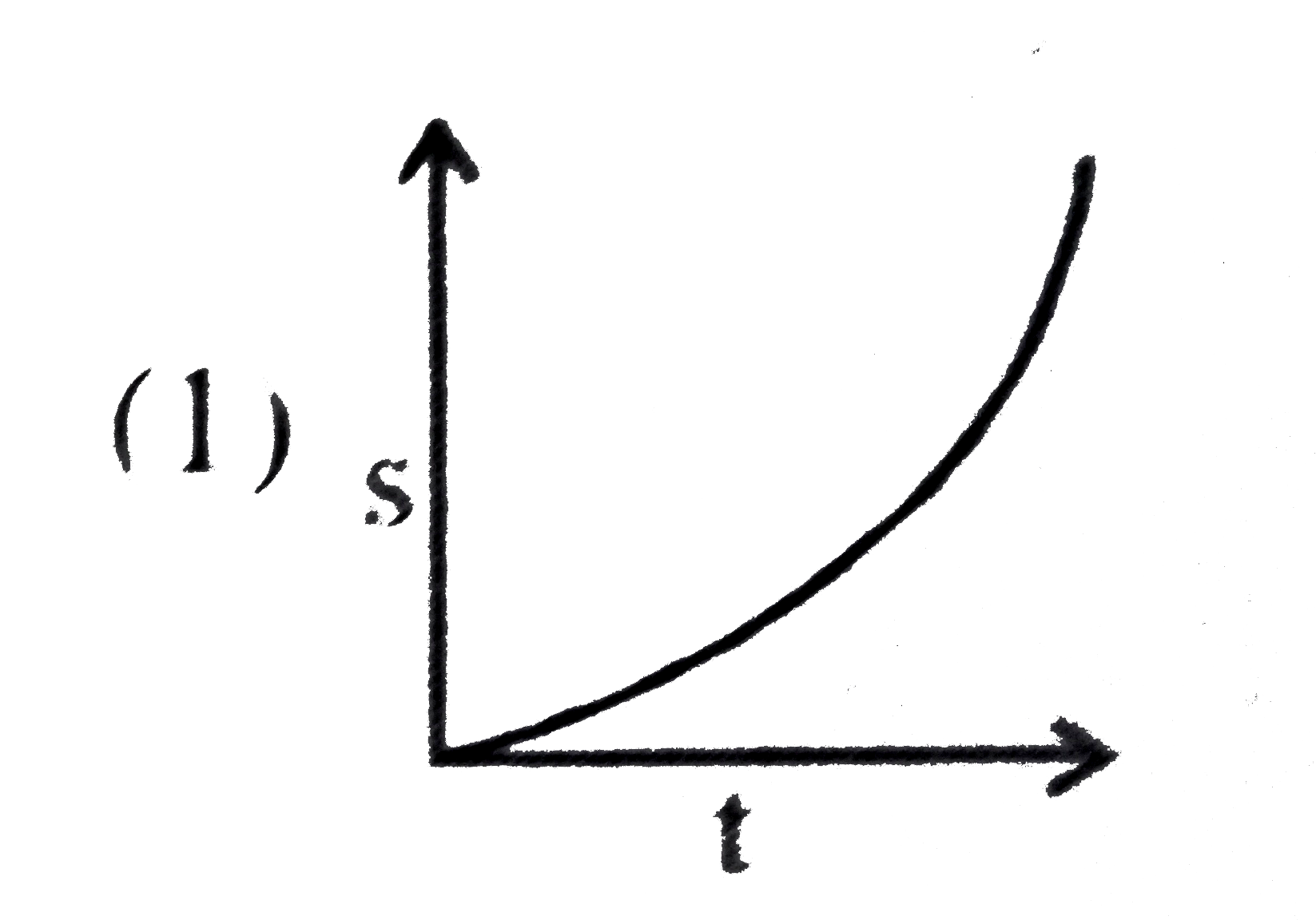
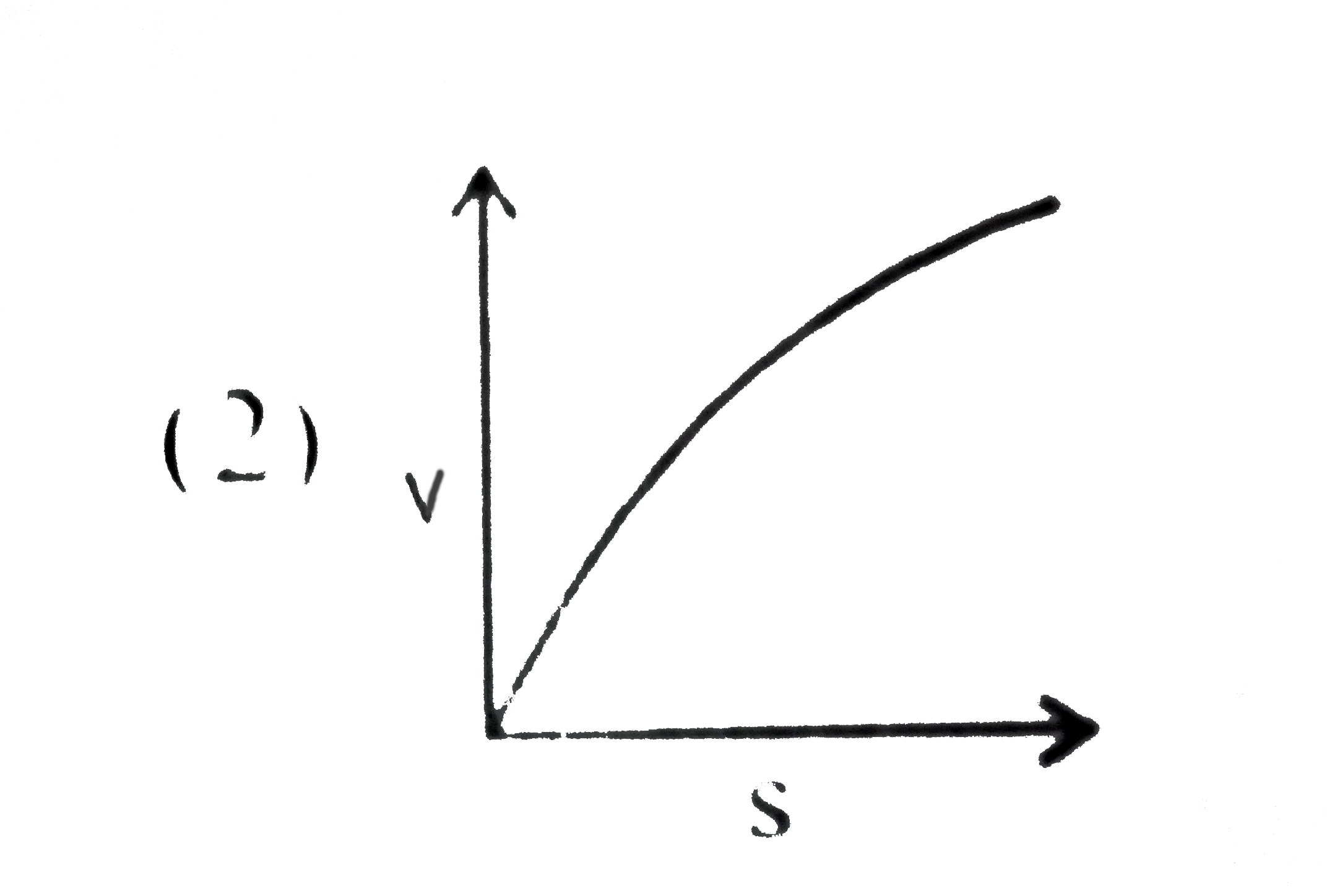
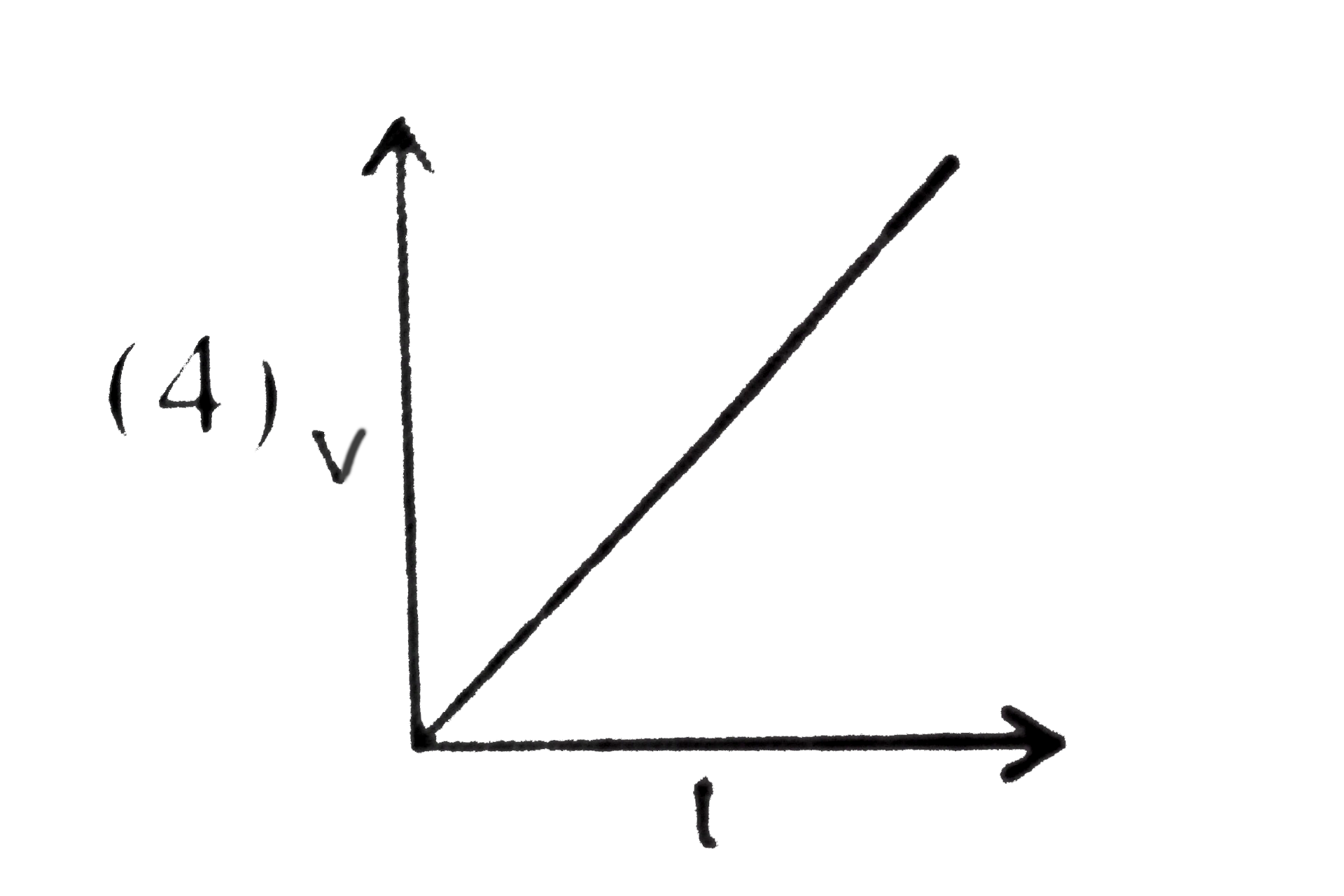
For an object starting from rest with uniform acceleration which of the following graph is incorrect, where s, v, t are displacement, velocity & time.

A

B

C

D

Text Solution

Verified by Experts

The correct Answer is:

C

`s=1/2 at^(2) s prop t^(2)`
`v^(2) 2 as v =sqrt(2as)impliesv prop sqrts`
` t=sqrt((2s)/(a))t prop sqrts`
` V=at V prop t`
Hence graph 3rd is incorrect .
Promotional Banner

Topper's Solved these Questions

Similar Questions

Explore conceptually related problems

A particle start from rest, with uniform acceleration at time t , choose the correct option

A particle starts from rest with uniform acceleration and it's velocity after n seconds is v . The displacement of the body in last two seconds is.

The displacement (s)- velocity ( v ) graph of a particle if it starts moving from rest with a uniform acceleration which is parallel to its instantaneous direction of motion is

.An object is moving with a uniform acceleration which is parallel to its instantaneous direction of motion.The displacement x - velocity (v) graph of this object is

A body starts from rest with uniform acceleration. The velocity of the body after t seconds is v. The displacement of the body in last three seconds is

An object is moving with a uniform acceleration which is parallel to its instantaneous direction of motion. The dispalcement (s)-velocity (v) graph of this object is.

The acceleration (a)-time(t) graph for a particle moving along a straight from rest is shown in figur. Which of the following graph is the best representation of its velocity (v) with time (t) ?

A particle accelerates from rest with uniform acceleration alpha then decelerates to rest witha constant deceleration beta . Find total displacement. Given time is T

ALLEN-TEST PAPER 4-PHYSICS
  1. Differentiation of cos (sqrt(x)) with respect to x is

    Text Solution

    |

  2. Given a function y=x^(2)-2sqrt(x). What is rate of change in y with re...

    Text Solution

    |

  3. If y=(x^(2))/((x+1))"then"(dy)/(dx)"is":-

    Text Solution

    |

  4. If y=log (e) x+sin x+e^(x) then (dy)/(dx) is:

    Text Solution

    |

  5. If y=x^(3)cosx" then "(dy)/(dx)=……………………

    Text Solution

    |

  6. If the velocity of a paraticle moving along x-axis is given as v=(4t^(...

    Text Solution

    |

  7. The value of int(0)^(2) 3x^(2)dx+int(0)^(pi//2) sin x dx is :-

    Text Solution

    |

  8. The value of integral underset(2)overset(4)int(dx)/(x) is :-

    Text Solution

    |

  9. Area bounded by curve y=sinx, whit x-axis, when x varies from 0 to (pi...

    Text Solution

    |

  10. If velocity of a particle is given by v= (2t+3) m//s then average velo...

    Text Solution

    |

  11. Angle of elevation of top of building is 30^(@) from place A and beco...

    Text Solution

    |

  12. If Electric-current 'i' time (t) graph shown in figure. The average cu...

    Text Solution

    |

  13. A man travels one-third part of his total distance with speed v(1) and...

    Text Solution

    |

  14. The position 'x' of a particle moving along x-axis at any instant t re...

    Text Solution

    |

  15. The position of particle 'x' with respect to time at any instant 't' a...

    Text Solution

    |

  16. For an object starting from rest with uniform acceleration which of th...

    Text Solution

    |

  17. The slope of the tangent to the curve y=ln(cosx)" at "x=(3pi)/(4)" i...

    Text Solution

    |

  18. A particle moves along the x-axis such that its co-ordinate (x) varies...

    Text Solution

    |

  19. If y= sin x+cos x then (d^(2)y)/(dx^(2)) is :-

    Text Solution

    |

  20. If velocity v varies with time t as v=2t^(2), then the plot between v ...

    Text Solution

    |
