Home
Class 11
PHYSICS
The resultant of two forces, one double ...

The resultant of two forces, one double the other in magnitude is perpendicular to the smaller of the two forces. The angle between the two forces is

A

`120^@`

B

`60^@`

C

`90^@`

D

`150^@`

Text Solution

Verified by Experts

The correct Answer is:
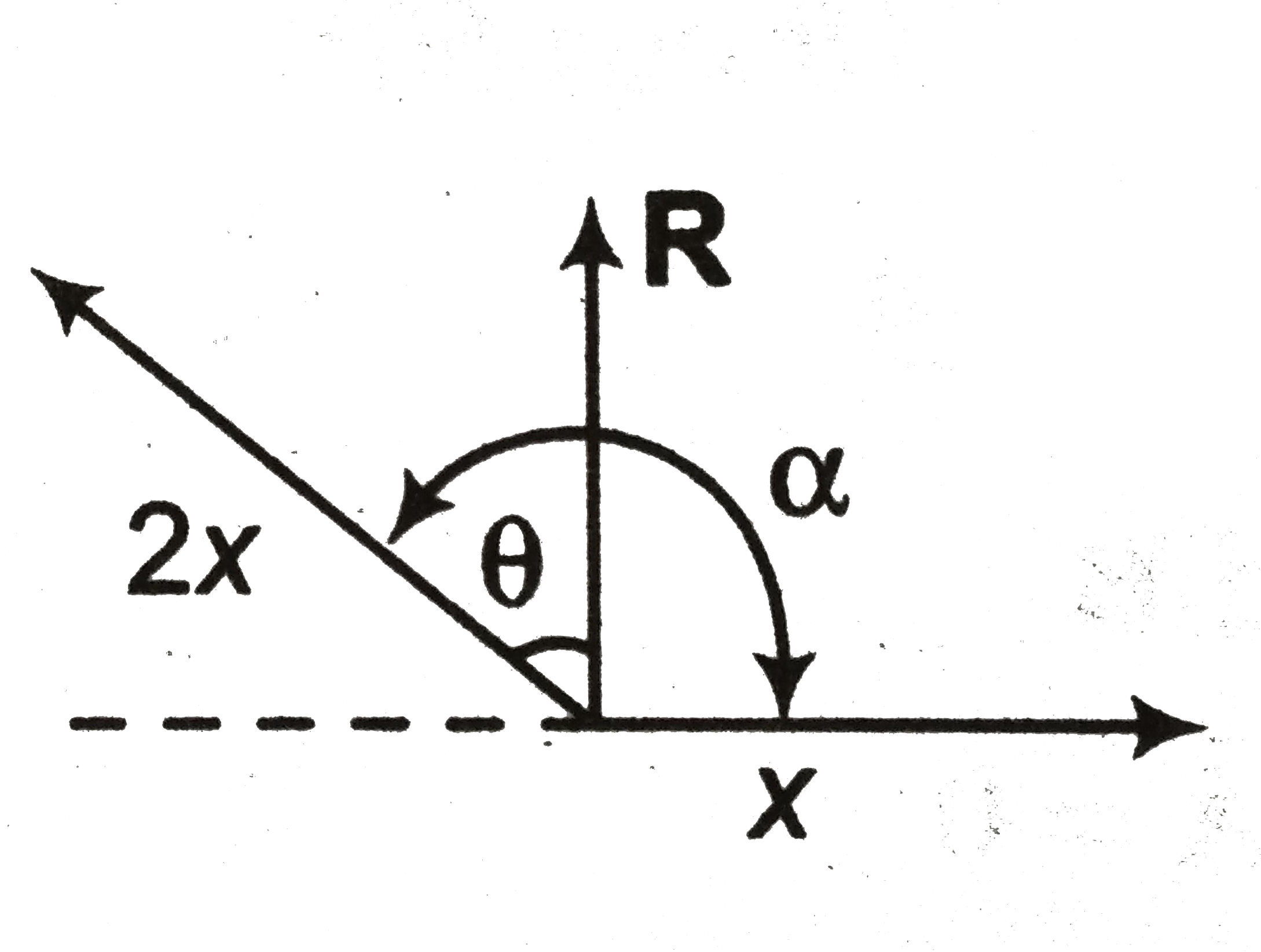
A


`2x sin theta= x`
`:. Theta = 30^@`
or `alpha = 120^@.`
Promotional Banner

Topper's Solved these Questions

  • VECTORS

    DC PANDEY|Exercise Subjective|24 Videos
  • VECTORS

    DC PANDEY|Exercise Example|39 Videos
  • VECTORS

    DC PANDEY|Exercise Exercise 5.3|4 Videos
  • UNITS, DIMENSIONS & ERROR ANALYSIS

    DC PANDEY|Exercise Medical entrances gallery|32 Videos
  • WAVE MOTION

    DC PANDEY|Exercise Integer Type Question|11 Videos

Similar Questions

Explore conceptually related problems

Two forces with equal magnitudes F act on a body and the magnitude of the resultant force is F /3. The angle between the two forces is

If the resultant of two forces of magnitudes p and 2p is perpendicular to p , then the angle between the forces is

Two forces, each of magnitude F have a resultant of the same magnitude F. The angle between the two forces is

The resultant of two forces acting an anlge of 120^(@) is 10 kg wt and is perpendicular to one of the forces. That force is

Square of the resultant of two forces of equal magnitude is equal to three times the product of their magnitude. The angle between them is

Square of the resultant of two forces of equal magnitude is equal to three times the product of their magnitude. The angle between them is :

Square of the resultant of two forces of equal magnitude is equal to three times the product of their magnitude. The angle between them is

Two forces with equal magnitudes F act on body and the magnitude of the resultant forces is (F)/(3). The angle between the two forces is

DC PANDEY-VECTORS-Single Correct
  1. Which of the sets given below may represent the magnitudes of three ve...

    Text Solution

    |

  2. The resultant of vecA and vecB makes an angle alpha with vecA and beta...

    Text Solution

    |

  3. The angles which the vector A=3hati + 6hatj+2hatk makes with the co-or...

    Text Solution

    |

  4. Unit vector parallel to the resultant of vectors A = 4hatj - 3hatj and...

    Text Solution

    |

  5. The component of vector A=2hati+3hatj along the vector hati+hatj is

    Text Solution

    |

  6. Two vectors A and B are such that A+B = C and A^2 +B^2 = C^2. If theta...

    Text Solution

    |

  7. If |AxxB| = sqrt3 A.B, then the value of |A+B| is

    Text Solution

    |

  8. If the angle between the vectors A and B is theta, the value of the p...

    Text Solution

    |

  9. Given that P 12, Q = 5 and R = 13 also P+Q=R, then the angle between P...

    Text Solution

    |

  10. Given that P+Q+R= 0. Two out of the three vectors are equal in magnitu...

    Text Solution

    |

  11. The angles between P+Q and P-Q will be

    Text Solution

    |

  12. The value of n so that vectors 2hati+3hatj-2hatk, 5hati+nhatj+hatk and...

    Text Solution

    |

  13. If a and b are two vectors.then the value of (a+b)xx(a-b) is

    Text Solution

    |

  14. The resultant of two forces 3P and 2P is R. If the first force is doub...

    Text Solution

    |

  15. The resultant of two forces, one double the other in magnitude is perp...

    Text Solution

    |

  16. Three vectors satisfy the relation A.B =0 and A.C=0 then A is paralle...

    Text Solution

    |

  17. The sum of two forces at a point is 16N. if their resultant is normal...

    Text Solution

    |

  18. The sum of two vectors A and B is at right angles to their difference....

    Text Solution

    |

  19. Let vec(C )= vec(A)+vec(B) then

    Text Solution

    |

  20. Let the angle between two nonzero vector vecA and vecB is 120^@ and it...

    Text Solution

    |

