Home
Class 11
PHYSICS
In the pulley-block arrangement shown in...

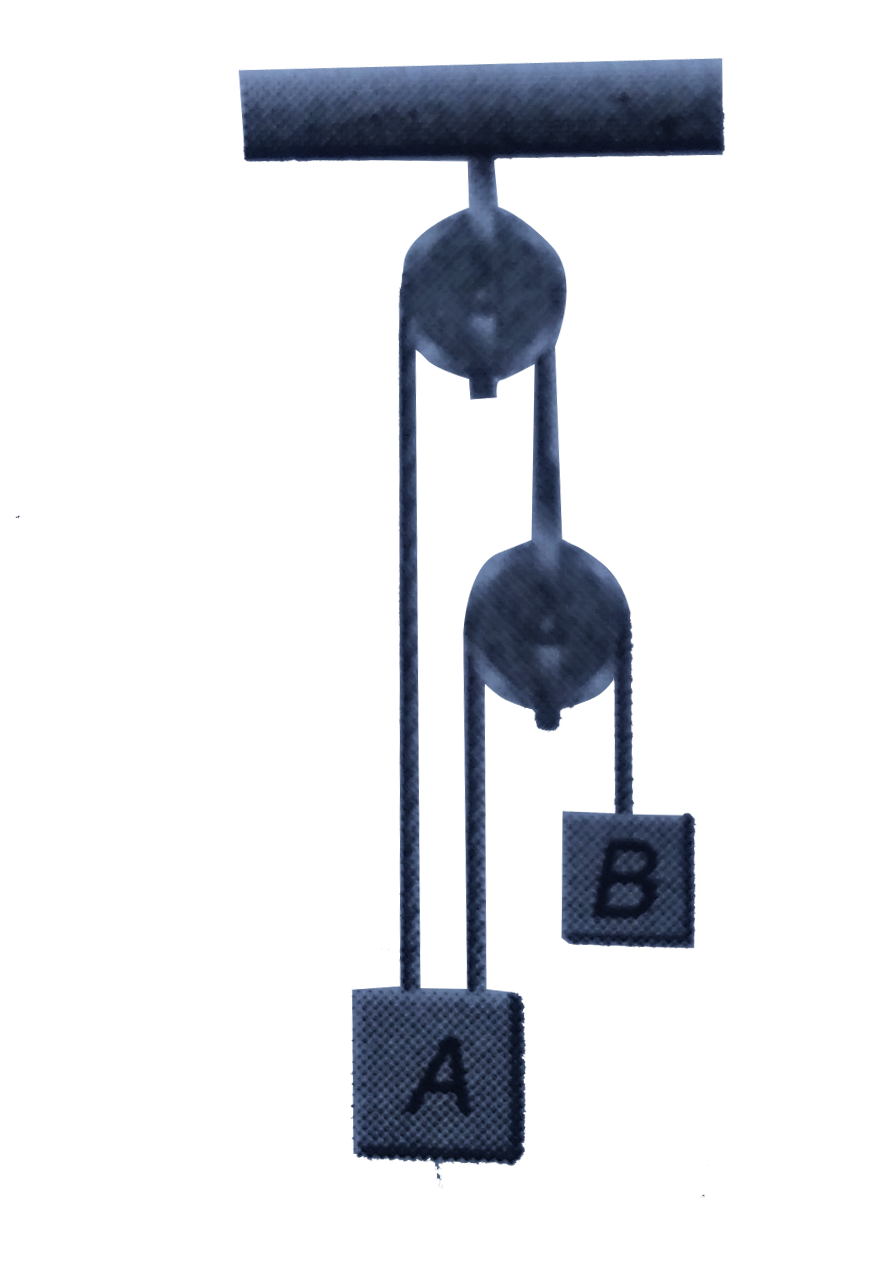
In the pulley-block arrangement shown in figure , find the relation between acceleration of blocks `A` and `B`

Text Solution

Verified by Experts
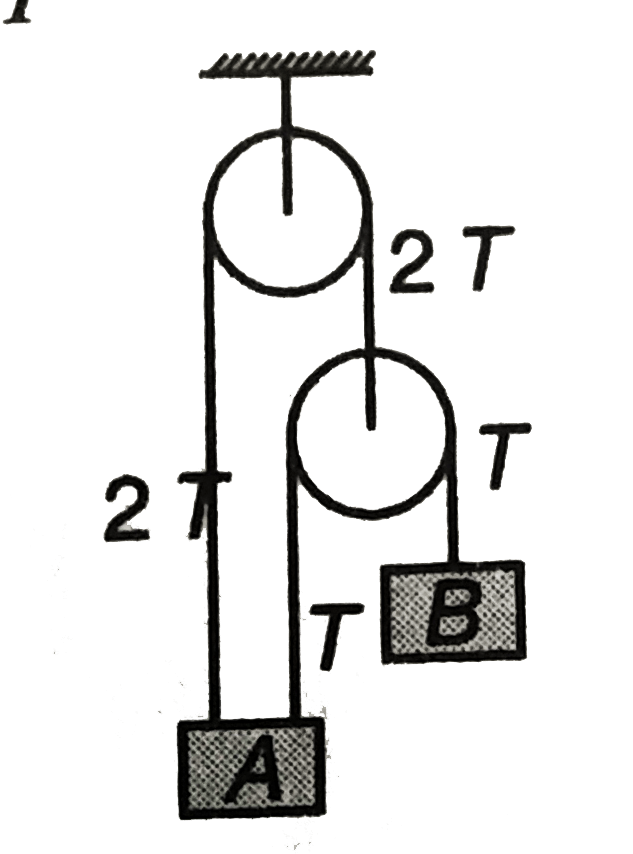
`T_(A) = 3T, T_(B) = T`

In such try of problem
`a prop (1)/(T)`
` :. |a_(B)| = 3 |a_(A)|`
or `a_(B) = - 3a_(A)` as `a_(A)` and `a_(B)` are in opposite direction.
Promotional Banner

Topper's Solved these Questions

  • LAWS OF MOTION

    DC PANDEY|Exercise Objective Question|32 Videos
  • LAWS OF MOTION

    DC PANDEY|Exercise Comprehension|9 Videos
  • LAWS OF MOTION

    DC PANDEY|Exercise Exercise 8.5|2 Videos
  • KINEMATICS 1

    DC PANDEY|Exercise INTEGER_TYPE|15 Videos
  • LAWS OF THERMODYNAMICS

    DC PANDEY|Exercise Level 2 Subjective|18 Videos

Similar Questions

Explore conceptually related problems

In the pulley-block arrangement shown in figure , find the relation between a_(A),a_(B) and a_(C)

In an arrangement shown in the figure, the acceleration of block A and B are given-

In the figure shown, find out acceleration of each block.

In the arrangement shown, the pulleys and the strings are ideal.The acceleration of the block B is

In the arrangement shown, the pulleys and the string are ideal. The acceleration of block B is.

In the arrangement shown in figure , find the retio of tension in the strings attached with 4kg block and the with 1kg block

In the arrangement shown, the pulleys and strings are massless. The acceleration of block B is :

In the arrangement shown, the pulleys are smooth and the strings are inextensible. The acceleration of block B is :

In the arrangement shown in the figure the coefficient of friction between the blocks C and D is mu_(1) = 0.7 and that between block D and the horizontal table is mu_(2) = 0.2 . The system is released from rest. [ Take g = 10 ms^(–2) ] Pulleys and threads are massless. (a) Find the acceleration of the block C. (b) Block B is replaced with a new block. What shall be the minimum mass of this new block so that block C and D accelerate in opposite direction?

DC PANDEY-LAWS OF MOTION-Single Correct
  1. A cube of mass 2 kg is help stationary against a rought wall by a forc...

    Text Solution

    |

  2. A 20 kg monkey has a firm hold on a light rope that passes over a fric...

    Text Solution

    |

  3. In the pulley-block arrangement shown in figure , find the relation be...

    Text Solution

    |

  4. In the pulley-block arrangement shown in figure , find the relation be...

    Text Solution

    |

  5. In the figure shown ,find :(g = 10 m//s^(2)) (a) acceleration of ...

    Text Solution

    |

  6. Find the acceleration of the A and B in the situation show in the figu...

    Text Solution

    |

  7. A conveyor belt is moving with constant speed of 6 m//s. A small block...

    Text Solution

    |

  8. Coefficient of friction between two block shown in figure ia mu = 0.4....

    Text Solution

    |

  9. A 2 kg block is present against a rough wall by a force F = 20 N as sh...

    Text Solution

    |

  10. A 2 kg block is kept over a ground with coefficient of friction mu = 0...

    Text Solution

    |

  11. A 6 kg block is kept over a rough surface with coefficient of friction...

    Text Solution

    |

  12. What is the largest mass of C in kg that can be suspended without movi...

    Text Solution

    |

  13. A sphere of mass 1 kg rests at one corner of a cube. The cube is moved...

    Text Solution

    |

  14. A smooth block of mass m is held stationary on a smooth wedge of mass ...

    Text Solution

    |

  15. Two blocks of masses m(1) and m(2) are placed in contact with each oth...

    Text Solution

    |

  16. A small block of mass m rests on a smooth wedge of angle theta. With w...

    Text Solution

    |

  17. To a ground observer the block C is moving with u(0) and the block A w...

    Text Solution

    |

  18. In each case m(1) = 4 kg and m(2) = 3 kg. If a(1) and a(2) and a(3) ar...

    Text Solution

    |

  19. For the arrangement shown in the figure the coefficient of friction be...

    Text Solution

    |

  20. In the figure shown find relation between magnitudes of a(A) and a(B).

    Text Solution

    |

