Home
Class 11
PHYSICS
In the figure shown the accelerationof A...

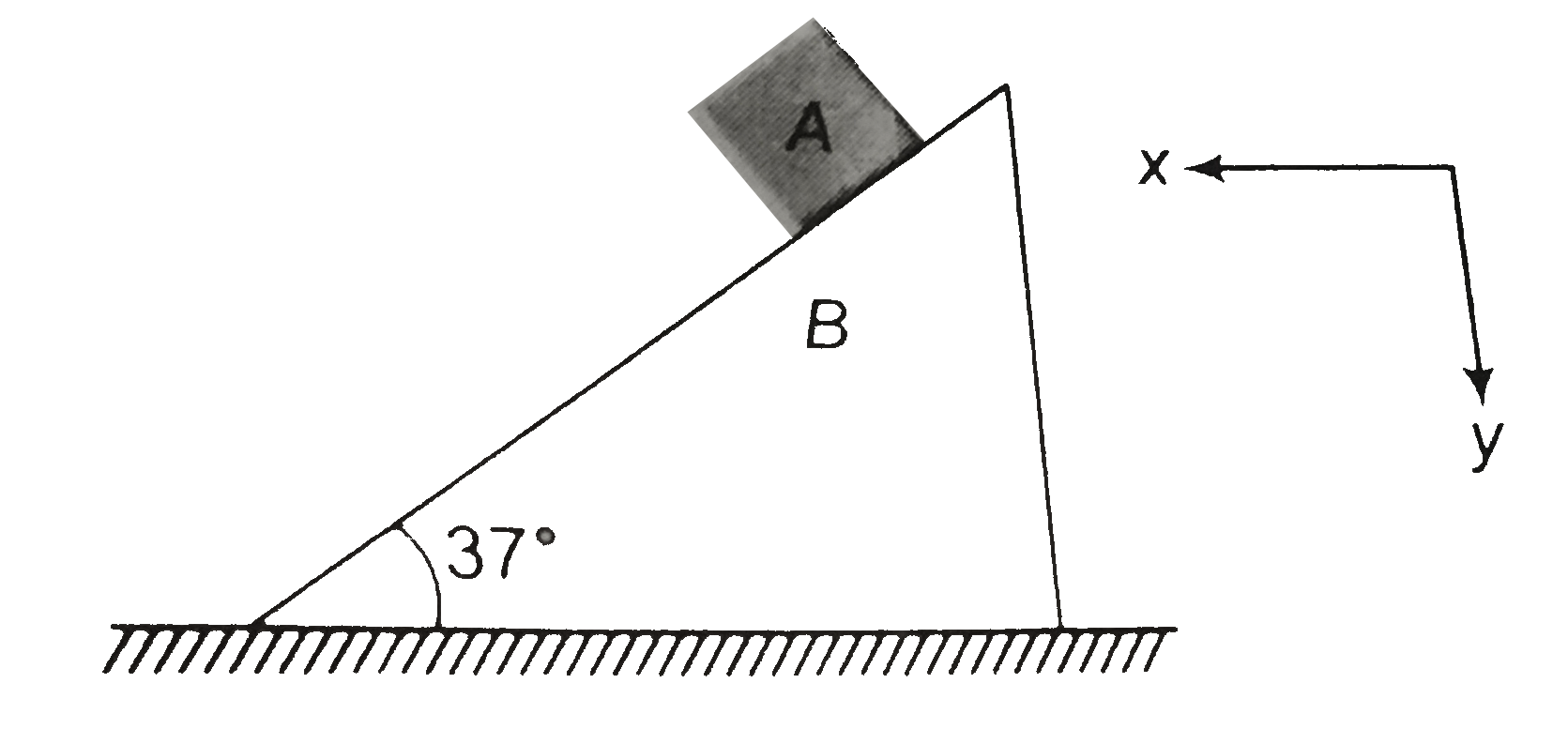
In the figure shown the accelerationof `A` is `a_(A) = (15 hati + 15 hatj)`. Then the acceleration of `B` is (A remain in contact with B)

A

`5 hati`

B

`-15 hati`

C

`-10 hati`

D

`-5 hati`

Text Solution

Verified by Experts

The correct Answer is:
D

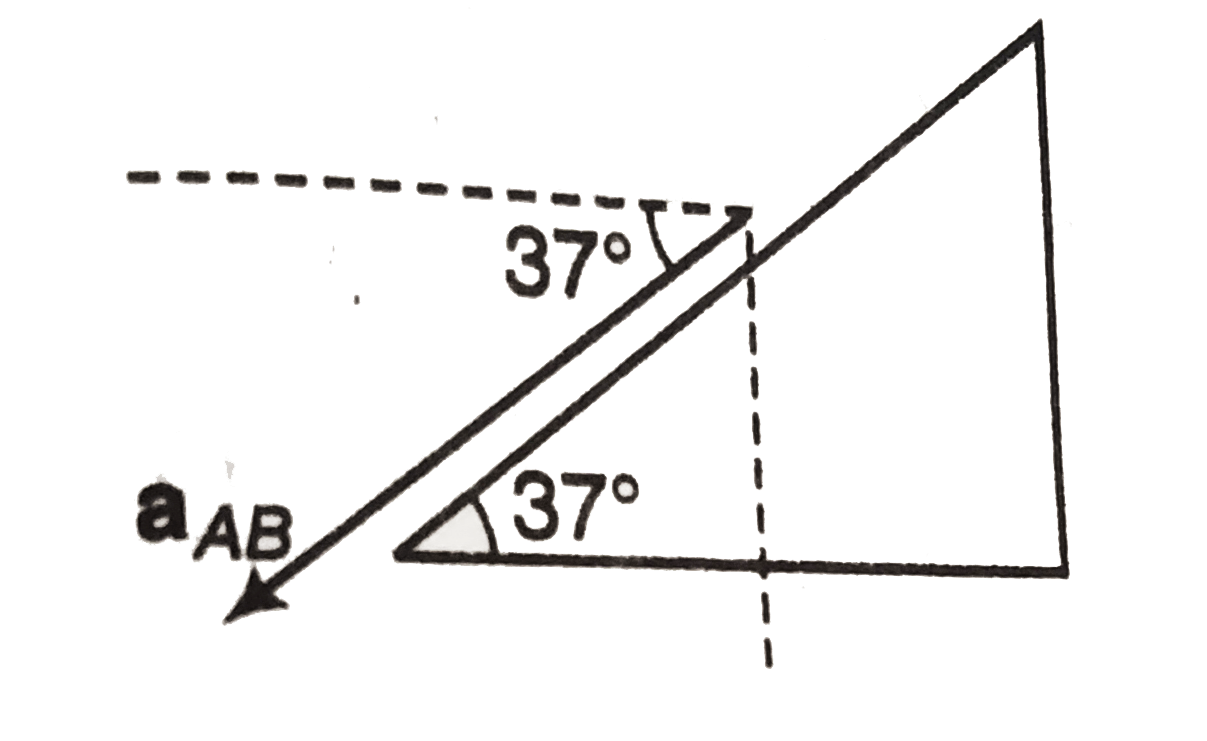
Let `a_(B) = a hati`
Then, `a_(AB) = a_(A) - a_(B)`
`= (15 - a) hati + 15 hatj`

Since `a_(AB)` is along the plane as shown in figure.
`:. tan 37 ^(@) = (3)/(4) = (15)/(15 - a)`
Solving this equation , we get `a = - 5`
or `a_(B) = (- 5 hati)`
Promotional Banner

Topper's Solved these Questions

  • LAWS OF MOTION

    DC PANDEY|Exercise Comprehension|9 Videos
  • LAWS OF MOTION

    DC PANDEY|Exercise Subjective Question|27 Videos
  • LAWS OF MOTION

    DC PANDEY|Exercise Single Correct|90 Videos
  • KINEMATICS 1

    DC PANDEY|Exercise INTEGER_TYPE|15 Videos
  • LAWS OF THERMODYNAMICS

    DC PANDEY|Exercise Level 2 Subjective|18 Videos

Similar Questions

Explore conceptually related problems

In the figure shown the acceleration of A is, vec(a)_(A) = 15 hat (i) + 15 hat (j) then the acceleration of B is (A remains in contact in B)

In fig, the acceleration of A is vec(a)_(A)=15hat(i)+15hat(j) . Then the acceleration of B is (A remains in constact with B)

In the figure shown the acceleration of A is, bara_(A)=(15hati+15hatj)m//s^(2). If A is sliding on B then the acceleration of B is.

In the situation as shown in the figure if acceleration of B is a, then find the acceleration of A ( B always remain horizintal),

In the arrangement shown in figure, if the acceleration of B is overline(a) , then find the acceleration of A

In the figure shown find relation between magnitudes of a_(A) and a_(B) .

In the figure find the velocity and acceleration of B, if instaneous velocity and acceleration of A are as shown in the Fig.

In the figure shown the velocity of A with respect to ground is (20hat(i) + 15hat(j)) m//s , then what will be the magnitude of velocity of the wedge 'B' with respect to ground frame. (A remains in contact with B)

In the diagram shown, the acceleration of the block B as shown in relative to the block A and relative to ground is a_(BA) and a_(BG) respectively. If the block A is moving towards left with an acceleration a_(0) then .

In the figure, the blocks are of equal mass. The pulley is fixed. In the position shown. A moves down with a speed u and v_(B)= the speed of B. (i) B will never lose contact with the ground. (ii) The downward acceleration of A is equal in magnitude to the horizontal acceleration of B (iii) v_(B)=ucostheta (iv) v_(B)=u//costheta

DC PANDEY-LAWS OF MOTION-Objective Question
  1. In the figure shown the block B moves with , velocity 10 ms^(-1). The ...

    Text Solution

    |

  2. In the figure m(A) = m(B) = m(C) = 60 kg. The coefficient of friction ...

    Text Solution

    |

  3. In the figure shown the accelerationof A is a(A) = (15 hati + 15 hatj)...

    Text Solution

    |

  4. Two blocks A and B each of mass m are placed on a smooth horizontal su...

    Text Solution

    |

  5. Two block A and Bmove along a semicircular wire frame as shown in figu...

    Text Solution

    |

  6. If the coefficient of friction between A and B is mu, the maximum acce...

    Text Solution

    |

  7. A livotad beam of negligible mass has mass suspended from one end and ...

    Text Solution

    |

  8. A block of mass m sides down an inclined right angled trough .If the c...

    Text Solution

    |

  9. If force F is increasing with time and at t=0, F = 0, where will slipp...

    Text Solution

    |

  10. A plank of mass 2 kg and length 1 m is placed on horizontal floor.A sm...

    Text Solution

    |

  11. The block each of mass 1 kg are placed as shown .They are connected by...

    Text Solution

    |

  12. Two particalA and B each of mass m are kept stationary by applying a h...

    Text Solution

    |

  13. The velocity- time graph of the figure shown the motion of a wooden bl...

    Text Solution

    |

  14. As shown in figure, A is a man of mass 60 kg standing on a block B of ...

    Text Solution

    |

  15. In the figure shown A and B are free to move . All the surface are smo...

    Text Solution

    |

  16. M(A) = 3 kg ,M(B) = 4 kg ,M(C) = 8 kg. Coefficient of friction between...

    Text Solution

    |

  17. A man pulls a block of mass equal to himself with a light string .The ...

    Text Solution

    |

  18. A block of mass 1 kg is at rest relative to a smooth wedge moving left...

    Text Solution

    |

  19. For the given situation shown in figure , choose the correct option (g...

    Text Solution

    |

  20. In the figure shown , all the string are massless and friction is abse...

    Text Solution

    |

