Home
Class 11
PHYSICS
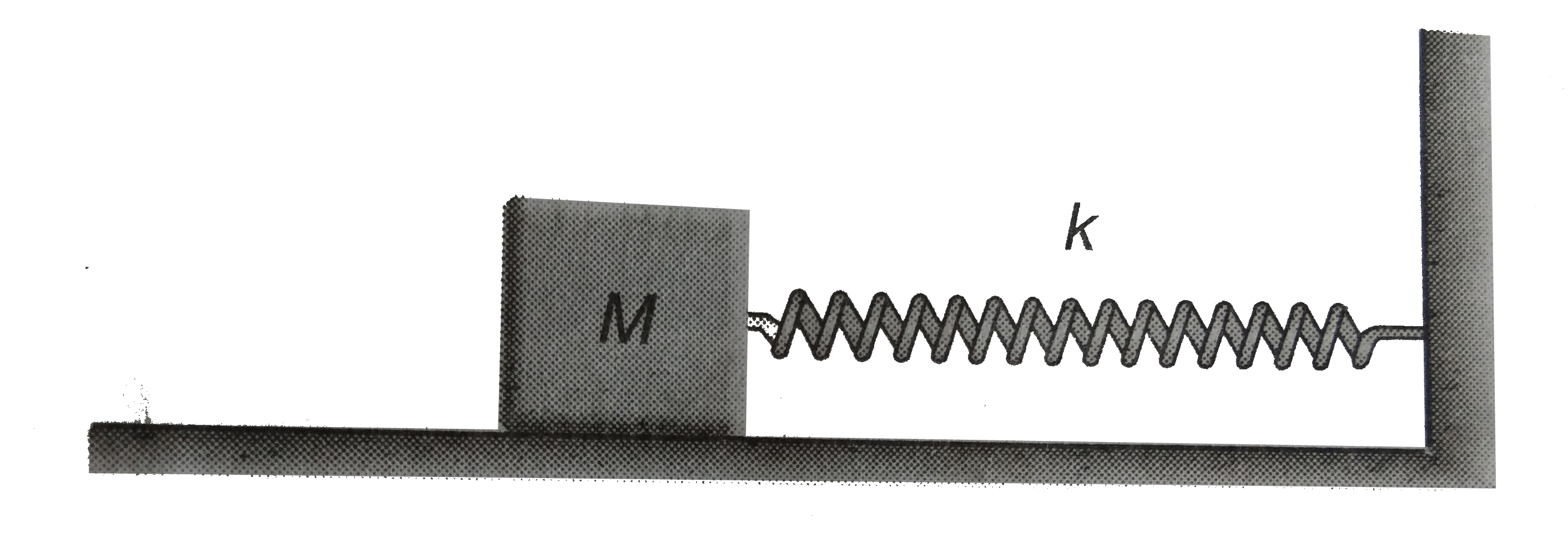
The block shown in the figure is acted o...

The block shown in the figure is acted on by a sping with spring constant (k) and (a) weak frictional force of constant of constant magitude (f.) The block is pulled a distance `x_(0)` from equilibrium position and then then then fren released. It oscillates many times ultimately comes to rest.

(a) Show that the decrease of amplitude is the same for each cycle of lscillation.
(b) Find the number of cycles the mass oscillates before coming to rest.

Text Solution

Verified by Experts

The correct Answer is:
A, B, D

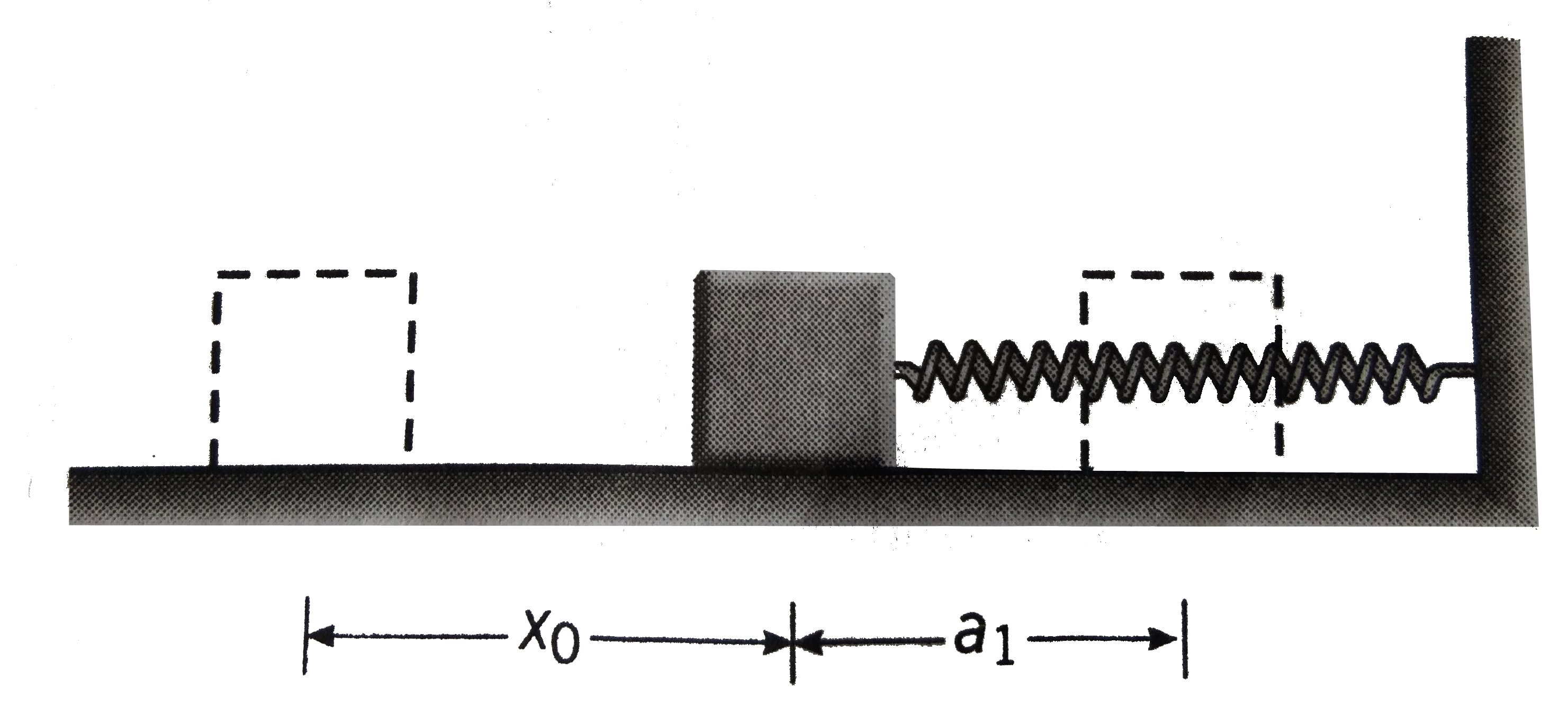
(a) From energy conservation principle,
Work done against friction=dicrease in elastic PE
or `f(x_(0)+a_(1)) =1/2k(x_(0)^(2)-a_(0)^(2))`
or `x_(0)=a_(1) =(2f)/k`...(i)
From Eq. (i), we see that decrease of amplitude
`(x_(0)-a_(1))` is `(2f)/k`, which is constant and same for each cycle of oscillation.

(b) The block will come to rest when `ka=f`
`a=k/f`
In the similar manner, we can write
`a_(1) -a_(2)=(2f)/k`....(i)
`a_(2) -a_(3) =(2f)/k`......(ii)
`a_(n-1) -a_(n) =(2f)/k....(n)`
Adding Eqs. `(i), (ii)`,...etc., we get
`x_(0)-a_(n) =n((2f)/k)`
or `a_(n) =x_(0)-n((2f)/k)`.....(B)
Equating Eq. (A) and (B), we get
`k/f =x_(0)-n((2f)/k)`
or `n=(x_(0)-k/f)/(2f) = (kx_(0))/(2f)-(1)/(2)`
Number of cycles,
`m=n/2(kx_(0))/(4f)-(1)/(4)=(1)/(4)((kx_(0))/(f)-1)`.
Promotional Banner

Topper's Solved these Questions

  • WORK, ENERGY & POWER

    DC PANDEY|Exercise Level 2 Comprehension Based|2 Videos
  • WORK, ENERGY & POWER

    DC PANDEY|Exercise Level 2 More Than One Correct|9 Videos
  • WAVE MOTION

    DC PANDEY|Exercise Integer Type Question|11 Videos
  • WORK, ENERGY AND POWER

    DC PANDEY|Exercise MEDICAL ENTRACES GALLERY|33 Videos

Similar Questions

Explore conceptually related problems

A block whose mass m is 680g is fastened to a spring whose spring constant k is 65N/m. The block is pulled a distance x=11cm from its equilibrium position at x=0 on a frictionless surface and released from rest at t= 0. What is the amplitude of the oscillation?

A block whose mass m is 680g is fastened to a spring whose spring constant k is 65N/m. The block is pulled a distance x=11cm from its equilibrium position at x=0 on a frictionless surface and released from rest at t= 0. What is the phase constant phi for the motion?

As shown in the figure, two light springs of force constant k_(1) and k_(2) oscillate a block of mass m. Its effective force constant will be

Figure shows a system consisting of a massless pulley, a spring of force constant k and a block of mass m. If the block is slightly displaced vertically down from is equilibrium position and then released, the period of its vertical oscillation is

A block of mass m length force a verical of spring constant k If the block is polled down by a distance of 2mg//k from its equilibrium position and released for the subsequent in the spring to maximum compressed in it mg//k

A block of mass one kg is fastened to a spring with a spring constant 50Nm^(-1) . The block is pulled to a distance x=10cm from its equilibrium position at x=0 on a frictionless surface from rest at t=0. Write the expression for its x(t) and v(t).

A block whose mass m is 680g is fastened to a spring whose spring constant k is 65N/m. The block is pulled a distance x=11cm from its equilibrium position at x=0 on a frictionless surface and released from rest at t= 0. What is the maximum speed v_(m) of the oscillating block, and where is the block when it has this speed?

Two identical springs of spring constant k are attached to a block of mass m and to fixed supports as shown in figure. When the mass is displaced from equilibrium position by a distance x towards right, find the restoring force.

Tow identical springs of spring constant k are attached to a block of mass m and to fixed supports as shown in figure. When the mass is displaced from equilibrum position by a distance x towards right, find the restoring force.

