Home
Class 11
PHYSICS
In the figure shown masses of the blocks...

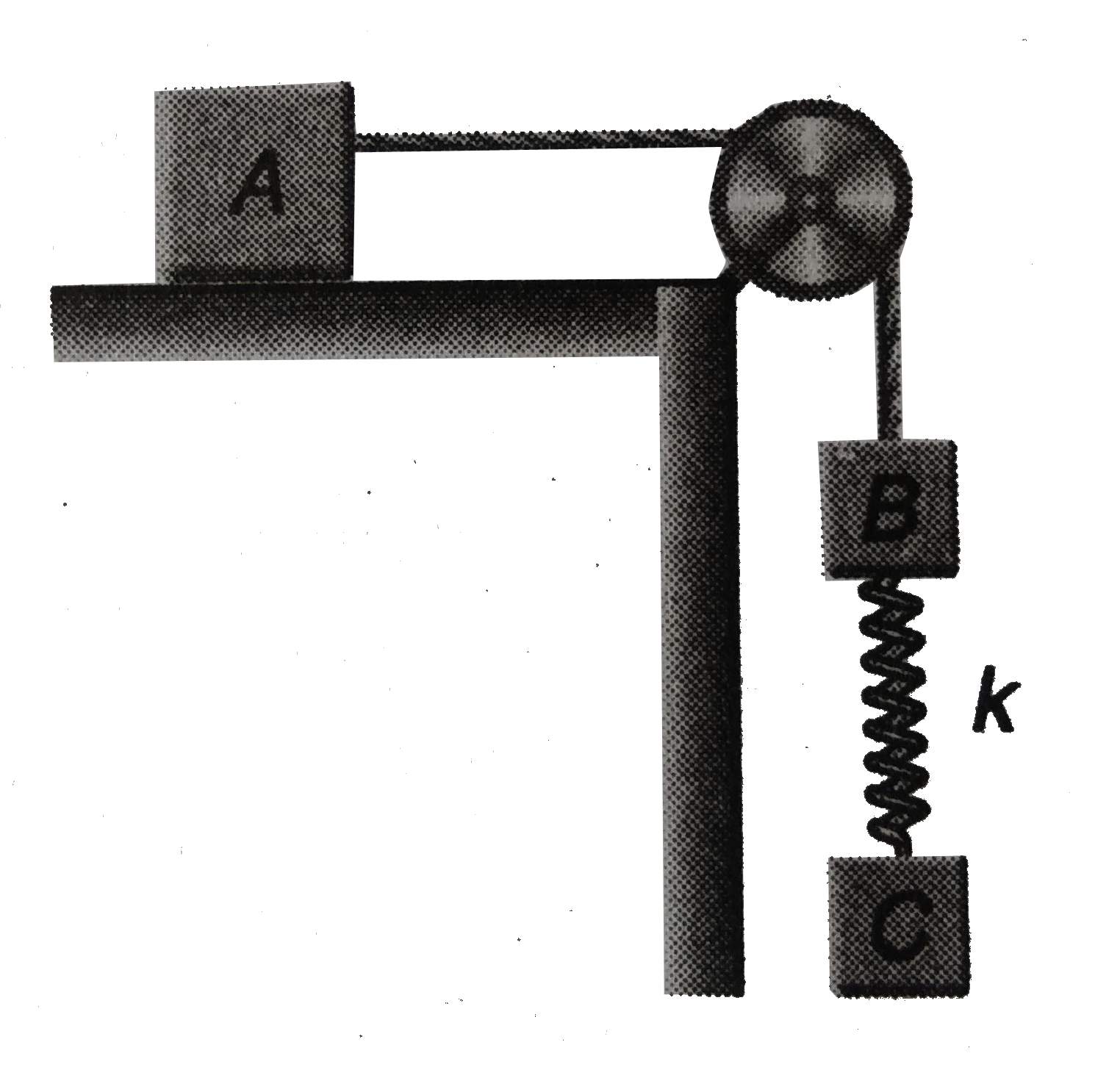
In the figure shown masses of the blocks A, B and C are 6kg, 2kg and 1kg respectively. Mass of the spring is negligibly small and its stiffness is 1000 N//m. The coefficient of friction between the block A snd the table is `mu =0.8`. Initially block C is held such that spring is in relaxed position. The block is released from rest. Find `(g=10 m//s^(2))`.

(a) the maximum distance moved by the kinetic `C`.
the acceleration of each block, when clongation in the spring is maximum.

Text Solution

Verified by Experts

The correct Answer is:
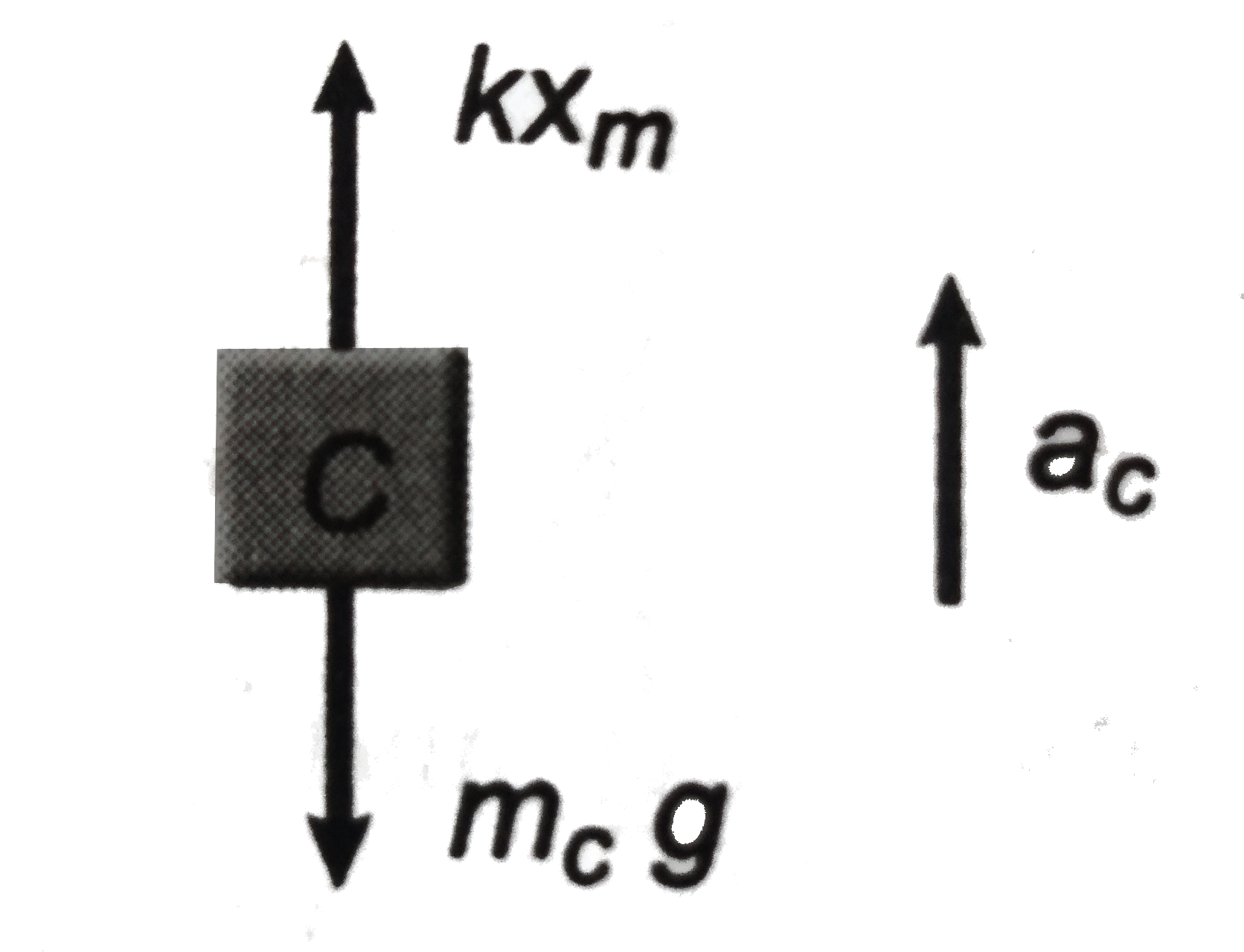
A, B, C

`mum_(A)g = 0.8 xx 6 xx 10 = 48 N`
`(m_(B) + m_(C))g = (1+2) xx 10 = 30 N`
Since `(m_(B) - m_(C))g gt mum_(A)g, a_(A) = a_(B) = 0`.
From conservation of energy principal we can prove that maximum distance moved by `C` or maximum extension in the spring would be
`x_(m) = (2m_(C)g)/(k) = (2 xx 1 xx 10)/(1000)`
`= 0.02 m`

At maximum extension
`a_(C) = (kx_(m) - m_(C)g)/(m_(C))`
Substituting the values we have,
`a_(C) = 10 m//s^(2)`.
Promotional Banner

Topper's Solved these Questions

  • WORK, ENERGY & POWER

    DC PANDEY|Exercise Level 2 Comprehension Based|2 Videos
  • WORK, ENERGY & POWER

    DC PANDEY|Exercise Level 2 More Than One Correct|9 Videos
  • WAVE MOTION

    DC PANDEY|Exercise Integer Type Question|11 Videos
  • WORK, ENERGY AND POWER

    DC PANDEY|Exercise MEDICAL ENTRACES GALLERY|33 Videos

Similar Questions

Explore conceptually related problems

A block of mass 2 kg, initially at rest on a horizontal floor, is now acted upon by a horizontal force of 10 N . The coefficient of friction between the block and the floor is 0.2. If g = 10 m//s^(2) , then :

Three blocks A , B and C , whose masses are 9kg , 9kg and 18kg respectively as shown in the figure, are released from rest. The co-efficient of friction between block A and the horizontal surface is 0.5 & the co-efficient of friction between block B and the horizontal surface is 0.5 . Find the acceleration of block C just release [Take g=10m//s^(2) ]. All strings and pulleys are ideal

Two blocks of Masses M and 2M are connected by a spring of stiffness k .The coefficient of friction between the blocks and the surface is mu Find the minimum constant force F to be applied to 2m in order to slide the mass M .

A block of mass 0.18 kg is attached to a spring of force constant 2N/m. The coefficient of friction between the block and the floor is 0.1. Initially, the block is at rest and the spring is unstretched. An impulse is given to the block. The block slides a distance of 0.06 m and comes to rest for the first time. The initial velocity of the block in m/s is v=N/10. Then, N is

A block of mass m=4kg is placed oner a rough inclined plane as shown in figure. The coefficient of friction between the block and the plane is mu=0.5 . A force F=10N is applied on the block at an angle of 30^(@) .

A block of mass 0.18 kg is attached to a spring of force-constant 2 N//m . The coefficient of friction between the block and the floor is 0.1 Initially the block is at rest and the spring is un-stretched. An impulse is given to the block as shown in the figure. The block slides a distance of 0.06 m and comes to rest for the first time. The initial velocity of the block in m//s is V = N//10 . Then N is : .

The coefficient of friction between the block A of mass m & block B of mass 2m is mu . There is no friction between block B & the inclined plane. If the system of blocks A & B is released from rest & there is no slipping between A & B then :

