Home
Class 11
PHYSICS
A circular disc is rotating with an angu...


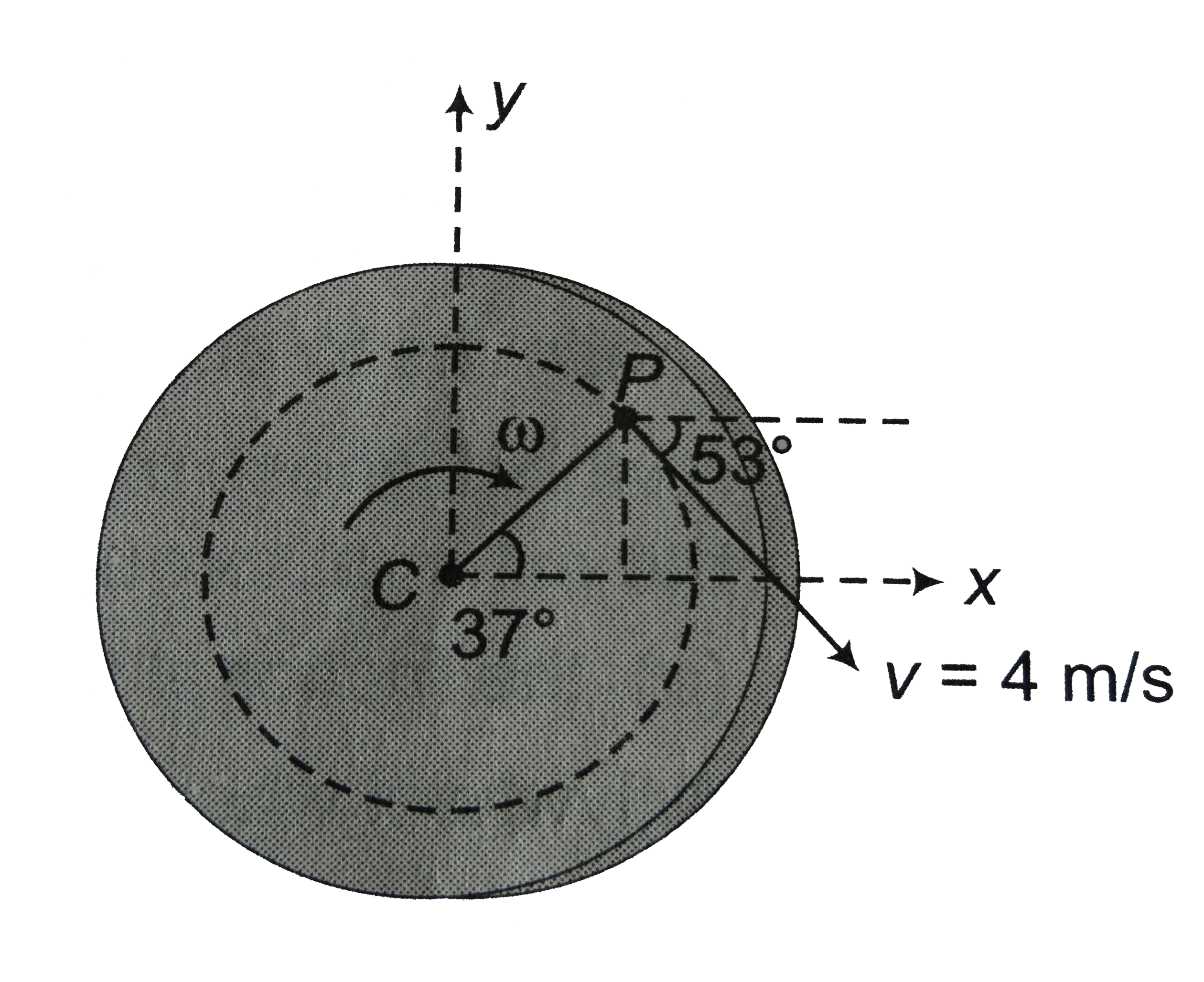
A circular disc is rotating with an angular speed (in radian per sec)
`omega=2t^(2)`
given, `CP=2m`
In terms of `hati,hatj` and `hatk` at `t=1s`
find,
(a). `omega`
(b). `alpha`
(c). linear velocity of the particle lying at `P` (d). linear acceleration of the particle lying `P`

Text Solution

Verified by Experts


`omega=2t^(2)impliesalpha=(domega)/(dt)=4t`
at `t=1s`, `omega=2rad//s` and `alpha=4rad//s^(2)`
for the particle at `P`, `r=CP=2m`
(a). Rotation is clockwise. So according to right hand rule `omega` is perpendicular to paper inwards along negative z-direction
`thereforeomega=(-2hatk)rad//s`
(b). `omega` is increasing. so `alpha` is alos in the direction of `omega`
`thereforealpha=(-4hatk)rad//s^(2)`
(c). `v=romega=(2)(2)=4m//s`
This velocity is tangential to the doted circle of `P` as shown in figure. `thereforev=(4cos53^(@))hati-(4sin53^(@))hatj`
or `v=(2.4hati-3.2hatj)m//s`
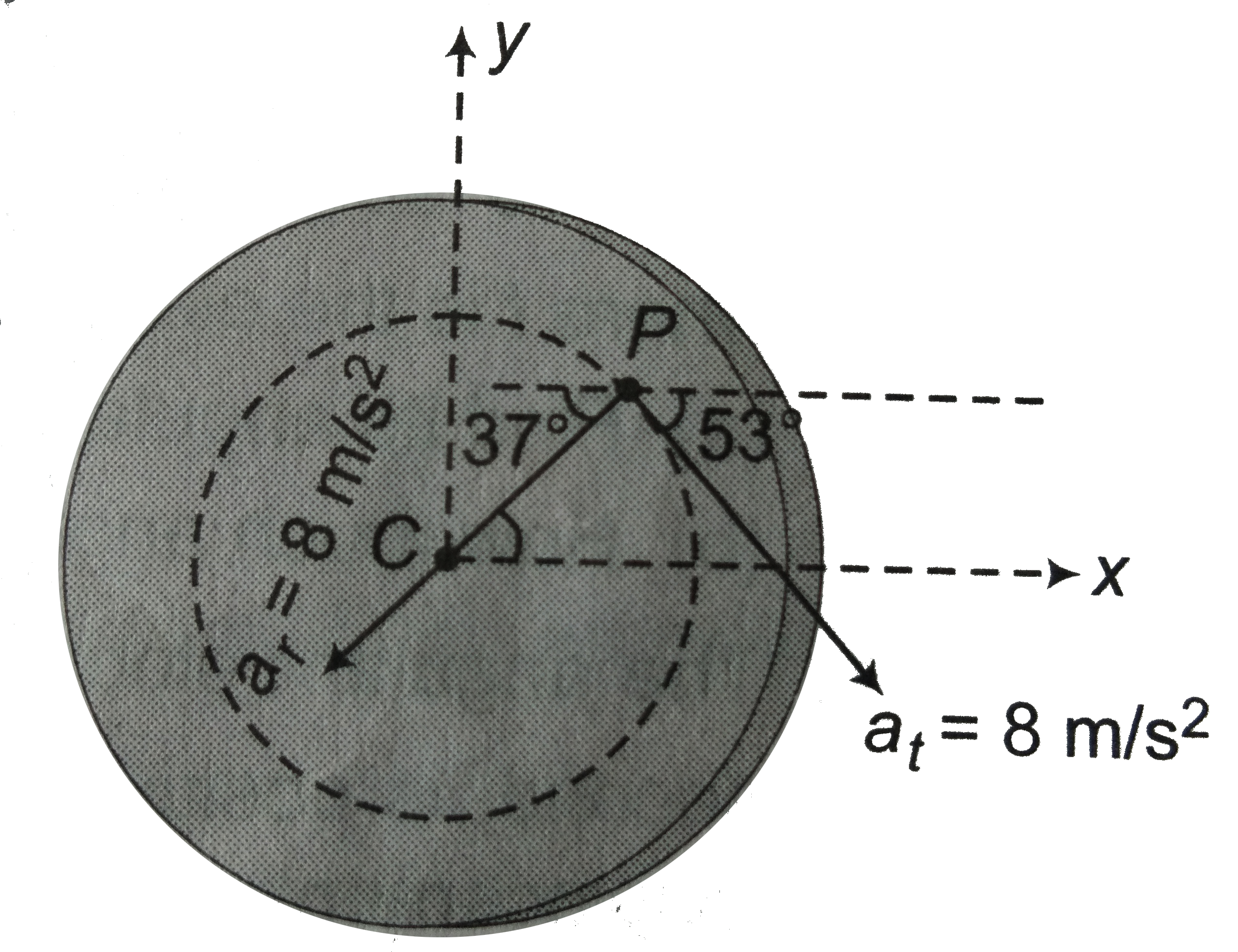
(d). Acceleration of the particle has two components
(i). `a_(r)=romega^(2)` (radial component)
`=(2)(2)^(2)=8m//s^(2)`
this components is towareds centre C.
(ii). `a_(t)=ralpha` (tangential component)
`=(2)(4)=8m//s^(2)`
this component is in the direction of linear velocity, as `omega` or `v` is increasing
`thereforea=(8cos53^(@)-8cos37^(@))(hati)`
`+(8sin53^(@)+8sin37^(@))(-hatj)`
or `a=(-1.6hati-11.2hatj)m//s^(2)`
Promotional Banner

Topper's Solved these Questions

  • ROTATIONAL MECHANICS

    DC PANDEY|Exercise Solved Examples|25 Videos
  • ROTATIONAL MECHANICS

    DC PANDEY|Exercise Miscellaneous Examples|2 Videos
  • ROTATION

    DC PANDEY|Exercise (C) Chapter Exercises|39 Videos
  • ROTATIONAL MOTION

    DC PANDEY|Exercise Integer Type Questions|17 Videos

Similar Questions

Explore conceptually related problems

If velocity of a particle is given by v=2t^(2)-2 then find the acceleration of particle at t = 2 s.

Velocity of a particle is given as v = (2t^(2) - 3)m//s . The acceleration of particle at t = 3s will be :

The radius vector vec r=2i+5k and the angular velocity of a particle is vec w=3i-4k .Then the linear velocity of the particle is

In the shown figure, a=2m//s^(2),omega=(2t)rods^(-1) and CP=1m In terms of hati and hatj , find linear acceleration of the particle at P at P at t=1 s

The radius vector vec r=2i+5k and the angular velocity of a particle is vec w=3i-4k Then the linear velocity of the particle is

the angular velocity omega of a particle varies with time t as omega = 5t^2 + 25 rad/s . the angular acceleration of the particle at t=1 s is

A particle is revolving in a circle of radius 1 m with an angular speed of 12 rad/s. At t = 0, it was subjected to a constant angular acceleration alpha and its angular speed increased to (480pi) rotation per minute (rpm) in 2 sec. Particle then continues to move with attained speed. Calculate (i) angular acceleration of the particle, (ii) tangential velocity of the particle as a function of time. (iii) acceleration of the particle at t = 0.5 second and at t = 3 second (iv) angular displacement at t = 3 second.

In the figure shown upsilon=2m//s omega=5rad//s and CP=1m In terms of hati and hatj find linear velocity of particle P.

Velocity vector of a particle is given as vecv=4thati+3hatj At t=0 position of the particle is given as vecr_(0)=2hatj Find the position vector of the particle at t=2 sec and te average acceleration of the particle for t=0 to t=2sec.

In the figure shown omega=(v)/(2R) in terms of hati and hatj find linear velocities of particles M, N, R and S.

