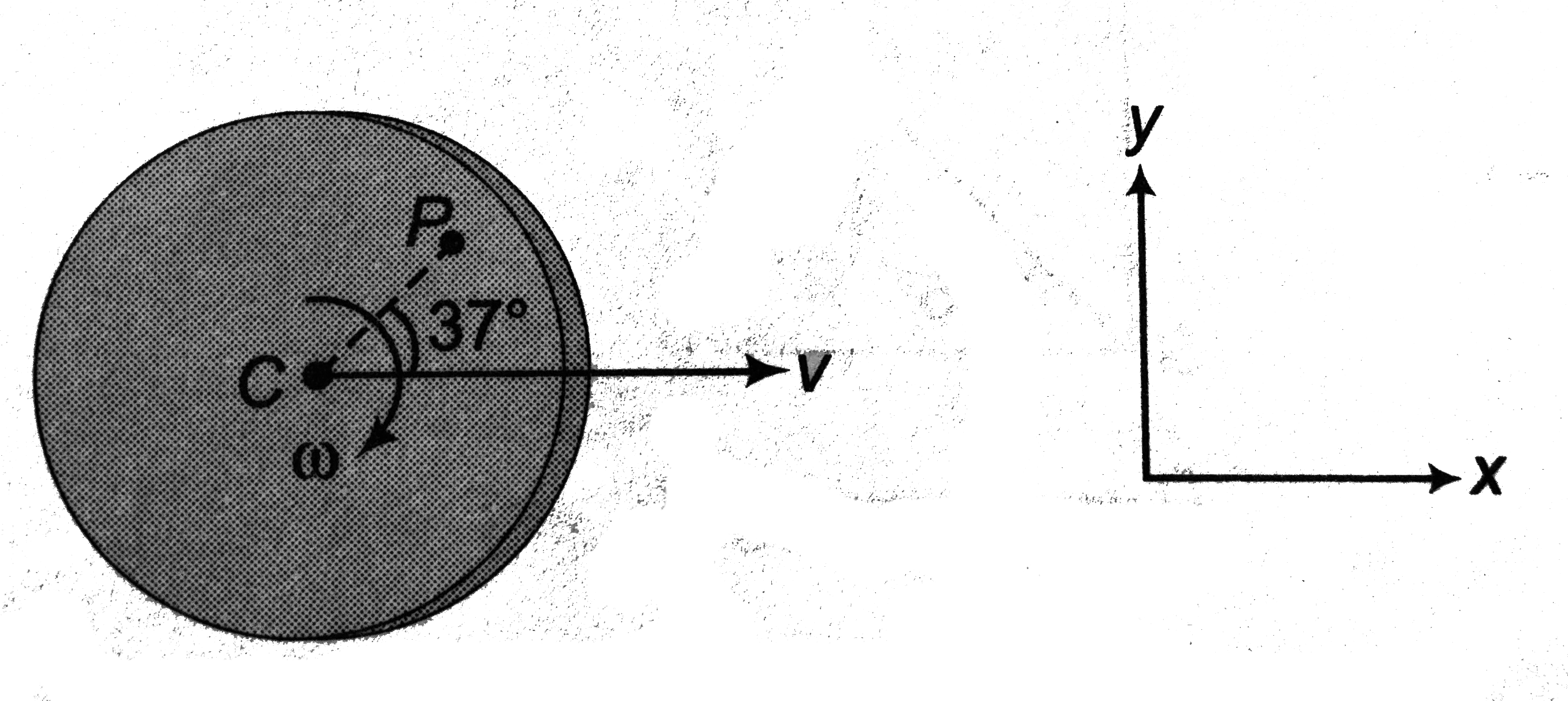
In the figure shown `upsilon=2m//s` `omega=5rad//s` and `CP=1m` In terms of `hati` and `hatj` find linear velocity of particle P.
Text Solution
Verified by Experts
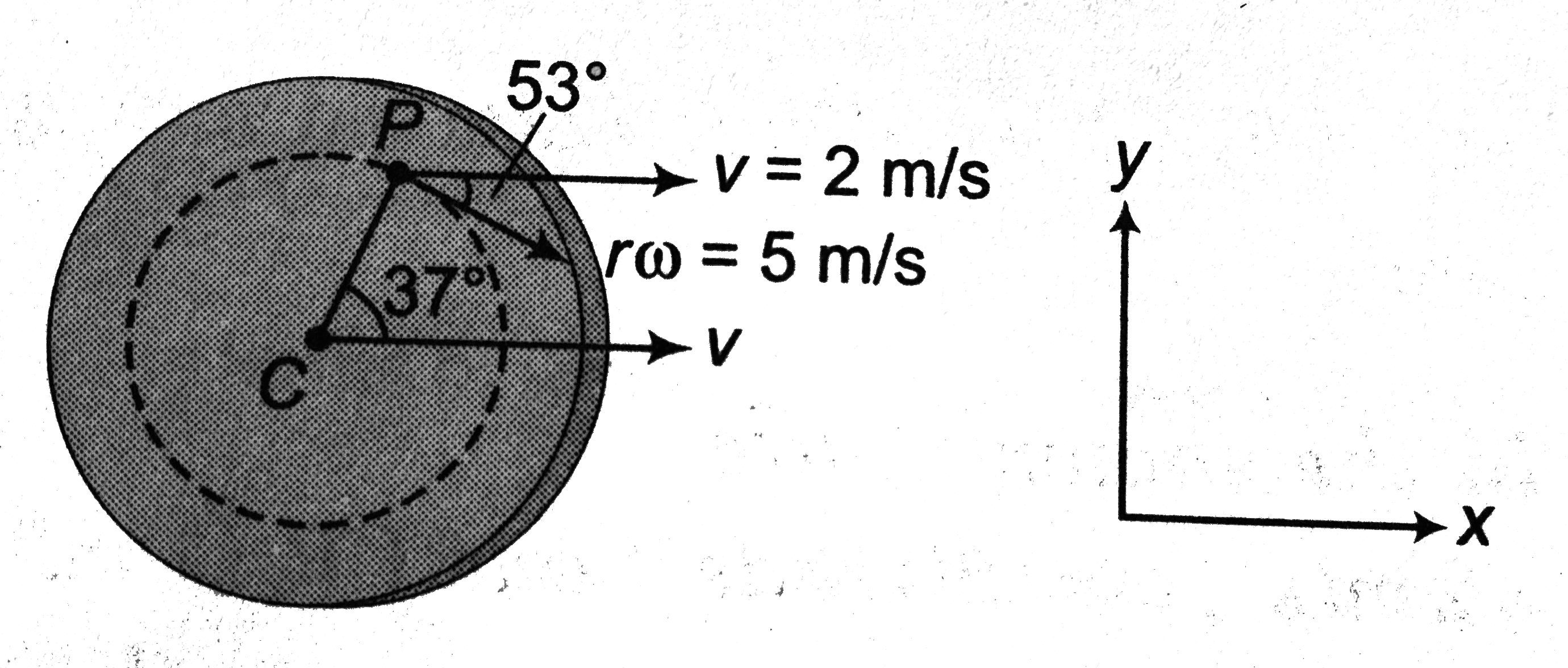
For particle `P`, `r=CP=1m` `impliesromega=(1)(5)=5m//s` Net velocity of `P` is the vector sum of v and `romega` as shown in figure. `thereforeV_(P)=2hati+(5cos53^(@)hati-5sin53hatj)` `=2hati+3hati-4hatj=(5hati-4hatj)m//s`
Topper's Solved these Questions
ROTATIONAL MECHANICS
DC PANDEY|Exercise Solved Examples|25 Videos
ROTATIONAL MECHANICS
DC PANDEY|Exercise Miscellaneous Examples|2 Videos
ROTATION
DC PANDEY|Exercise (C) Chapter Exercises|39 Videos
ROTATIONAL MOTION
DC PANDEY|Exercise Integer Type Questions|17 Videos
Similar Questions
Explore conceptually related problems
In the shown figure, a=2m//s^(2),omega=(2t)rods^(-1) and CP=1m In terms of hati and hatj , find linear acceleration of the particle at P at P at t=1 s
In the figure shown omega=(v)/(2R) in terms of hati and hatj find linear velocities of particles M, N, R and S.
A circular disc is rotating with an angular speed (in radian per sec) omega=2t^(2) given, CP=2m In terms of hati,hatj and hatk at t=1s find, (a). omega (b). alpha (c). linear velocity of the particle lying at P (d). linear acceleration of the particle lying P
If angular velocity of a particle having position vector vec r = (2hati - 2hatj + 2hatk)m about the origin is vec w = (2hati - 2hatj - hatk)rad/s then magnitude of linear velocity of the particle will be
If angular velocity of a point object is vecomega=(hati+hat2j-hatk) rad/s and its position vector vecr=(hati+hatj-5hatk) m then linear velocity of the object will be
The acceleration of a particle is given by the relation as a = -kv^(5//2) , where is a constant. The particle starts at x=0 with a velocity of 16 m/s, and when x = 6, the velocity is observed to be 4 m/s. Find the velocity of particle when x=5m and the time at which the velocity ofthe particle is 9 m/s.
In the figure the variations of componets of acceleration of particles of mass 1kg is shown w.r.t. time. The initial velocity of the particle is vec(u)=(-3 hati+4hatj) m/s. the total work done by the resultant force on the particles in time intervals from t=0 to t=4 seconds is :
A particle is moving in x-y plane. Its initial velocity and acceleration are u=(4 hati+8 hatj) m//s and a=(2 hati-4 hatj) m//s^2. Find (a) the time when the particle will cross the x-axis. (b) x-coordinate of particle at this instant. (c) velocity of the particle at this instant. Initial coordinates of particle are (4m,10m).
A particle describing circular motion as shown in figure. The velocity of particle in m s is-
A particle is moving with uniform speed 0.5 m//s along a circle of radius 1m then the angular velocity of particle is (in rad s^(-1) )
DC PANDEY-ROTATIONAL MECHANICS-Subjective Questions