Home
Class 11
PHYSICS
A disc is rolling (without slipping) on ...


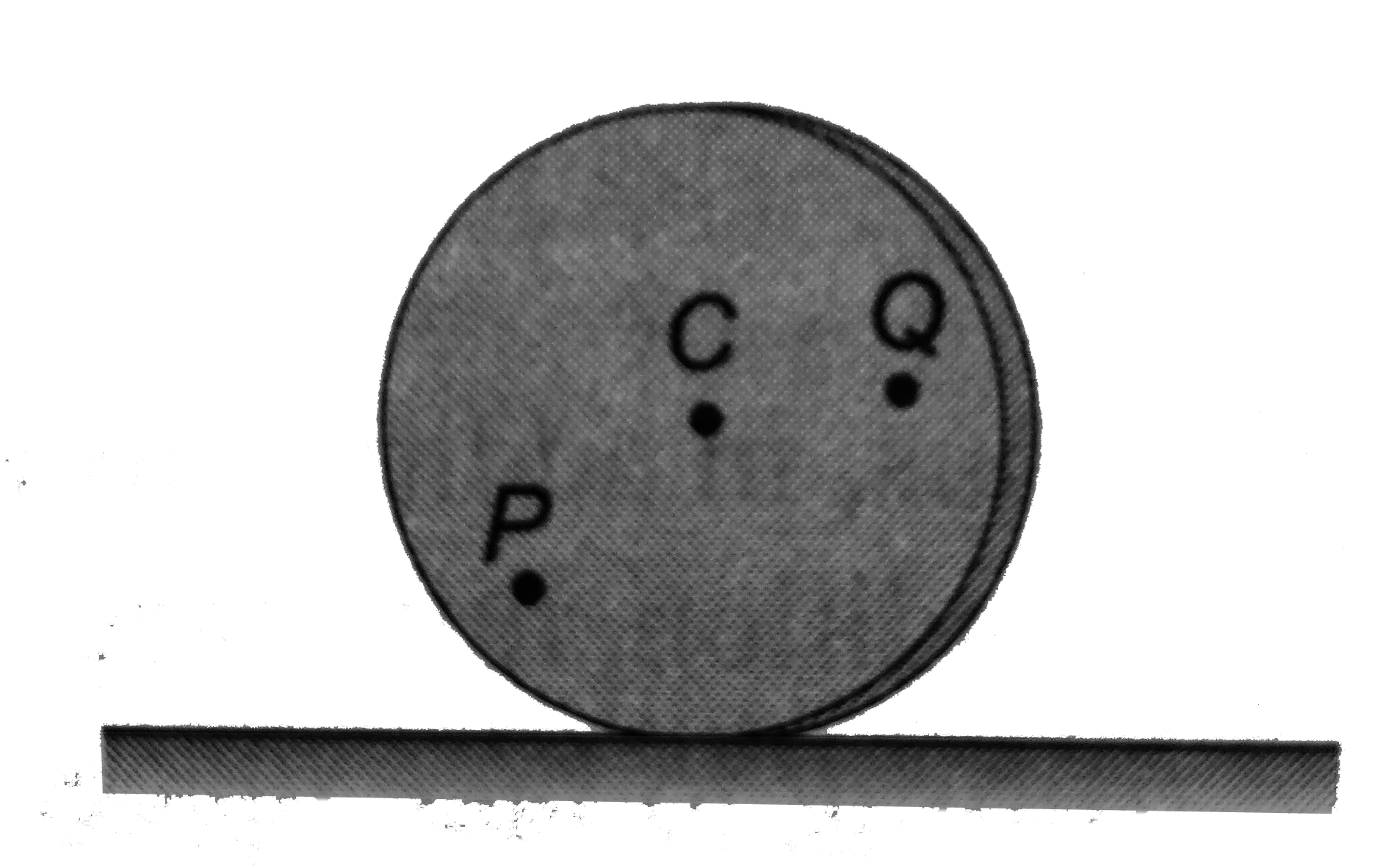
A disc is rolling (without slipping) on a horizontal surface. C is its centre and Q and P are two point equidistanec from C. let `upsilon_(p),upsilon_(Q)` and `upsilon_(C)` be the magnitude of velocities of points P, Q, and C repsectively,
(a). `upsilon_(Q)gtupsilon_(C)gtupsilon_(P)`
(b). `upsilon_(Q)ltupsilon_(C)ltupsilon_(P)`
(c). `upsilon_(Q)=upsilon_(P),upsilon_(C)=(1)/(2)upsilon_(P)`
(d). `upsilon_(Q)ltupsilon_(C)gtupsilon_(P)`

Text Solution

Verified by Experts


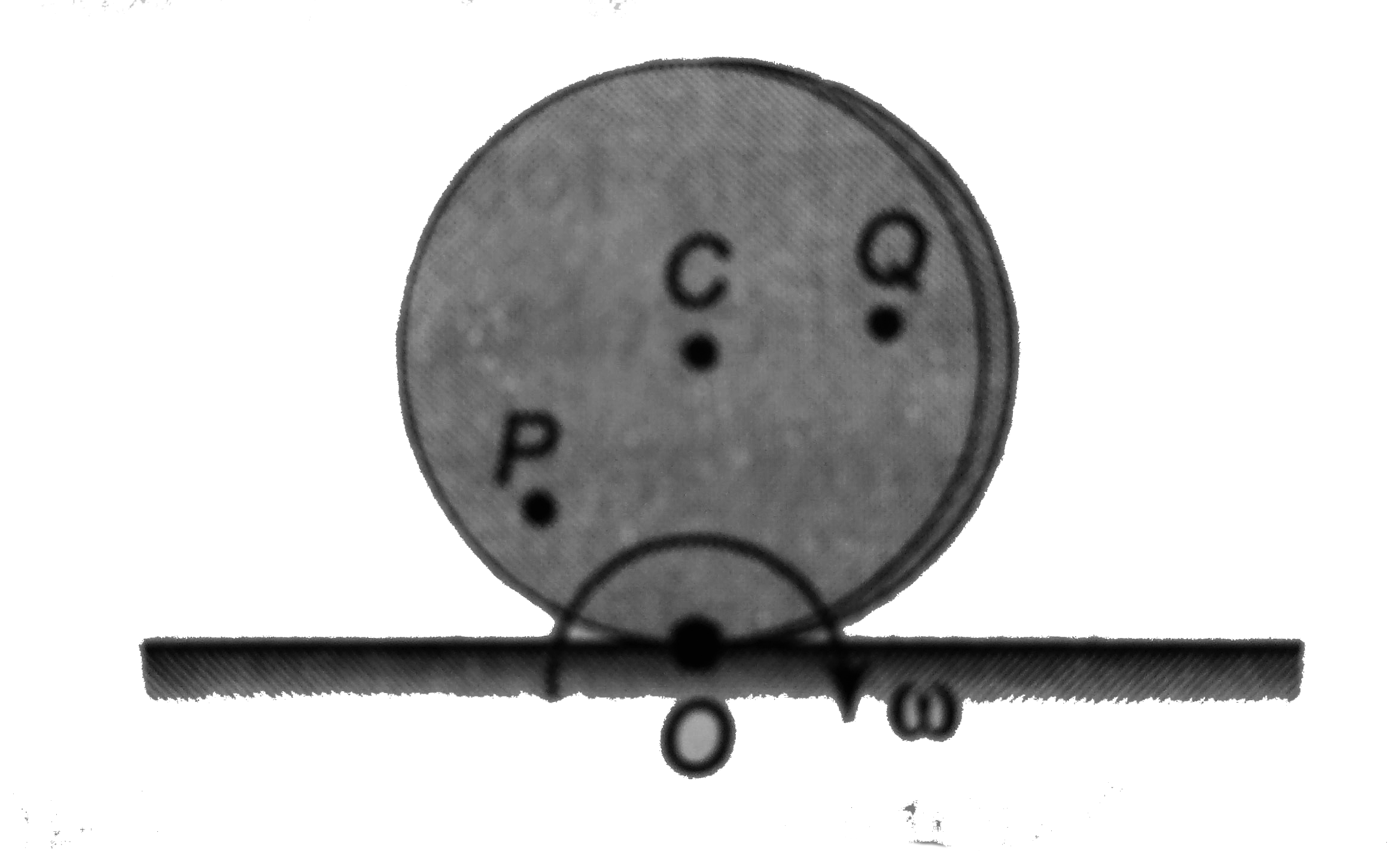
In case of pure rolling bottom most point in the instantaneous centre of zero velocity.
Velocity of any point on the disc, `v=romega` where `r` is the distance of point from `O`.
`r_(Q)gtr_(C)gtr_(P)impliesthereforev_(Q)gtv_(C)ltV_(p)`
Therefore, the correct option is (a).
Promotional Banner

Topper's Solved these Questions

  • ROTATIONAL MECHANICS

    DC PANDEY|Exercise Solved Examples|25 Videos
  • ROTATIONAL MECHANICS

    DC PANDEY|Exercise Miscellaneous Examples|2 Videos
  • ROTATION

    DC PANDEY|Exercise (C) Chapter Exercises|39 Videos
  • ROTATIONAL MOTION

    DC PANDEY|Exercise Integer Type Questions|17 Videos

Similar Questions

Explore conceptually related problems

A disc is rolling (without slipping) on a horizontal surface. C is its center and Q and P are two points equidistant from C . Let V_(P), V_(Q) and V_(C) be the magnitude of velocities of points P, Q and C respectively, then .

A disc is rolling without slipping on a horizontal surface with C, as its centre and Q and P the two points equidistant from C. Let v_(P),v_(Q) and v_(C) be the magnitudes of velocities of point P,Q and C respectively, then

A disc is rolling without slipping with angular velocity omega . P and Q are two points equidistant from the centre C. the order of magnitude fo velocity is

The root mean square velocity of hydrogen molecule at 27^(@)C is (upsilon_(H) and that of oxygen at 402^(@)C is (upsilon_(0) , then

For a gas C_(P)-C_(V)=R in a state P and C_(P)-C_(V)=1.10 R in a state Q, T_(P) and T_(Q) are the temperatures in two different states P and Q respectively. Then

Sum of the first p,q and r terms of an A.P are a,b and c,respectively.Prove that quad (a)/(p)(q-r)+(b)/(q)(r-p)+(c)/(r)(p-q)=0

The molar specific heats of an ideal gas at constant pressure and volume are denotes by C_(P) and C_(upsilon) respectively. If gamma = (C_(P))/(C_(upsilon)) and R is the universal gas constant, then C_(upsilon) is equal to

Check the dimensional consistency of the relation upsilon = (1)/(I) sqrt((P)/(rho)) where I is length, upsilon is velocity, P is pressure and rho is density,

A resistor R ,an inductor L , and a capacitor C are connected in series to an oscillator of freqency upsilon .if the resonant frequency is upsilon_(r) , then the current lags behind voltage, when:
