From the low of conservation of angular momentum.
`Iomega_(0)=2Iomega` Here, `I=` moment of inertial of each disc relative to common rotation axis
`thereforeomega=(omega_(0))/(2)=` steady state angular velocity
the angular velocity of each disc varies due to the torque `tau` of the friction forces to calculate `tau` let us take an elementary ring with radii `r` and `r+dr`. The torque of the friction forces acting on the given ring is equal to
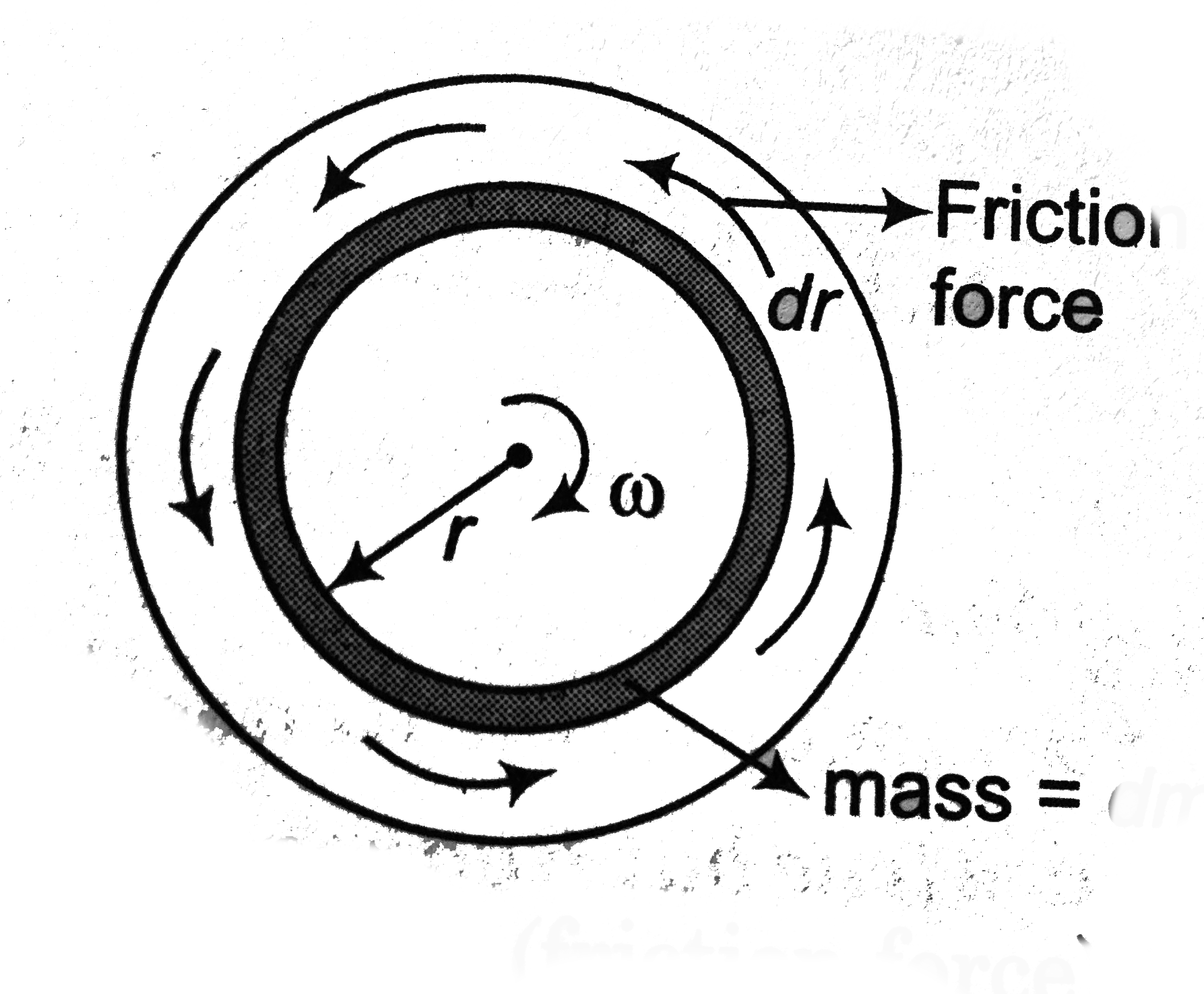
`dtau=` (friction force) `(r_(bot))=[mu(dm)g](r)`
`=mu((mg)/(pir_(0)^(2)))(2pirdr)r`
`=((2mumg)/(r_(0)^(2)))r^(2)dr`
where `m` is the mass of each disc. Integrating this with respect to `r` between `0` and `r_(0)`, we get
`tau=(2)/(3)mumgr_(0)=` constant
`alpha=(tau)/(I)=((2mumgr_(0)//3))/((mr_(0)^(2)//2))`
`=(4mug)/(3r_(0))=` constant
Now, angular speed of lower disc increases with this `alpha` from `O` to `(omega_(0))/(2)` and `alpha` is constant
`therefore(omega_(0))/(2)=alphat`
or `t=(omega_(0))/(2alpha)=(3r_(0)omega_(0))/(8mug)`


