Home
Class 11
PHYSICS
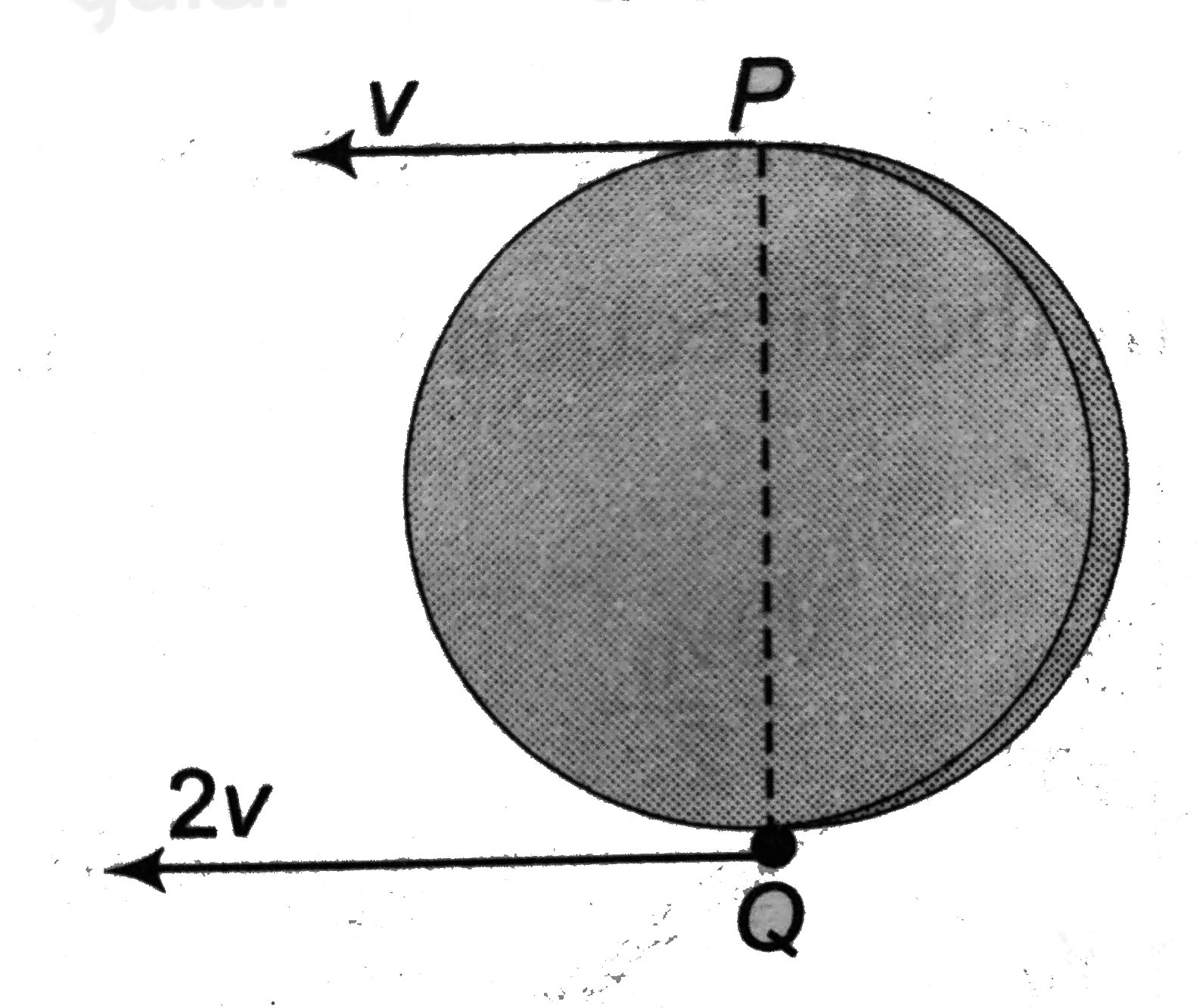
Two point P and Q. diametrically opposit...


Two point P and Q. diametrically opposite on a disc of radius R have linear velocities v and 2v as shown in figure. Find the angular speed of the disc.

Text Solution

Verified by Experts

`omega=-(v_(r))/(PQ)=(2v-v)/(2R)=(v)/(2R)`
Rotation is clockwise So, `omega` is perpendicular to paper inward.
Promotional Banner

Topper's Solved these Questions

  • ROTATIONAL MECHANICS

    DC PANDEY|Exercise Exercise 12.3|4 Videos
  • ROTATIONAL MECHANICS

    DC PANDEY|Exercise Exercise 12.4|11 Videos
  • ROTATIONAL MECHANICS

    DC PANDEY|Exercise Exercise 12.1|10 Videos
  • ROTATION

    DC PANDEY|Exercise (C) Chapter Exercises|39 Videos
  • ROTATIONAL MOTION

    DC PANDEY|Exercise Integer Type Questions|17 Videos

Similar Questions

Explore conceptually related problems

A disc of mass M and radius R moves in the x-y plane as shown in the figure. The angular momentum of the disc at the instant shown is –

A particle of mass m strikes elastically with a disc of radius R , with a velocity vec"v" as shown in the figure. If the mass of the disc is equal to that of the particle and the surface of the contact is smooth, find the velocity of the disc just after the collision.

A disc of the radius R is confined to roll without slipping at A and B. If the plates have the velocities v and 2v as shown, the angular velocity of the disc is

In the figure (i) a disc of mass M(kg) and radius R(m) is rotating smoothly about a fixed vertical axis AB with angular speed 26 rad//s A rod rod CD of length (R)/(2)(m) and mass M(kg) is hinged at one end at point 'D' on the disc. The rod remains in vertical position and rotates along with the disc about axis AB . At some moment the rod CD gets a very smal impulse at point 'C' due to air due to which the rod falls on the disc along one radius and sticks to the disc as shown in figure (ii) . Now find the angular velocity of the disc in rad//s .

A solid sphere is set into motion on a rough horizontal surface with a linear velocity v in the forward direction and an angular velocity v/R in the anticlockwise direction as shown in the figure. Find the linear speed of the sphere, when it stops rotating.

A man of mass m stands on a horizontal platform in the shape of a disc of mass m and radius R , pivoted on a vertical axis thorugh its centre about which it can freely rotate. The man starts to move aroung the centre of the disc in a circle of radius r with a velocity v relative to the disc. Calculate the angular velocity of the disc.

Two discs A and B are moving with their flat circular surface on a smooth horizontal surface. Mass, radius and velocity of the two discs are - m_(A) = 2M, m_(B) = M, r_(A) = R, = 2R, v_(A) = v, and v_(B) = 2v . The velocities of the two discs are oppositely directed so that they just cannot avoid collision and stick to each other (see figure) (a) Find the angular speed of the composite system after collision (b) Find loss in kinetic energy due to collision

the disc of the radius r is confined to roll without slipping at A and B if the plates have the velocities shown, determine the angular velocity of the disc.

Particle P shown in figure is moving in a circle of radius R=10 cm with linear speed v=2m//s Find the angular speed of particle about point O.
