Home
Class 11
PHYSICS
A man pushes a cylinder of mass m1 with ...

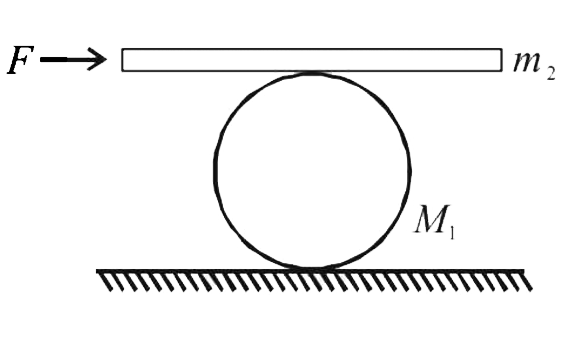
A man pushes a cylinder of mass `m_1` with the help of a plank of mass `m_2` as shown in figure. There in no slipping at any contact. The horizontal component of the force applied by the man is F.
(a) the acceleration fo the plank and the center of mass of the cylinder, and

(b) the magnitudes and direction of frictional force at contact points.

Text Solution

Verified by Experts


We can choose any arbitrary direction of frictional forces at different contacts.
In the final answer, the negative value will show for opposite direction
let `f_(1)=` friction between plank and cylinder
`f_(2)=` friction between cylinder and ground
`a_(1)=` acceleration of plank
`a_(2)=` acceleration of centre of mass of cylinder
and `alpha=` angular acceleration of cylinder about is COM.

Decreation of `f_(1)` and `f_(2)` are as shown here.
Since, there is not slipping anywhere
`thereforea_(1)=2a_(2)` ..(i)
(acceleration of plank `=` acceleration fo top point of cylinder)
`a_(1)=(F-f_(1))/(m_(2))` ...(ii)
`a_(2)=(f_(1)+f_(2))/(m_(1))`
`alpha((f_(1)-f_(2))R)/(I)`
`(I=` moment of inertia of cylinder about COM)

`thereforealpha=((f_(1)-f_(2))R)/((1)/(2)m_(1)R^(2))`
`alpha=(2(f_(1)-f_(2))/(m_(1)R)` ..(iv)
`a_(2)=Ralpha(2(f_(1)-f_(2))/(m_(1))` ....(v)
(acceleration of bottommost point of cylinder `=0`)
(a). solving eqs (i), (ii), (iii) and (V) we get
`a_(1)=(8F)/(3m_(1)+8m_(2))`
and `a_(2)=(4F)/(3m_(1)+8m_(2))`
(b). `f_(1)=(m_(1)F)/(3m_(1)+8m_(2))`
Since all quantities are positive, they are correctly shown in figures.
Promotional Banner

Topper's Solved these Questions

  • ROTATIONAL MECHANICS

    DC PANDEY|Exercise Subjective Questions|2 Videos
  • ROTATIONAL MECHANICS

    DC PANDEY|Exercise Level 2|1 Videos
  • ROTATION

    DC PANDEY|Exercise (C) Chapter Exercises|39 Videos
  • ROTATIONAL MOTION

    DC PANDEY|Exercise Integer Type Questions|17 Videos

Similar Questions

Explore conceptually related problems

A boy pushes a cylinder of mass M with the help of a plank of mass m as shown in figure. There is no slipping at any contact. The horizontal component of the force applied by the boy on the plank is F. Find (a) The acceleration of the centre of the cylinder (b) The friction force between the plank and the cylinder

A plank of mass m_1 with a uniform sphere of mass m_2 placed on it rests on a smooth horizontal plane. A constant horizontal force F is applied to the plank. With what acceleration will the plank and the centre of the sphere move provided there is no sliding between the plank and the sphere?

A cylinder is sandwiched between two planks. Two constant horizontal forces F and 2F are applied on the planks as shown. Determine the acceleration of the centre of mass of cylinder and the top plank. If there is no slipping at the top and bottom of cylinder.

A solid sphere of mass m and radius R is placed over a plank of same mass m . There is sufficient friction between sphere and plank to prevent slipping. When a horizontal force F is applied at centre of sphere, acceleration of the plank is

A disc of mass m and radius R is placed over a plank of same mass m. There is sufficient friction between disc and plank to prevent slipping. A force F is applied at the centre of the disc. Acceleration of the plank is

A sphere of mass m and radius r is placed on a rough plank of mass M . The system is placed on a smooth horizontal surface. A constant force F is applied on the plank such that the sphere rolls purely on the plank. Find the acceleration of the sphere.

A cylinder of mass 2kg and radius 10cm is held between two planks as shown in Fig. Calculate KE of the cylinder when there is no slipping at any point.

A solid cylinder of mass M and radius 2R is rolled up on an incline with the help of a plank of mass 2M as shown in the figure. A constant force F is acting on the plank parallel to the incline. There is no slipping at any of the contact. The friction force between the plank and cylinder is given by:

Consider a cylinder of mass M and radius R lying on a rough horizontal plane. It has a plank lying on its top as shown in the figure. A force F is applied on the plank such that the plank moves and causes the cylinder to roll. The plank always remains horizontal. There is no slipping at any point to contact. (a) what are the directions of the fricition forces acting at A and B on the plank and the cylinder ? (b) Calculate the acceleration of the cylinder. (c ) Find the value of frictional force at A & B .

The mass m is placed on a body of mass M. There is no friction. The force F is applied on M on it moves with acceleration a. Then, the force on the top body is

DC PANDEY-ROTATIONAL MECHANICS-Level 2 Subjective
  1. A ball of mass m and radius r rolls along a circular path of radius R ...

    Text Solution

    |

  2. A heavy homogeneous cyliner has mass m and radius R. It is accelerated...

    Text Solution

    |

  3. A man pushes a cylinder of mass m1 with the help of a plank of mass m2...

    Text Solution

    |

  4. For the system shown in figure, M=1kg m=0.2 kg, r=0.2m calculate (g=10...

    Text Solution

    |

  5. A cylinder of mass m is kept on the edge of a plank of mass 2m and len...

    Text Solution

    |

  6. The 9 kg cradle is supported as shown by two uniform disks that roll w...

    Text Solution

    |

  7. the disc of the radius r is confined to roll without slipping at A an...

    Text Solution

    |

  8. A thin uniform rod AB of mass m=1kg moves translationally with acceler...

    Text Solution

    |

  9. The assembly of two discs as shown in figure is placed on a rough hori...

    Text Solution

    |

  10. A horizontal plank having mass m lies on a smooth horizontal surface. ...

    Text Solution

    |

  11. A ball rolls without sliding over a rough horizontal floor with veloci...

    Text Solution

    |

  12. A sphere a disk and a hoop made of homogeneous materials have the same...

    Text Solution

    |

  13. ABC is a triangular framwork of three uniform rods each of mass m and ...

    Text Solution

    |

  14. A uniform stick of length L and mass M hinged at end is released from ...

    Text Solution

    |

  15. A uniform rod AB of mass 3m and length 4l, which is free to turn in a ...

    Text Solution

    |

  16. A uniform rod of length 4l and mass m is free to rotate about a horizo...

    Text Solution

    |

  17. A stick of length l lies on horizontal table. It has a mass M and is f...

    Text Solution

    |

  18. A rod of length l forming an angle theta with the horizontal strikes a...

    Text Solution

    |

  19. Three particles A, B and C each of mass m, are connected to each other...

    Text Solution

    |

  20. A semicircular track of radius R=62.5cm is cut in a block. Mass of blo...

    Text Solution

    |

