Home
Class 11
PHYSICS
A boy mass m runs on ice with velocity v...


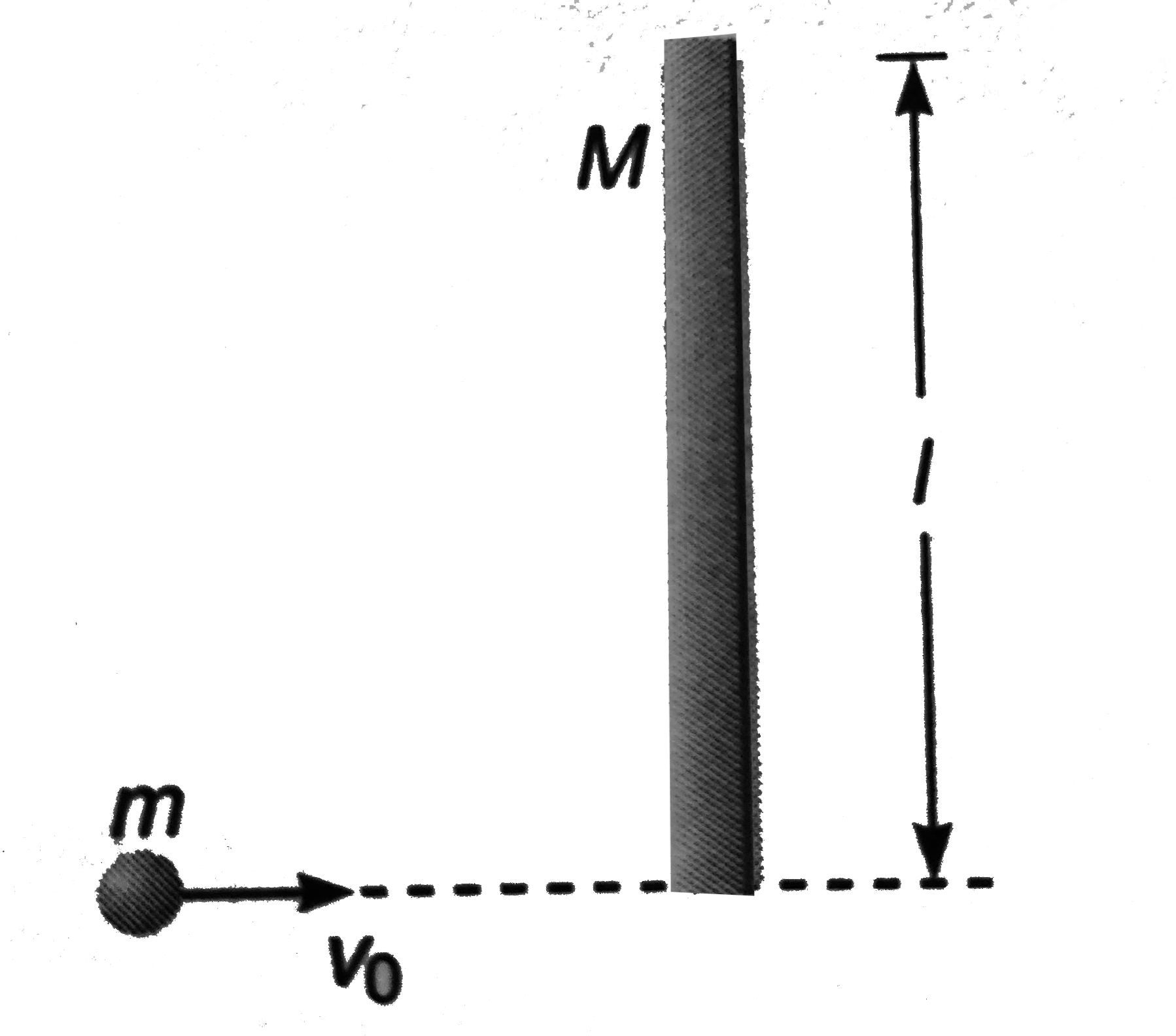
A boy mass m runs on ice with velocity `v_()` and steps on the end of a plank of length `l` and mass `M` which is perpendicular to his path.
(a). Describe quatitatively the motion of the system after the boy is on the plank. Neglect friction with the ice.
(b). One point on the plank is at rest immediately after the collision. Where is it?

Text Solution

Verified by Experts


C is the COM of `(M+m)`
`BC=((M)/(M+m))(l)/(2)` ltbr and `OC=((m)/(M+m))((l)/(2))`
from conservation of linear momentum,
`(M+m)v=mv_(0)`
or `v=((m)/(M+m))v_(0)` .(i)
From conservation of angular momentum about point C we have
`mv_(0)(BC)=Iomega`
or `(mMv_(0)l)/(2(M+m))=[m((M)/(M+m))^(2)((l)/(4))^(2)+(Ml^(2))/(12)+M((m)/(M+m))^(2)((l^(2))/(4))]omega`
putting `(mv_(0))/(M+m)=v`
From Eq (i) we have
`(v)/(omega)=(l)/(6)[(4m+M)/(M+m)]`
Now a point say P at a distance `x=(v)/(omega)`, from C
(tawards O) will be at rest Hence distance of point P from by at B will be
`BP=BC+x`
`=((M)/(M+m))((l)/(2))+(l)/(6)[(4m+M)/(M+m)]`
`=(2l)/(3)`
Promotional Banner

Topper's Solved these Questions

  • ROTATIONAL MECHANICS

    DC PANDEY|Exercise Level 2 Subjective|36 Videos
  • ROTATION

    DC PANDEY|Exercise (C) Chapter Exercises|39 Videos
  • ROTATIONAL MOTION

    DC PANDEY|Exercise Integer Type Questions|17 Videos

Similar Questions

Explore conceptually related problems

A man of mass m stands at the left end of a uniform plank of length L and mass M, which lies on a frictionaless surface of ice. If the man walks to the other end of the plank, then by what distance does the plank slide on the ice?

A rod AB of mass M and length L is lying on a horizontal frictionless surface. A particle of mass m travelling along the surface hits the end A of the rod with a velocity v_(0) in a direction perpendicular to AB. The collision in elastic. After the collision the particle comes to rest (a). Find the ratio m//M (b). A point P on the rod is at rest immediately after collision find the distance AP. (c). Fid the linear speed of the point P a time piL//3v_(0) after the collision.

A uniform rod of length l and mass 2m rest on a smooth horizontal table. A points mass m moving horizontally at right angles to the rod with an initial velocity v collides with one end of the rod and sticks to it. Determine (a) the angular velocity of the system after collision, (b) the position of the point on the rod which remains stationary immediately after collision, (c) the chabge in kinetic energy of the system as a result of the collision.

A boy of mass m stands on one end of a wooden plank of length L and mass M. The plank is floating on water. If the boy walks from one end of the plank to the other end at a constant speed, the resulting displacement of the plank is given by :

A man of mass M stands at one end of a plank of length L Which lies at rest on a frictionless surface . The man walks to the other end of the plank. If the mass of the plank is 3M, the distance that the man moves relative to the ground is

A man of mass M stands at one end of a plank of length L which lies at rest on a frictionless surface. The man walks to the other end of the planck. If the mass of the planck is M/2 , then the distance that the man moves relative to the ground is

A particle of mass m is projected at an angle of 60^(@) with a velocity of 20m//s relative to the ground from a plank of same mass m which is placed on smooth surface Initially Plank was at rest The minimum length of the plank for which the ball will fall on the plank itself is (g=10m//s^(2))

A boy pushes a cylinder of mass M with the help of a plank of mass m as shown in figure. There is no slipping at any contact. The horizontal component of the force applied by the boy on the plank is F. Find (a) The acceleration of the centre of the cylinder (b) The friction force between the plank and the cylinder

