Home
Class 11
PHYSICS
A block of mass 100 g attached to a spri...

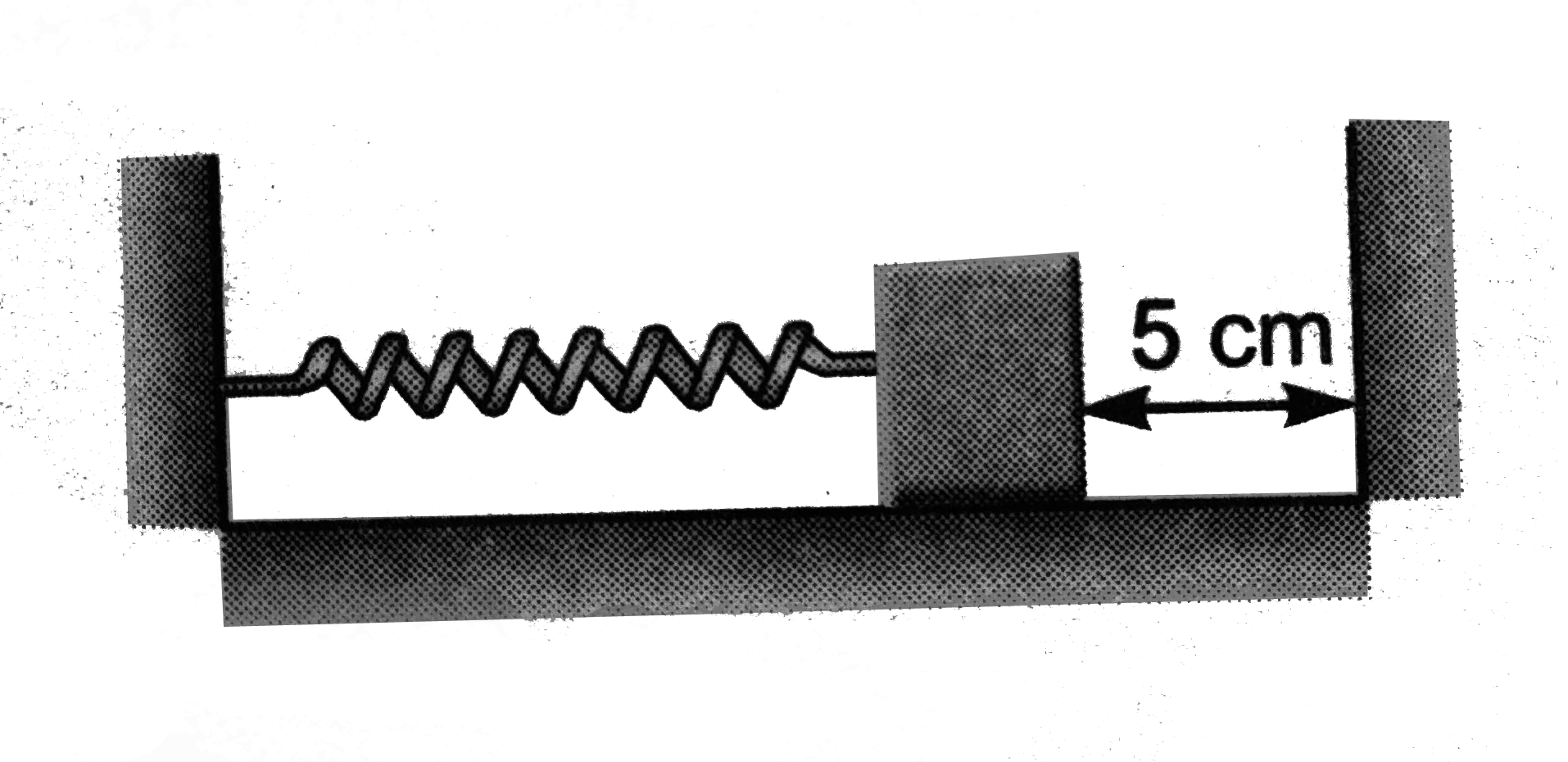
A block of mass `100 g` attached to a spring ofstiffness `100 N//Mis` lying on a frictionless floor as shown. The block is moved to compress the spring by `10 cm` and released. If the collation with the wall is elastic then find the time period of oscillations.

Text Solution

Verified by Experts

The correct Answer is:

A, C, D

The given distance on RHs 5cm is `(A)/(2)` and from `0` to `(A)/(2)` time taken is `(T)/(12)`.
`T = t_(LHS) + t_(RHS) = (T)/(2) + 2 ((T)/(12))`
`= (2)/(3)T = (2)/(3)(2pi)sqrt((m)/(k))`
`= (4pi)/(3)sqrt((0.1)/(100)) = 0.133 s`
Promotional Banner

Topper's Solved these Questions

  • SIMPLE HARMONIC MOTION

    DC PANDEY|Exercise Example Type 7|1 Videos
  • SIMPLE HARMONIC MOTION

    DC PANDEY|Exercise Example Type 8|1 Videos
  • SIMPLE HARMONIC MOTION

    DC PANDEY|Exercise Example Type 5|7 Videos
  • SEMICONDUCTORS AND ELECTRONIC DEVICES

    DC PANDEY|Exercise More than One Option is Correct|3 Videos
  • SOLVD PAPERS 2017 NEET, AIIMS & JIPMER

    DC PANDEY|Exercise Solved paper 2018(JIPMER)|38 Videos

Similar Questions

Explore conceptually related problems

A block of mass 0.9 kg attached to a spring of force constant k is lying on a frictionless floor. The spring is compressed to sqrt(2) cm and the block is at a distance 1//sqrt(2) cm from the wall as shown in the figure. When the block is released, it makes elastic collision with the wall and its period of motion is 0.2 sec . Find the approximate value of k

In the figure, the block of mass m, attached to the spring of stiffness k is in correct with the completely elastic wall, and the compression in the spring is e. The spring is compressed further by e by displacing the block towards left and is then released. If the collision between the block and the wall is completely eleastic then the time period of oscillation of the block will be

A block is attached to a spring and is placed on a horizontal smooth surface as shown in which spring is unstretched. Now the spring is given an initial compression 2x_(0) an block is released from rest. Collision with the wall PQ are elastic. Find the time period of motion of the block:

A block of mass M connected to an ideal spring of force constant k, is placed on a smooth surface. The block is pushed to the left so as to compress the spring by a length A and then it is released. The block hits an elastic wall at a distance (3A)/(2) from its point of release. Assume the collision to be instantaneous. (a) Calculate the time required by the block to complete one oscillation (b) Draw the velocity - time graph for one oscillation of the block. (c) Find the value of k for which average force experienced by the wall due to repeated hitting of the block is F_(0) .

A block is attached to a spring and is placed on a horizontal smooth surface as shown in which spring is unstretched. Now the spring is given an initial compression 2x_(0) an block is released from rest. Collision with the wall PQ are elastic. Write its equation of motion indicating position as a function of time:

A block of mass m compresses a spring iof stifffness k through a distacne l//2 as shown in the figure .If the block is not fixed to the spring the period of motion of the block is

A block of mass m is connected to three springs as shown in Fig. The block is displaced down slightly and left free, it starts oscillating. Find time period of oscillations.

A block of mass m = 2 kg is attached to two unstretched spring of force constant k_(1)=100 N//m and k_(2)=125 N//m The block is displaced towards left through a distance of 10 cm and released. Find the speed of the block as it passes through the mean position.
