Home
Class 11
PHYSICS
Two block A and B of masses m(1) = 3kg a...

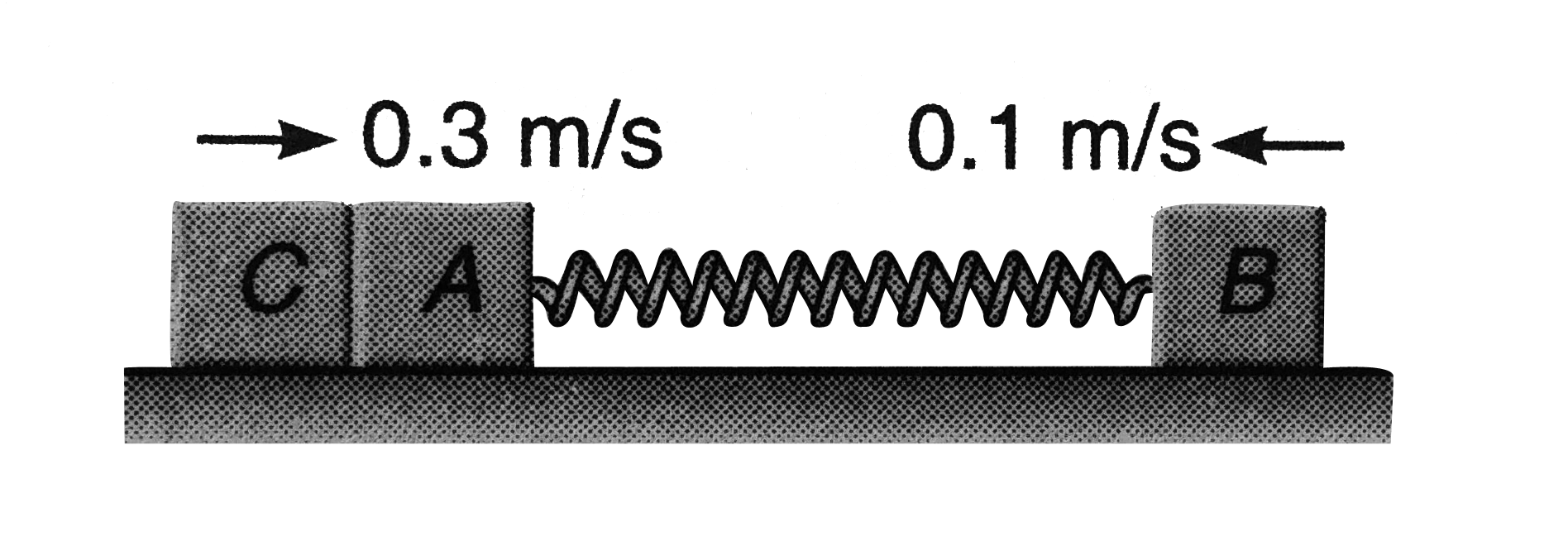
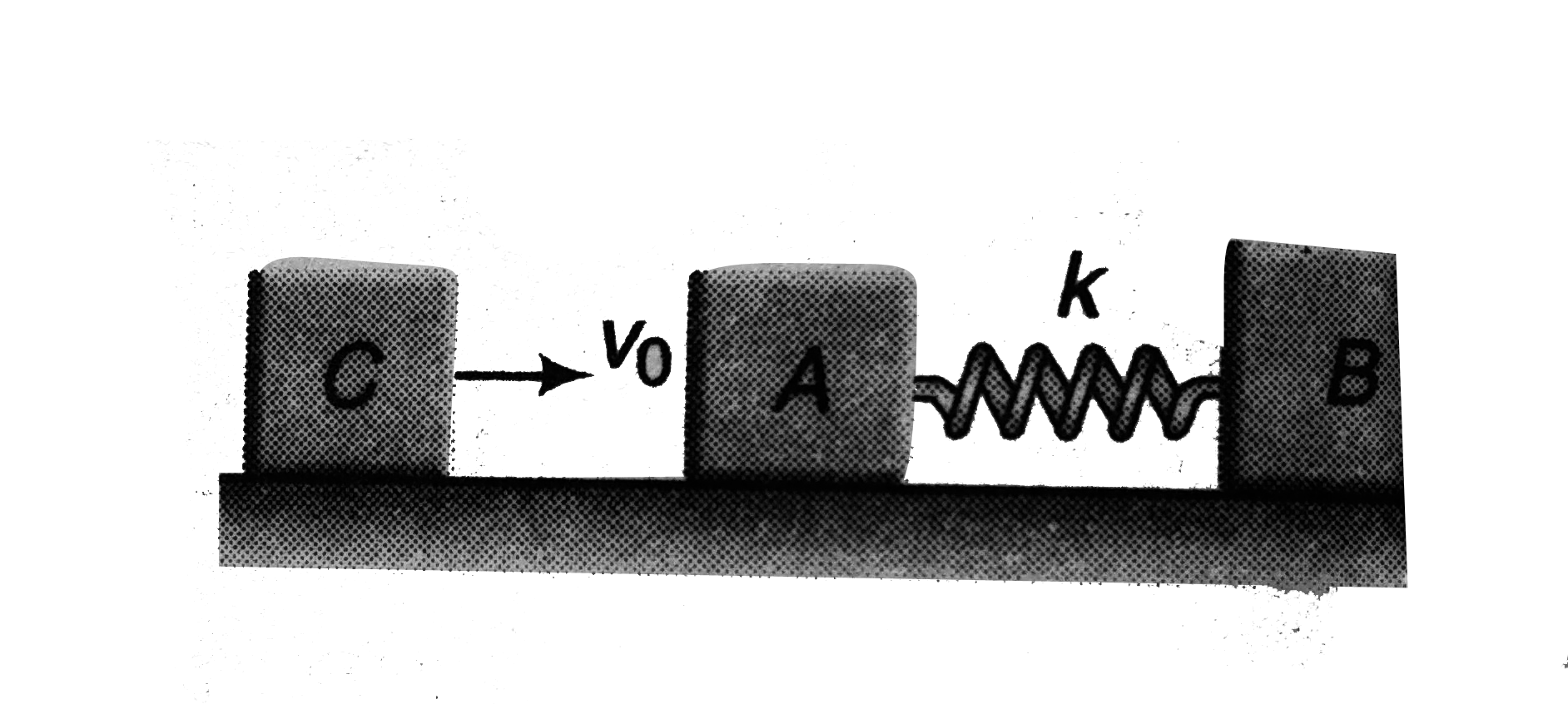
Two block `A` and `B` of masses `m_(1) = 3kg` and `m_(2) = 6kg` respectively are connected with each other by a spring of force constant `k = 200 N//m` as shown in figure. Blocks are pulled away from each other by `x_(0) = 3cm` and then released. When spring is in its natural length and block are moving towards each other, another block `C` of mass `m = 3kg` moving with velocity `v_(0) = 0.4m//s` (towards right) collides with `A` and gets stuck to it. Neglecting friction, calculate

(a) velocity `v_(1)` and `v_(2)` of the blocks `A` and `B` respectively just before collision and their angular frequency .
(b) velocity of centre of mass of the system, after collision,
( c) amplitude of oscillation of combined body,
(d) loss of energy during collision.

Text Solution

Verified by Experts

The correct Answer is:
A, B, C, D

(a) `(1)/(2) kx_(0)^(2) = (1)/(2)mu v_(r)^(2)`
Here, `mu =` reduced mass `= (6 xx 3)/(6 + 3)`
`= 2kg`
`:. v_(r) = sqrt((k)/(mu))x_(0) = (sqrt((200)/(2)))(3 xx10^(-2))`
`= 0.3m//s = 2v + v`
`:. v = 0.1m//s`
`:. v_(1) = 0.2m//s`
and `v_(2) = 0.1m//s`
Angular frequency
`omega = sqrt((k)/(mu)) = sqrt((200)/(2))`
`= 10rad//s`

(b) `v_(cm) = (m_(1)v_(1) + m_(2)v_(2) + m_(3)v_(3))/(m_(1) + m_(2) + m_(3))`
` = ((3)(0.2) - (6)(0.1) + 3(0.4))/(3 + 6 + 3)`
`= 0.1m//s` (towards right)
( c) After collision velocity of combined blocks `(A + C)`
`v_(0) = ((3 xx 0.2) + (3)(0.4))/(3 + 3) = 0.3m//s`
and velocity of block `B` is `v_(2) = 0.1m//s`

The spring will compress till velocity of all the blocks equal to the centre of mass. Applying conservation of mechanical energy, `(1)/(2)(3 + 3)(0.3)^(2) + (1)/(2)(6)(0.1)^(2) = (1)/(2)(3 + 3 + 6)(0.1)^(2) + (1)/(2)kA^(2)`
Solving this we get ,`A = 0.048m`
or `A = 4.8cm`
(d) `Delta E = (1)/(2)(3)(0.4)^(2) + (1)/(2)(3)(0.2)^(2) - (1)/(2)(3 + 3)(0.3)^(2)`
`= 0.24 + 0.06 - 0.27 = 0.03 J`
Promotional Banner

Topper's Solved these Questions

  • SIMPLE HARMONIC MOTION

    DC PANDEY|Exercise Exercise 14.1|5 Videos
  • SIMPLE HARMONIC MOTION

    DC PANDEY|Exercise Intro. Exer.|1 Videos
  • SIMPLE HARMONIC MOTION

    DC PANDEY|Exercise Level 2 Comprehension|2 Videos
  • SEMICONDUCTORS AND ELECTRONIC DEVICES

    DC PANDEY|Exercise More than One Option is Correct|3 Videos
  • SOLVD PAPERS 2017 NEET, AIIMS & JIPMER

    DC PANDEY|Exercise Solved paper 2018(JIPMER)|38 Videos

Similar Questions

Explore conceptually related problems

Two blocks A and B of mass m and 2m respectively are connected by a light spring of force constant k. They are placed on a smooth horizontal surface. Spring is stretched by a length x and then released. Find the relative velocity of the blocks when the spring comes to its natural length

Two blocks of masses m_(1) =1kg and m_(2) = 2kg are connected by a spring of spring constant k = 24 N/m and placed on a frictionless horizontal surface. The block m_(1) is imparted an initial velocity v_(0) = 12cm/s to the right. The amplitude of osciallation is

Two identical blocks A and B of mass m each are connected to each other by spring of spring constant k. Block B is initially shifted to a small distance x_(0) to the left and then released. Choose the correct statements for this problem, after the spring attains it's natural length.

A 2 kg block is connected with two springs of force constants k_(1)=100 N//m and k_(2)=300 N//m as shown in figure. The block is released from rest with the springs unstretched. The acceleration of the block in its lowest postion is (g=10 m//s^(2))

Two blocks of masses 3kg and 6kg respectivley are placed on a smooth horizontal surface. They are connected by a light spring of force constant k=200N//m . Initially the spring is unstretched. The indicated velocities are imparted to the blocks. Find the maximum extension of the spring.

Three blocks of masses 2 kg , 3 kg and 5 kg are connected to each other with light string and are then placed on a frictionless surface as shown in the figure. The system is pulled by a force F= 10 N then tension T_(1)=

A block of mass m = 2 kg is connected to a a spring of force constant k = 50 N//m . Initially the block is at rest and tlhe spring has natural length. A constant force F = 60 N is applied horizontally towards, the maximum speed of the block (in m//s ) will be (negelect friction).

A block of mass m = 2 kg is connected to a spring of force constant k = 50 n//m . Initially the block is at rest and the spring has natural length . A constant force f = 60 N , is applied horizontally towards right, the maximum speed of the block (in m//s will be (neglect frication).

DC PANDEY-SIMPLE HARMONIC MOTION-Level 2 Subjective
  1. A 1kg block is executing simple harmonic motion of amplitude 0.1m on a...

    Text Solution

    |

  2. Two particles are in SHM along same line. Time period of each is T and...

    Text Solution

    |

  3. A particle that hangs from a spring oscillates with an angular frequen...

    Text Solution

    |

  4. A 2kg mass is attached to a spring of force constant 600 N//m and res...

    Text Solution

    |

  5. A block of mass 4kg hangs from a spring of force constant k = 400 N//m...

    Text Solution

    |

  6. A plank with a body of mass m placed on it starts moving straight up a...

    Text Solution

    |

  7. A particle of mass m free to move in the x - y plane is subjected to a...

    Text Solution

    |

  8. Determine the natural frequency of vibration of the 100N disk. Assume ...

    Text Solution

    |

  9. The disk has a weight of 100 Nand rolls without slipping on the horizo...

    Text Solution

    |

  10. A solid uniform cylinder of mass m performs small oscillations due to ...

    Text Solution

    |

  11. A block of mass m is attached to one end of a light inextensible strin...

    Text Solution

    |

  12. In the shown arrangement, both the spring are in their natural lengths...

    Text Solution

    |

  13. Two block A and B of masses m(1) = 3kg and m(2) = 6kg respectively are...

    Text Solution

    |

  14. A rod of length l and mass m, pivoted at one end, is held by a spring ...

    Text Solution

    |

  15. In the arrangement shown in figure, pulleys are light and spring are i...

    Text Solution

    |

  16. A light pulley is suspended at the lower end of a spring of constant k...

    Text Solution

    |

  17. Figure shows a solid uniform cylinder of radius R and mass M, which is...

    Text Solution

    |

  18. Find the natural frequency of the system shown in figure. The pulleys ...

    Text Solution

    |