Home
Class 11
PHYSICS
The graph shows the behaviour of a steel...

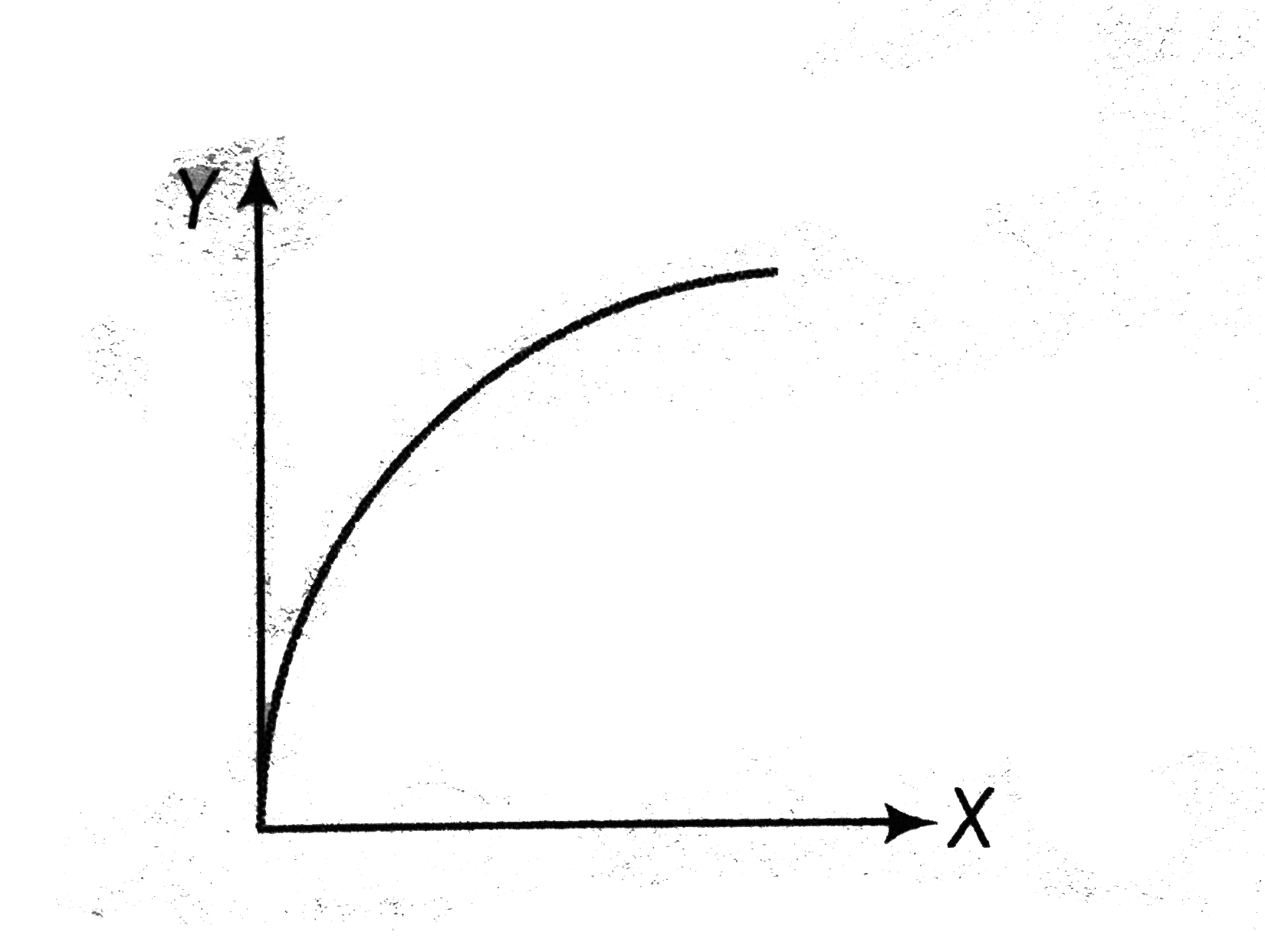
The graph shows the behaviour of a steel wire in the region for whoch the wire obeys Hooke's law. The graph is a parabola. The variables ` X` and `Y` -axes, respectively can be [ stress `(sigma)`,strain `( epsilon)` and elastic potential energy(U) ]

A

A) `U, sigma`

B

B) `U, epsilon`

C

C) `sigma, epsilon`

D

D) `None of these

Text Solution

Verified by Experts

The correct Answer is:

B

`U = 1/2 sigma epsilon =1/2(Y epsilon)epsilon`
`rArr U =1/2 Y epsilon^(2) ` is similar to x `= ky^(2)`
Which is a parabola passing through origin and symmetric about x-axis.
Promotional Banner

Topper's Solved these Questions

  • ELASTICITY

    DC PANDEY|Exercise Level 1 Subjective|8 Videos
  • ELASTICITY

    DC PANDEY|Exercise Level 2 Single Correct|10 Videos
  • ELASTICITY

    DC PANDEY|Exercise Assertion And Reason|22 Videos
  • CURRENT ELECTRICITY

    DC PANDEY|Exercise All Questions|434 Videos
  • ELECTROSTATICS

    DC PANDEY|Exercise Integer|17 Videos

Similar Questions

Explore conceptually related problems

The graph show the behaviour of a length of wire in the region for which the substances obeys Hooke's law. P and Q represent

The graph shows the behaviout of a length of wire in the region for which the substance obeys Hook's law. D and Q represent

The stress strain graph for a metal wire is as shown in the figure. In the graph, the region in which Hooke's law is obeyed, the ultimate strength and fracture are represented by

When a uniform metallic wire is stretched the lateral strain produced in it is beta .if sigma and Y are the Poisson's ratio and Young's modulus for wire, then elastic potential energy density of Wire is

Figure shows the relationship between tensile stress and strain for a typical material. Below proportional point A, stress is directly proportional to strain which means Young's moudulus (Y) is a constant. In this region the material obeys Hooke's law. Provided the strain is below the yield point 'B' the material returns to its original shape and size when the force is removed. Beyond the yield point, the material retains a permancnt deformation after the stress is removed. For stresses beyond the yeld point, the material exhibit plastic flow, which means that it continues to elongate for little increases in the stress. Beyond C a local constriction occurs. The material fractures at D (i.e. breaking point). The graph below shows the stress-strain curve for 4 different materials. Material which is good for making wires by stretching is

Figure shows the relationship between tensile stress and strain for a typical material. Below proportional point A, stress is directly proportional to strain which means Young's moudulus (Y) is a constant. In this region the material obeys Hooke's law. Provided the strain is below the yield point 'B' the material returns to its original shape and size when the force is removed. Beyond the yield point, the material retains a permancnt deformation after the stress is removed. For stresses beyond the yeld point, the material exhibit plastic flow, which means that it continues to elongate for little increases in the stress. Beyond C a local constriction occurs. The material fractures at D (i.e. breaking point). The graph below shows the stress-strain curve for 4 different materials. If you bough a new shoe which bites in the beginning and later on fits perfectly, then the material used to making the shoe is

Figure shows the relationship between tensile stress and strain for a typical material. Below proportional point A, stress is directly proportional to strain which means Young's moudulus (Y) is a constant. In this region the material obeys Hooke's law. Provided the strain is below the yield point 'B' the material returns to its original shape and size when the force is removed. Beyond the yield point, the material retains a permancnt deformation after the stress is removed. For stresses beyond the yeld point, the material exhibit plastic flow, which means that it continues to elongate for little increases in the stress. Beyond C a local constriction occurs. The material fractures at D (i.e. breaking point). The graph below shows the stress-strain curve for 4 different materials. Material which is most brittle is

The figure shows the y – x graph at an instant for a small amplitude transverse wave travelling on a stretched string. Three elements (1, 2 and 3) on the string have equal original lengths (= Deltax) . At the given instant- (i) which element (among 1, 2 and 3) has largest kinetic energy? (ii) which element has largest energy (i.e., sum of its kinetic and elastic potential energy) (iii) Prove that energy per unit length (DeltaE)/(Deltax) of the string is constant everywhere equal to T((del y)/(del x))^(2) where T is tension the string.

According to Hooke's law, within the elastic limit stress/strain = constant. This constant depends on the type of strain or the type of force acting. Tensile stress might result in compressional or elongative strain, however, a tangential stress can only cause a shearing strain. After crossing the elastic limit, the material undergoes elongation and beyond a stage beaks. All modulus of elasticity are basically constants for the materials under stress. If stress/strain is x in elastic region and y in the region of yield, then
