Home
Class 11
PHYSICS
A body of mass 3.14 kg is suspended from...

A body of mass `3.14 kg` is suspended from one end of a wire of length `10 m`. The radius of cross-section of the wire is changing uniformly from `5xx10^(-4) m` at the top (i.e. point of suspension) to `9.8xx10^(-4) m` at the bottom . Young's modulus of elasticity is `2xx10^(11) N//m^(2)`. The change in length of the wire is

A

`4xx10^(-3) m`

B

`3xx10^(-3) m`

C

`10^(-3) m `

D

`2xx10^(-3) m `

Text Solution

Verified by Experts

The correct Answer is:
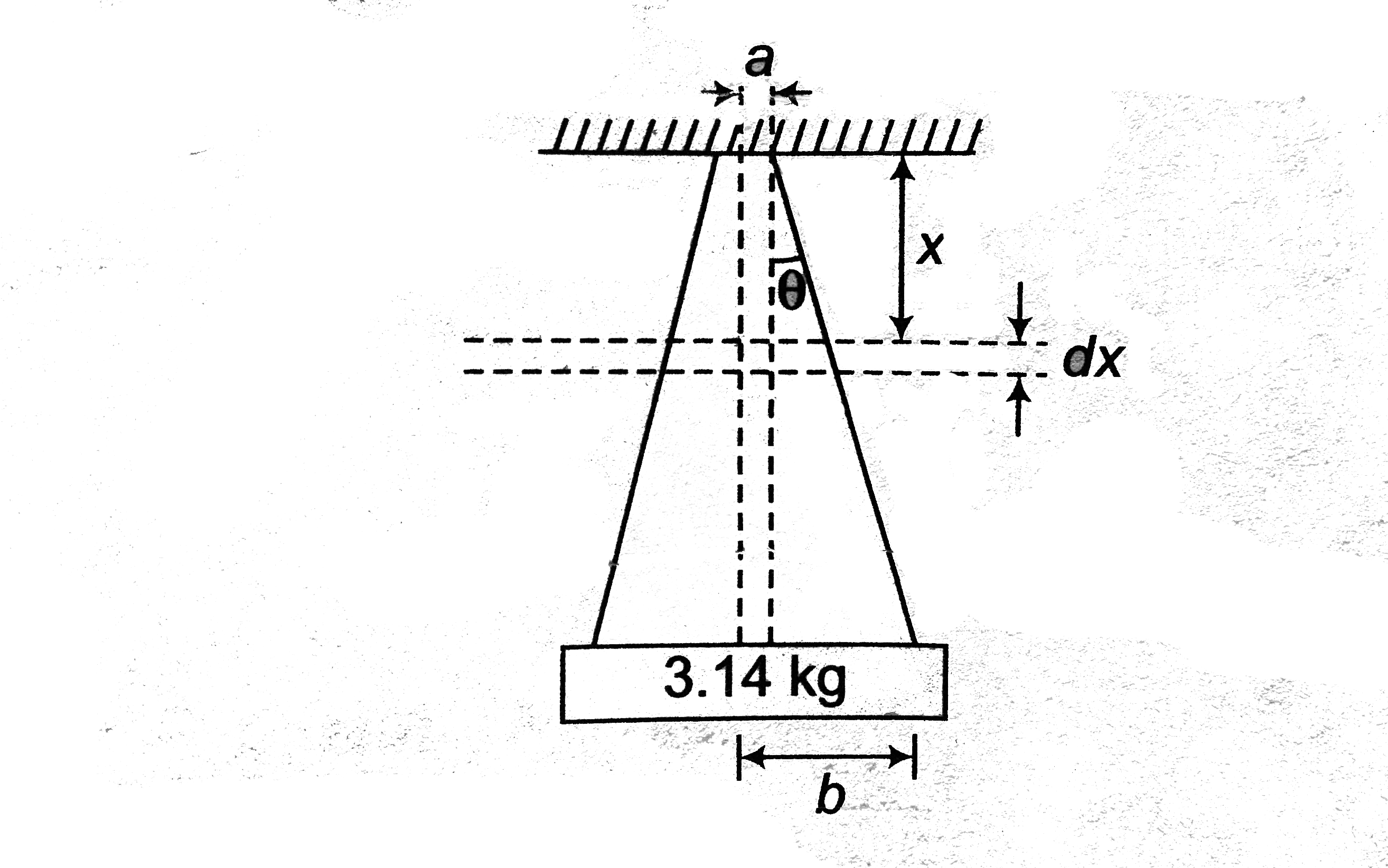
C

Change in length of element is
Cross-sectional area of the element is
`A = pi[a+(b-a)/Lx]^(2)`
Where , ` a =( b-a)/(L)x` is radius of the wire at the location of element .
`d(Deltal) = F/(pi[a+(b-a)/Lx]^(2)Y )dx`
Total change in length of wire is
`Deltal = F/(piY) int_(o)^(L) 1/(a+(b-a)/Lx)^(2)dx`
Let `a+(b-a)/Lx =t`
`rArr (b-a)/Ldx =dt rArr dx = (L)/(b-a)dt`
When `x=o` , `t =a` and when `x= L , t = b`
`:. Deltal = (F)/(piY) int_(a)^(b) t^(-2).(L )/(b-a)dt`
`= (FL)/(piY(b-a))(-1)(1/b-1/a)`
` = (FL)/(piY(b-a)).(b-a)/(ab)= (FL)/piYab`
`= ((3.14)(9.8)(10))/((3.14)(2xx10^(11))(5xx10^(-4))(9.8xx10^(-4))`
`= 10^(-3) m rArr :. DeltaL = 10^(-3) m`
Promotional Banner

Topper's Solved these Questions

  • ELASTICITY

    DC PANDEY|Exercise Level 1 Subjective|8 Videos
  • ELASTICITY

    DC PANDEY|Exercise Level 2 Single Correct|10 Videos
  • ELASTICITY

    DC PANDEY|Exercise Assertion And Reason|22 Videos
  • CURRENT ELECTRICITY

    DC PANDEY|Exercise All Questions|434 Videos
  • ELECTROSTATICS

    DC PANDEY|Exercise Integer|17 Videos

Similar Questions

Explore conceptually related problems

A body of mass 3.14 kg is suspended from one end of a non uniform wire of length 10m, such that the radius of the wire is changing uniformly from 9.8xx10^(-4) m at one end to 5xx10^(-4) m at the other end. Find the change in length of the wire in mm. Young's modulus of the material of the wire is 2xx10^(11)N//m^(2) (mass of wire is negligible)

A body of mass 6.28 kg is suspended from one end of a wire of length 10 m. The radius of the wire is changing uniformly from 19.6xx10^-4m at one end to 10 xx 10^-4 m at the order end. Find the change in the length of the wire. [Y=2xx10^11N//m^2]

A wire of area of cross section 1xx10^(-6)m^(2) and length 2 m is stretched through 0.1 xx 10^(-3)m . If the Young's modulus of a wire is 2xx10^(11)N//m^(2) , then the work done to stretch the wire will be

An iron wire of length 4 m and diameter 2 mm is loaded with a weight of 8 kg. if the Young's modulus Y for iron is 2xx10^(11)N//m^(2) then the increase in the length of the wire is

A block of mass M is suspended from a wire of length L, area of cross-section A and Young's modulus Y. The elastic potential energy stored in the wire is

A steel wire of length 3.0m is stretched through 3.0 mm. the cross-sectional area of the wire is 5.0mm^(2) . Calculate the elastic potential energy stroed in the wire in the stretched condition. Young's modulus of steel is 2.0 xx 10^(11) Nm^(-2) .

A copper wire of length 4.0 mm and area of cross-section 1.2 cm^(2) is stretched with a force of 4.8 xx 10^(3) N. If Young's modulus for copper is 1.2xx10^(11) N//m^(2) , the increases in the length of the wire will be

A wire of density 9xx10^3 kg//m^3 is stretched between two clamps 1 m apart and is stretched to an extension of 4.9xx10^-4 metre.Young's modulus of material is 9xx10^10 N//m^2 .Then

A steal wire of cross-section area 3xx10^(-6) m^(2) can withstand a maximum strain of 10^(-3) .Young's modulus of steel is 2xx10^(11) Nm^(-2) .The maximum mass this wire can hold is

