Home
Class 11
PHYSICS
Three waves from three coherent sources ...

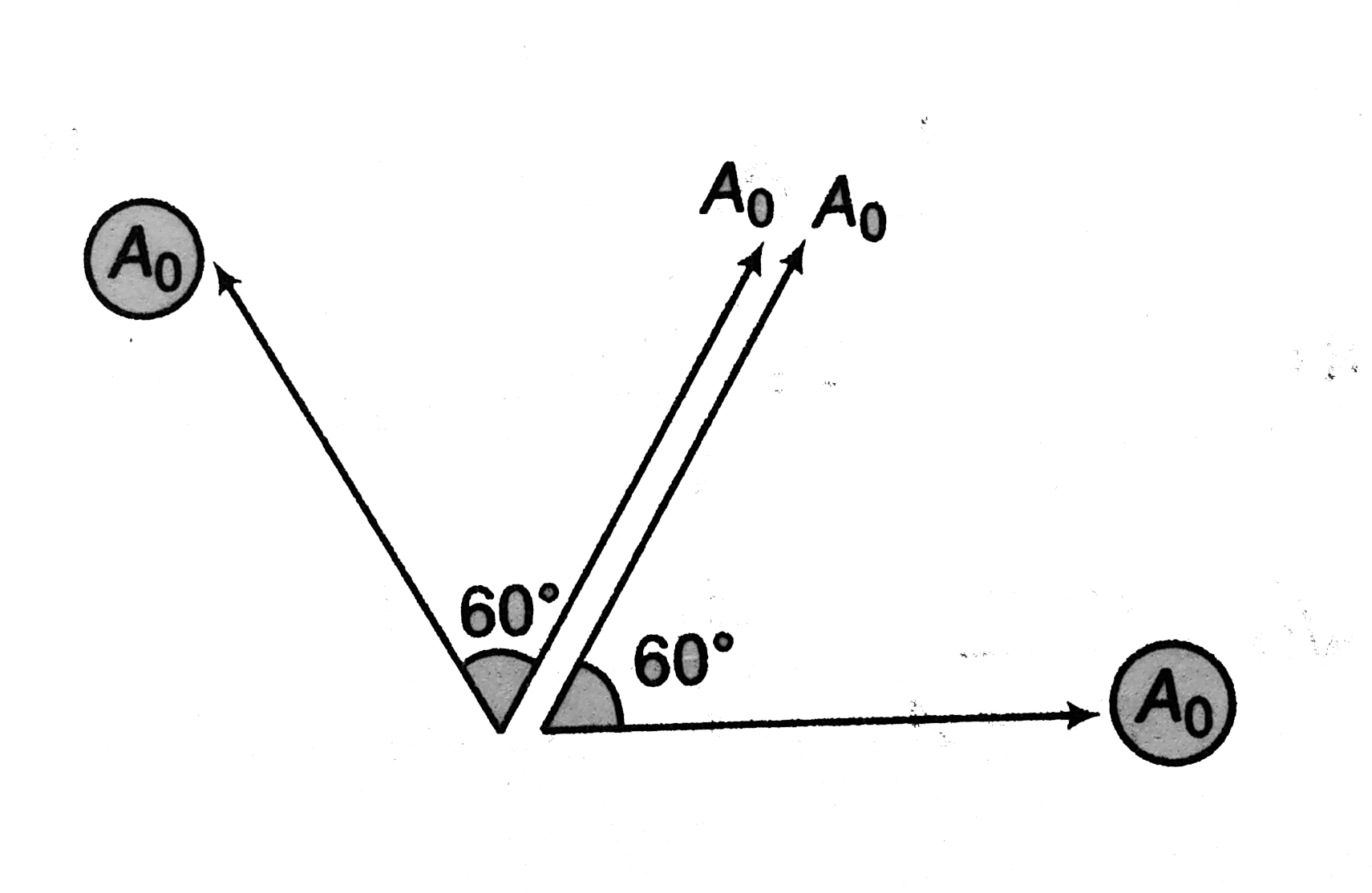
Three waves from three coherent sources meet at some point. Resultant amplitude of each is `A_0`. Intensity corresponding to `A_0 is I_0`. Phase difference between first wave and second wave is `60^@`. Path difference between first wave and third wave is `lambda/3`. The first wave lags behind in phase angle from second and third wave. Find resultant intensity at this point.

Text Solution

Verified by Experts

The correct Answer is:
D

Here, the sources are three. So, we don't have any direct formula for finding the resultant intensity. First we will find the resultant amplitude by vector method and then by the relation `I prop A^2`, we can also find the resulting intensity.
Further, a path difference of `lambda/3` is equivalent to phase difference of `120^@(Delta phi or phi = (2pi)/lambda. Delta x).
Hence, the phase difference first and second is `60^(@)` and between first and third is `120^(@)`. So, vector diagram for amplitude is as shown below.
` (##DCP_V03_C18_S01_002_S01.png" width="80%">
Now, resultant of first and third acting at `120^(@)` is also `A_0` (as `A=2A_(0) (cos) phi/2 and phi=120^@`) and
since the first and third are equal, so this resultant `A_(0)` passes through the bisector line of these two or in the direction of second amplitude vector. Therefore, the resultant amplitude is
`A= A_0 + A_0 = 2A_0`
and the resultant intensity is
`I=4I_0` (as `I prop A^2`).
Promotional Banner

Topper's Solved these Questions

  • SUPERPOSITION OF WAVES

    DC PANDEY|Exercise Example Type 1|1 Videos
  • SUPERPOSITION OF WAVES

    DC PANDEY|Exercise Example Type 2|1 Videos
  • SOUND WAVES

    DC PANDEY|Exercise Exercise 19.7|4 Videos
  • THERMOMETRY THERMAL EXPANSION AND KINETIC THEORY OF GASES

    DC PANDEY|Exercise Medical entrance gallary|30 Videos

Similar Questions

Explore conceptually related problems

Three waves from three coherent sources meet at some point . Resultant amplitude of each is A_0 . Intensity corresponding to A_0 is I_0 . Phase difference between first wave and the second wave is 60^@ . Path difference between first wave and the third wave is lambda/3. The first wave lags behind in phase angle from second and the third wave. Find resultant intensity at this point.

Three waves due to three coherent sources meet at one point. Their amplitudes are sqrt2A_0 , 3A_0 and sqrt2A_0 . Intensity corresponding to A_0 is l_0 . Phasse difference between first and second is 45^@ . Path difference between first and third is lambda/4 . In phase angle, first wave lags behind from the other two waves. Find resultant intensity at this point.

In interference, two individual amplitudes are A_0 each and the intensity is I_0 each. Find resultant amplitude and intensity at a point, where: (a) phase difference between two waves is 60^@ . (b) path difference between two waves is lambda/3 .

The path difference between two waves meeting at a point is (11//4)lamda . The phase difference between the two waves is…

In interference, two individual amplitudes are A_(0) each and the intensity is I_(0) each. Find resultant amplitude and intensity at a point, where (a) phase difference between two waves is 60^(@) . (b) path difference between two waves is lambda/3 .

For minimum intensity the phase difference between the two waves is

Two coherent waves of intensities I and 4I interfere at a point. If the resultant intensity is 3I, then the phase difference between te two waves at the point is

Two sound waves travel in the same direction in a medium. The amplitude of each wave is A and the phase difference between the two waves is 120^(@) . The resultant amplitude will be

Light waves of wavelength 5460 A, emitted by two coherent sources, meet at a point after travelling different paths. The path difference between the two wave trains at that point is 2.1 mum . then phase difference will be ?

What is the phase difference corresponding to path difference lambda of two waves reaching a point ?

