Home
Class 11
PHYSICS
Two waves are travelling in same directi...

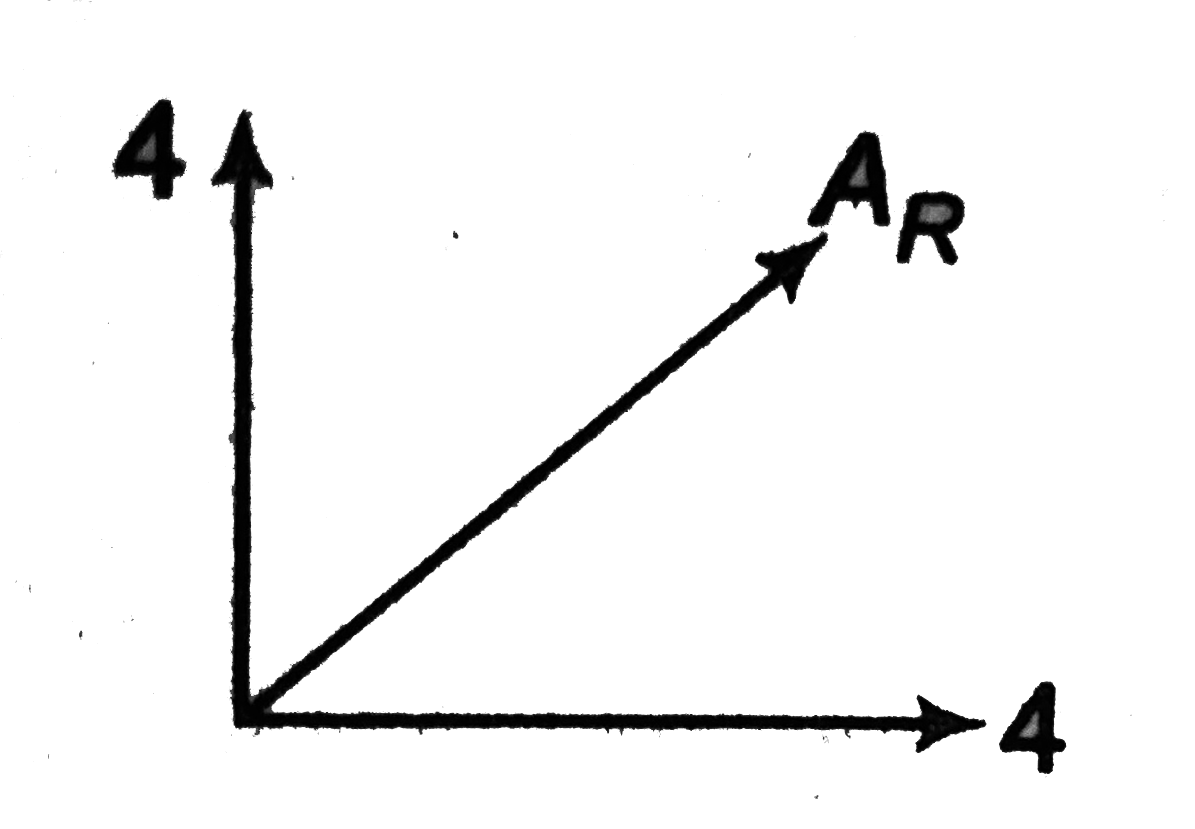
Two waves are travelling in same direction along a stretched string. The waves are `90^@` out of phase. Each wave has an amplitude of 4.0 cm. Find the amplitude of the resultant wave.

Text Solution

Verified by Experts

The correct Answer is:
C

`A_(R) = 4(sqrt2) cm `
`=5.66 cm`
Promotional Banner

Topper's Solved these Questions

  • SUPERPOSITION OF WAVES

    DC PANDEY|Exercise Subjective Questions|6 Videos
  • SUPERPOSITION OF WAVES

    DC PANDEY|Exercise Level 2 Single Correct|15 Videos
  • SUPERPOSITION OF WAVES

    DC PANDEY|Exercise Objective Questions|1 Videos
  • SOUND WAVES

    DC PANDEY|Exercise Exercise 19.7|4 Videos
  • THERMOMETRY THERMAL EXPANSION AND KINETIC THEORY OF GASES

    DC PANDEY|Exercise Medical entrance gallary|30 Videos

Similar Questions

Explore conceptually related problems

Two sinusoidal waves of the same period, with amplitudes of 5.0 and 7.0 mm, travel in the same direction along a stretched string, they produce a resultant wave with an amplitude of 10.0 mm. The phase constant of the 5.0mm wave is 0. What is the phase constant of the 7.0mm wave?

Two waves, each having a frequency of 100 Hz and a wavelength of 2 cm , are travelling in the same direction on a string. What is the phase difference between the wayes (a) if the second wave was produced 10 m sec later than the first one at the same place (b) if the two waves were produced at a distance 1 cm behind in the second one? (c) if each of the wave has an amplitude of 2.0 mm , what would be the amplitude of the resultant waves in part (a) and (b) ?

Two waves, travelling in the same direction through the same region, have equal frequencies, wavelengths and amplitudes. If the amplitude of each wave is 4 mm and the phase difference between the waves is 90^@ , what is the resultant amplitude ?

Two waves, each having a frequency of 100 Hz and a wavelength of 2.0 cm, are travelling in the same direction on a string. What is the phase difference between the waves (a) if the second wave was produced 0.015 s later than the first one at the same place, (b) if the two waves were produced at the same instant but the first one was produced a distance 4.0 cm behind the second one ? (c) If each of the waves has an amplitude of 2.0 mm, what would be the amplitudes of the resultant waves in part (a) and (b) ?

Two identical sinusoidal waves, moving in same direction along a stretched string, interfere, with each other. The amplitude of each wave is 10.0mm, and the phase difference between them is 80^(@) . What is the amplitude of the resultant wave and the nature of interference ?

Two sinusoidal waves of the same frequency travel in the same direction along a string. If A_(1) =m 3.0 cm, A_(2) = 4.0 cm, phi_(1) = 0 , and phi_(2) = pi//2 rad , what is the amplitude of the resultant wave ?

Two identical sinusoidal waves, moving in the same direction along a stretched string, interfere with each other. The amplitude y of each wave is 9.8 mm, and the phase difference p between them is 100^@. (a) What is the amplitude y. of the resultant wave due to the interference, and what is the type of this interference? (b) What phase difference, in radians and wavelengths, will give the resultant wave an amplitude of 4.9 mm?

Two sinusoidal waves of the same frequency travel in the same direction along a string. If y_(m1) =2.0 cm, y_(m2)=4.0cm , phi_(1)=0, and phi_(2)=pi//2 rad , what is the amplitude of the resultant wave?

DC PANDEY-SUPERPOSITION OF WAVES-Level 1 Subjective
  1. Two waves are travelling in same direction along a stretched string. ...

    Text Solution

    |

  2. Two wires of different densities are soldered together end to end then...

    Text Solution

    |

  3. A wave is represented by y1 = 10 cos (5x + 25 t) where, x is measu...

    Text Solution

    |

  4. Two waves passing through a region are represented by y=(1.0cm) sin [(...

    Text Solution

    |

  5. A string of length 20 cm and linear mass density 0.40 g//cm is fixed a...

    Text Solution

    |

  6. A wave pulse on a string has the dimensions shown in figure. The wave ...

    Text Solution

    |

  7. Two sinusoidal waves combining in a medium are described by the equati...

    Text Solution

    |

  8. A standing wave is formed by the interference of two travelling waves...

    Text Solution

    |

  9. Find the fundamental frequency and the next three frequencies that cou...

    Text Solution

    |

  10. A string vibrates in its first normal mode with a frequency of 220 vib...

    Text Solution

    |

  11. A 60.0 cm guitar string under a tension of 50.0 N has a mass per unit ...

    Text Solution

    |

  12. A wire having a linear density of 0.05 g//cmis stretched between two r...

    Text Solution

    |

  13. The vibrations from an 800 Hz tuning fork set up standing waves in a s...

    Text Solution

    |

  14. A string vibrates in 4 segments to a frequency of 400 Hz. (a) What i...

    Text Solution

    |

  15. A sonometer wire has a total length of 1m between the fixed ends. Wher...

    Text Solution

    |

  16. A guitar string is 90 cm long and has a fundamental frequency of 124 H...

    Text Solution

    |

  17. Adjacent antinodes of a standing wave on a string are 15.0 cm apart. A...

    Text Solution

    |

  18. A 1.50 m long rope is stretched between two supports with a tension th...

    Text Solution

    |

  19. A wire with mass 40.0 g is stretched so that its ends are tied down at...

    Text Solution

    |

  20. Two harmonic waves are represented in SI units by y1(x,t) = 0.2 sin ...

    Text Solution

    |

