Home
Class 11
PHYSICS
Two coherent narrow slits emitting sound...

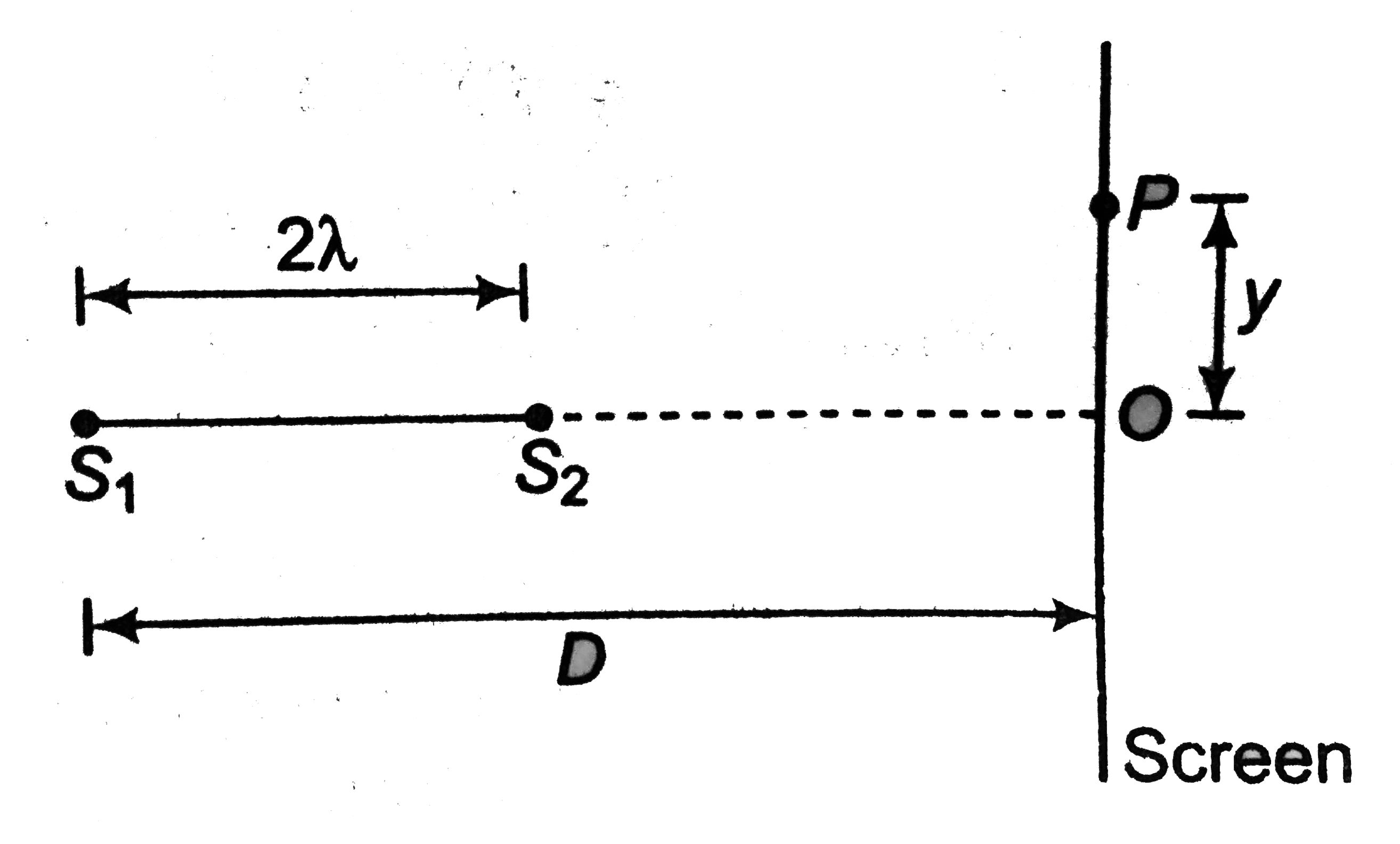
Two coherent narrow slits emitting sound of wavelength `lambda` in the same phase are placed parallet to each other at a small separation of `2 lambda` . The sound is delected by maving a delector on the screen at a distance `D(gt gt lambda)` from the slit `S_(1)` as shows in figure. Find the distance `y` such that the intensity at `P` is equal to intensity at `O` .

Text Solution

Verified by Experts

The correct Answer is:
C, D

At point `O` on the screen the path difference between the sound waves reaching from `S_(1)` and `S_(1)` is `2 lambda` , i.e. constructive interference is obtained at `O` . At a very large distance from point `O` on the screen the path difference is zero.

Thus, we can conlude that as we move away from point `O` on the screen path difference decrease from `2 lambda` at zero. At `O` constructive interference is obtained (where `Deltax = 2 lambda`) . So, next constructive interference will be obtained where `Delta x = lambda` . Hence,
`S_(1)P - S_(2)P = lambda`
or `sqrt(D^(2) +y^(2))- sqrt(y^(2) +(D - 2 lambda)^(2))= lambda`
`:. sqrt(D^(2) +y^(2))- lambda= sqrt(y^(2) +(D - 2 lambda)^(2))`
On squaring both sides, we get
`D^(2) + y^(2)+ lambda^(2) - 2lambda sqrt(D^(2) +y^(2))=y_(2) + D^(2)+4lambda^(2)- 4lambda D`
`:. 2sqrt(D^(2)+ y^(2))=4D- 3lambda`
as `Dgt gtlambda` , `4D- 3lambda~~4D`
`:. 2sqrt (D^(2)+ y^(2))=4D`
or `sqrt(D^(2)+ y^(2))=2D`
Again squaring both sides, we get
`D^(2) + y^(2) = 4D^(2)`
or `y= sqrt((3))D`
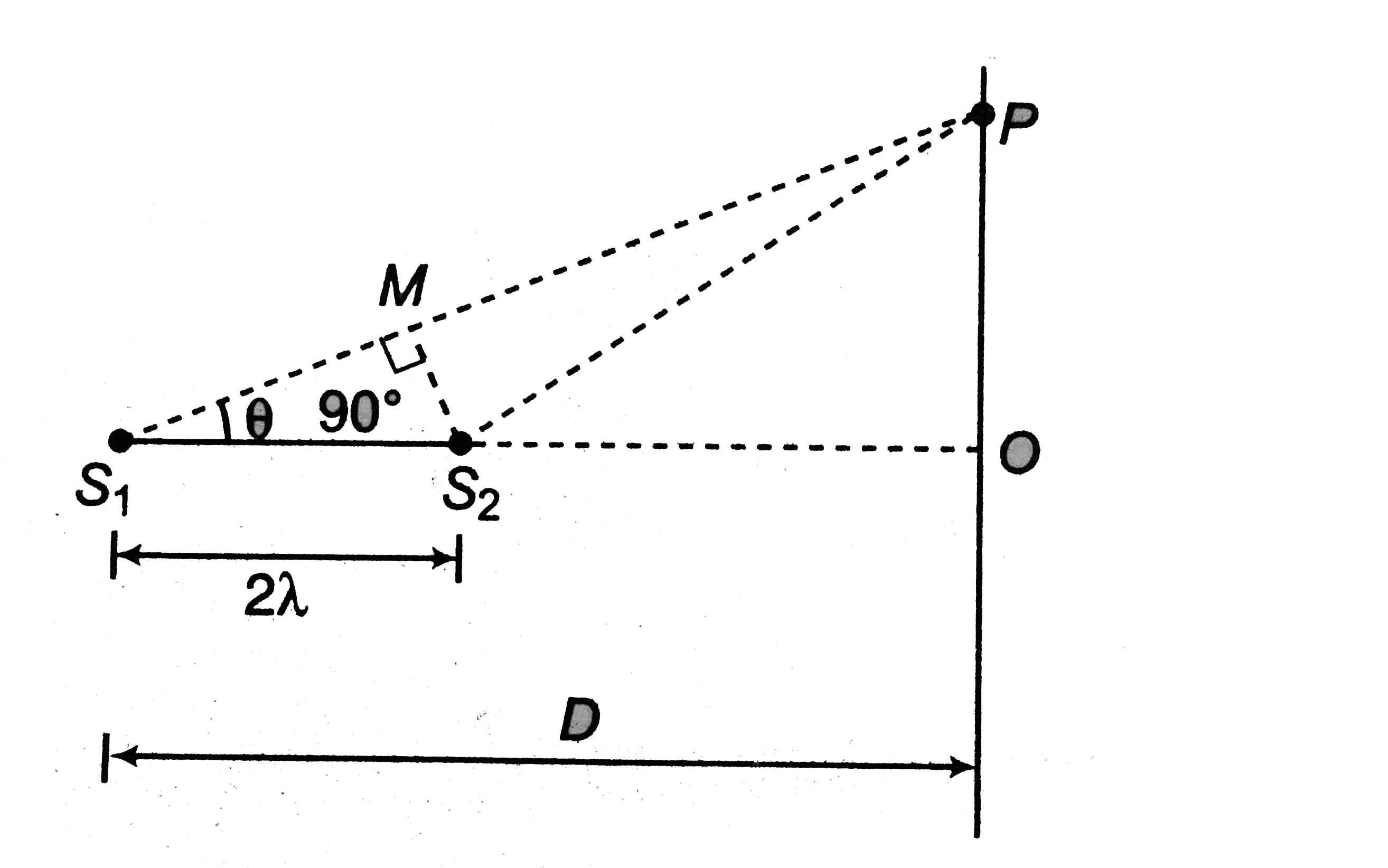
Let `Deltax = lambda` at angle theta as shows . Path difference between the waves is `S_(1)M = 2lambda cos theta` because `S_(2)P ~~ MP`
:. `2lambda cos theta = lambda`
or `theta = 60^(@) (Deltax = lambda)`
Now, `PO= S_(1)O tan theta = S_(1) O tan 60^(@)`
or `y= sqrt((3))D`
Promotional Banner

Topper's Solved these Questions

  • SOUND WAVES

    DC PANDEY|Exercise Level 1 Assertion And Reason|10 Videos
  • SOUND WAVES

    DC PANDEY|Exercise Level 1 Objective|34 Videos
  • SOUND WAVES

    DC PANDEY|Exercise TYPE 5.|2 Videos
  • SOLVD PAPERS 2017 NEET, AIIMS & JIPMER

    DC PANDEY|Exercise Solved paper 2018(JIPMER)|38 Videos
  • SUPERPOSITION OF WAVES

    DC PANDEY|Exercise Level 2 Subjective|8 Videos

Similar Questions

Explore conceptually related problems

Two coherent narrow slits emitting light of wavelength lambda in the same phase are placed parallel to each other at a small separation of 2lambda . The light is collected on a screen S which is placed at a distance D(gtgt lambda ) from the slit S_1 as shown in figure. Find the finite distance x such that the intensity at P is equal to intensity O. .

Two coherent narrow slits emitting light of wavelength lamda in the same phase are placed parallel to each other at a small separation of 3lamda the light is collected on a screen S which is placed at a distance D(gt gt lamda) from the slits the smallest distance x such that the P is a maxima.

Two coherent point sources S_1 and S_2 vibrating in phase emit light of wavelength lamda . The separation between them is 2lamda . The light is collected on a screen placed at a distance Dgt gt lamda from the slit S_1 as shown. The minimum distance, so that intensity at P is equal to the intensity at O

Two coherent sources A & B emitting light of wavelength lambda are placed at position (-D,0) and (-D,3lambda) respectively Here D gt gt lambda The number of minima on y-axis and maxima on x-axis respectively are

Consider two coherent, monochromatic (wavelength lambda ) sources S_(1) and S_(2) , separated by a distance d. The ratio of intensities of S_(1) and that of S_(2) (which is responsible for interference at point P, where detector is located) is 4. The distance of point P from S_(1) is (if the resultant intensity at point P is equal to (9)/(4) times of intensity of S_(1) ) ("Given : "angleS_(2)S_(1)P=90^(@), d gt0 and n" is a positive integer")

While conduction the Young's double slit experiment, a student replaced the two slits with a large opaque plate in the x-y plane containing two small holes that act as two coherent point sources (S_(1),S_(2)) emitting light of wavelength 600nm. The student mistakenly placed the screen parallel to the x-z plane (for zgt0) at a distance D=3 m from the mid-point of S_(1) , S_(2) , as shown schematically in the figure. The distance between the sources d=0.6003 mm . The origin O is at the intersection of the screen and the line joining S_(1)S_(2) . Which of the following is (are) true of the intensity pattern of the screen?

