Home
Class 11
PHYSICS
(p - V) diagram of (n) moles of an ideal...

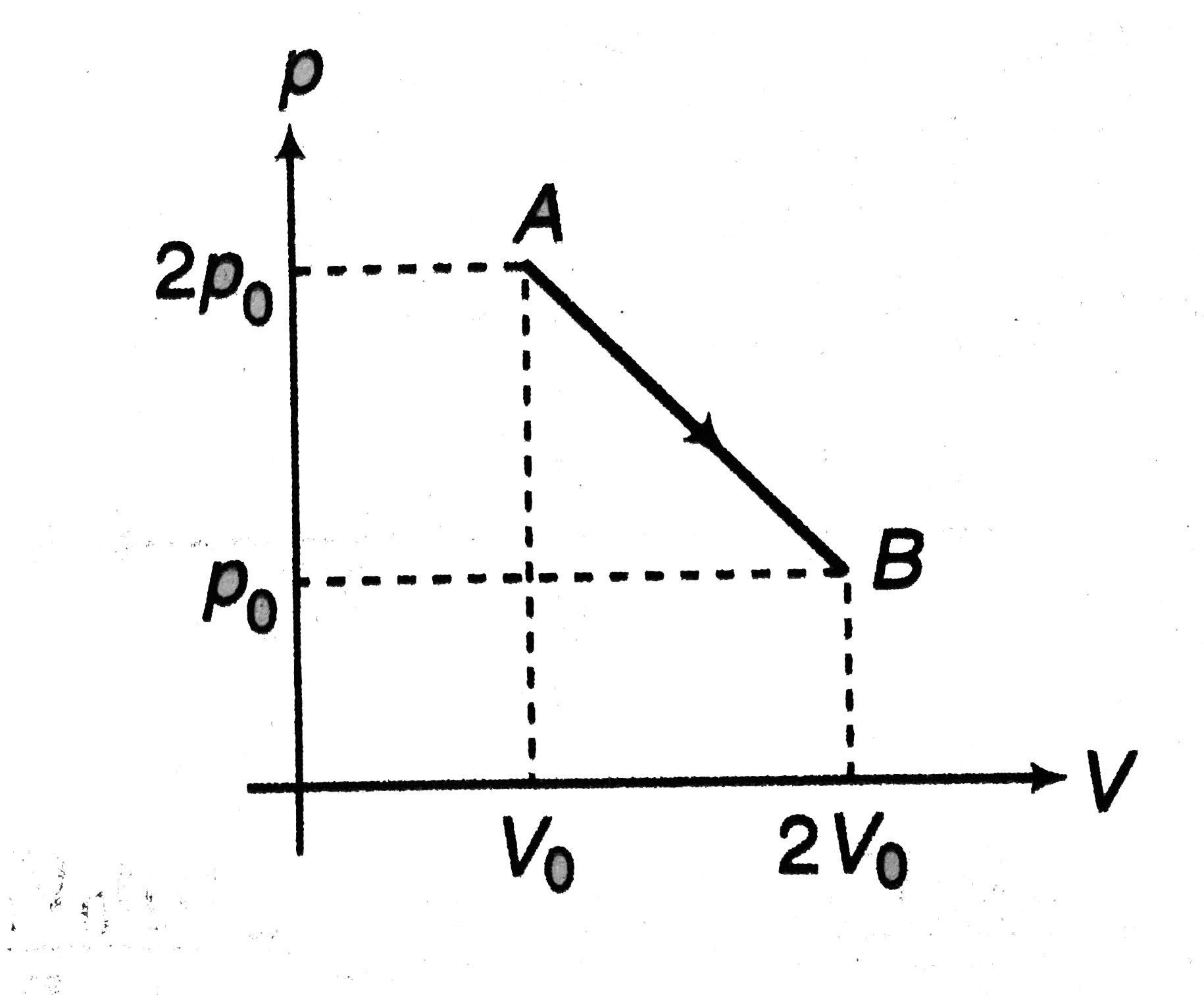
(p - V) diagram of (n) moles of an ideal gas is as shown in figure. Find the maximum temperature between (A) and (B).
.
How to proceed For given number of moles of a gas,
` T prop pV (p V = nRT)`
Although `(p V)_A = (p V)_B = 2p_0 V_0 or T_A = T_B`, yet it is not an isothermal process. Because in isothermal process (p- V) graph is a rectangular hyperbola while it is a straight line. So, to see the behaviour of temperature, First we will find either (T - V) equation or (T _ p) equation and from that equation we can judge how the temperature baries. From the graph, first we will write )p V) equation, then we will convert it either in (T - V) equation or in (T - p) quation with the help of equation, (pV = nRT).

Text Solution

Verified by Experts

The correct Answer is:

A, D

From the graph the (p - V) equation can be written as
`p = -((p_0)/(V_0))V + 3 P_0` `(y = -mx + c)`
or `pV = -((p_0)/(V_0))V^2 + 3 p_0 V`
or `n R T = 3 p_0 V -((p_0)/(V_0))V^2` ( as pV =nRT)
or `T = 1/(nR)[3 p _0V - ((p_0)/V_0)V^2]`
This is the required (T - V) equation. This is quadratic in (V). Hence, (T - V) graph is a parabola. now, to find maximum or minimum value of (T), we can substitute.
`(dT)/(dV) = 0`
or `3 p_0 -((2 p_0)/(V_0))V = 0 or V = 3/2 V_0`
Further `(d^2 T)/(dV^2)` is negative at ` V = 3/2 v_0`.
Hence, (t) is maximum at `v = 3/2 v_0` and this maximum value is
`T_(max) = 1/(n R)[(3 p_0)((3 V_0)/2)-((p_0)/(V_0))((3 V_0)/2)^2]`
or `T_(max) = (9 p_0 V_0)/(4 n R)`
Thus, (T - V) graph is as shown in figure.(##DCP_V03_C20_S01_031_S01##).
`T_A = T_B = (2 p_0 V_0)/(n R) and T_(max) =(9 p_0 V_0)/(4 n R)`
= `2.25 (p_0 V_0)/(n R)`.
Promotional Banner

Topper's Solved these Questions

  • THERMOMETRY,THERMAL EXPANSION & KINETIC THEORY OF GASES

    DC PANDEY|Exercise Exercise 20.1|5 Videos
  • THERMOMETRY,THERMAL EXPANSION & KINETIC THEORY OF GASES

    DC PANDEY|Exercise Exercise 20.2|7 Videos
  • THERMOMETRY,THERMAL EXPANSION & KINETIC THEORY OF GASES

    DC PANDEY|Exercise Example Type 3|2 Videos
  • THERMOMETRY THERMAL EXPANSION AND KINETIC THEORY OF GASES

    DC PANDEY|Exercise Medical entrance gallary|30 Videos
  • UNIT AND DIMENSIONS

    DC PANDEY|Exercise Assertion And Reason|2 Videos

Similar Questions

Explore conceptually related problems

One mole of a gas expands obeying the relation as shown in the P/V diagram. The maximum temperature in this process is equal to

n' moles of an ideal gas undergoes a process A to B as shown in the figure. The maximum temperature of the gas during the process will is (p_(0)v_(0))/(4nR) then value of N is:

Consider p - V diagram for an ideal gas shown in figure. Out of the following diagrams, which figure represents the T-p diagram ? (i)

Consider P-V diagram for an ideal gas shown in figure. Out of following diagrams(figure). Which represents the T-P diagram?

1 mole of an ideal gas in a cylindrical container have the P-V diagram as shown in figure.If V_(2)=4V_(1) then the ratio of temperatures (T_(1))/(T_(2)) will be

Straight line on (p - T) graph for an ideal gas represents isochoric process. If p prop T, V = constant .

One mole of an ideal gas undergoes a process P=P_(0)-alphaV^(2) where alpha and P_(0) are positive constant and V is the volume of one mole of gas Q. The maximum attainable temperature is

The curves A and B in the figure shown P-V graphs for an isothermal and an adiabatic process for an idea gas. The isothermal process is represented by the curve A.

One mole of a monoatomic ideal gas undergoes process AB in given P – V diagram then average specific heat for this process is:
