Home
Class 11
PHYSICS
Two plates eachb of area A, thickness L1...

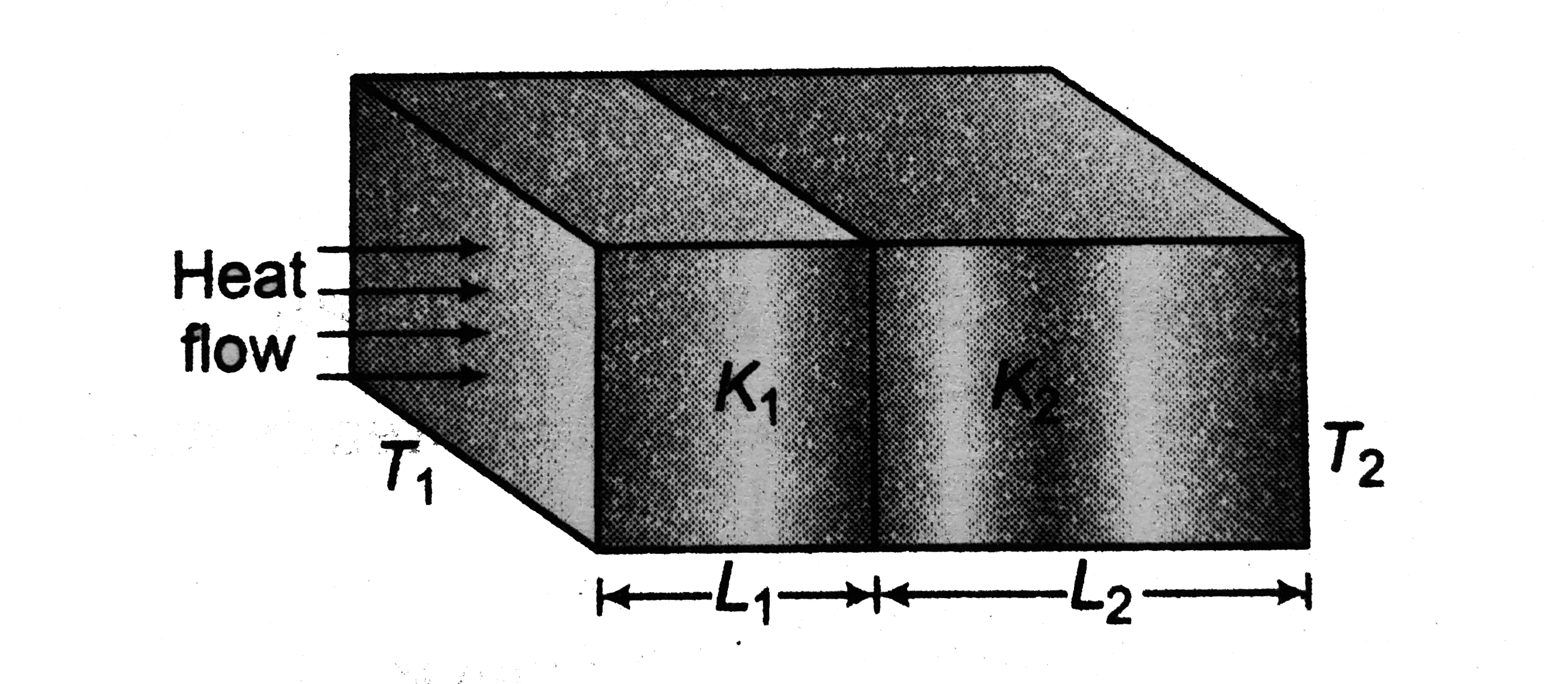
Two plates eachb of area A, thickness `L_1 and L_2` thermal conductivities `K_1 and K_2` respectively are joined to form a single plate of thickness `(L_1+L_2)`. If the temperatures of the free surfaces are `T_1 and T_2`. Calculate.

(a) rate of flow of heat
(b) temperature of interface and
(c) equivalent thermal conductivity.

Text Solution

Verified by Experts

The correct Answer is:

A, B

(a) If the thermal resistance of the two plates are `R_1 and R_2` respectively. Plates are
in series.
`R_s = R_1 + R_2 = (L_1/(AK_1)) + (L_2/(AK_2))`
as `R = L/(KA)`
and so `H = (dQ)/(dt) = (DeltaT)/R`
`= ((T_1-T_2)/(R_1+R_2)) = (A(T_1 -T_2))/[(L_1/K_1) + (L_2/K_2)]`
(b) If T is the common temperature of interface, then as in series rate of flow of heat remains
same, i.e. `H = H_1 (=H_2)`
`((T_1 - T_2)/(R_1 + R_2)) = (T_1 - T)/R_1`
i.e. `T = ((T_1R_2 + T_2R_2)/(R_1 + R_2))`
or ` T = ( [T_1 L_2/K_2] + T_2[L_1/K_1])/([L_1/K_1 + L_2/K_2] ) (as R = L/(KA))`
(c) If K is the equivalent conductivity of composite slab, i.e. slab of thickness `L_1 + L_2` and cross - sectional area A, then as in series.
`R_S = R_1 + R_2 or (L_1+L_2)/(AK_(eq)) = R_1 + R_2`
i.e. `K_(eq) = (L_1 + L_2)/(A(R_1 + R_2)) = (L_1 + L_2)/([L_1/K_1 + L_2/K_2])` (as `R = L/(KA)` ).
Promotional Banner

Topper's Solved these Questions

  • CALORIMETRY & HEAT TRANSFER

    DC PANDEY|Exercise Exercise 22.1|7 Videos
  • CALORIMETRY & HEAT TRANSFER

    DC PANDEY|Exercise Exercise 22.2|7 Videos
  • CALORIMETRY & HEAT TRANSFER

    DC PANDEY|Exercise Example Type 4|4 Videos
  • BASIC MATHEMATICS

    DC PANDEY|Exercise Exercise|13 Videos
  • CALORIMETRY AND HEAT TRANSFER

    DC PANDEY|Exercise Medical entrance s gallery|38 Videos

Similar Questions

Explore conceptually related problems

Two plates each of area A thickness L_(1) and L_(2) thermal conductivities K_(1) and K_(2) respectively are joined to from a single plate of thickness (L_(1)+L_(2)) If the temperatures of the free surfaces are theta_(1) and theta_(2) Calculate (a) Rate of flow of heat (b) Temperature of interface .

Two walls of thicknes l_(1) and l_(2) and ther-mal condctivities K_(1) and K_(2) are in contact In the steady state, if the temperature at the outer faces are T_(1) and T_(2) find the temperature at the common wall .

Two materials having coefficients of thermal conductivity ‘3 K’ and ‘K’ and thickness ‘d’ and ‘3 d’, respectively, are joined to form a slab as shown in the figure. The temperatures of the outer surfaces are theta_(2) and theta_(1) respectively, (theta_(2) gt theta_(1)) The temperature at the interface is:

If two conducting slabs of thickness d_1 and d_2 , and thermal conductivity K_1 and K_2 are placed together face to face as shown in figure in the steady state temperature of outer surfaces are theta_1 and theta_2 . The temperature of common surface is-

Two walls of thickness d and d and thermal conductivities k and k are in contact. In the steady state, if the temperature at the outer T_(1) and T_(2) , the temperature at the common wall is

If two metallic plates of equal thickness and thermal conductivities K_(1) and K_(2) are put together face to face and a common plate is constructed, then the equivalent thermal conductivity of this plate will be

If layer thickness L_(2) is 1.4 cm , then its thermal conductivity K_(2) will have value ("in " W//mK)

Two identical plates with thermal conductivities K and 3K are joined together to form a single plate of double thickness. The equivalent thermal conductivity of one composite plate so formed for the flow of heat through its thickness is.
