Home
Class 11
PHYSICS
Three rods of material x and three of ma...

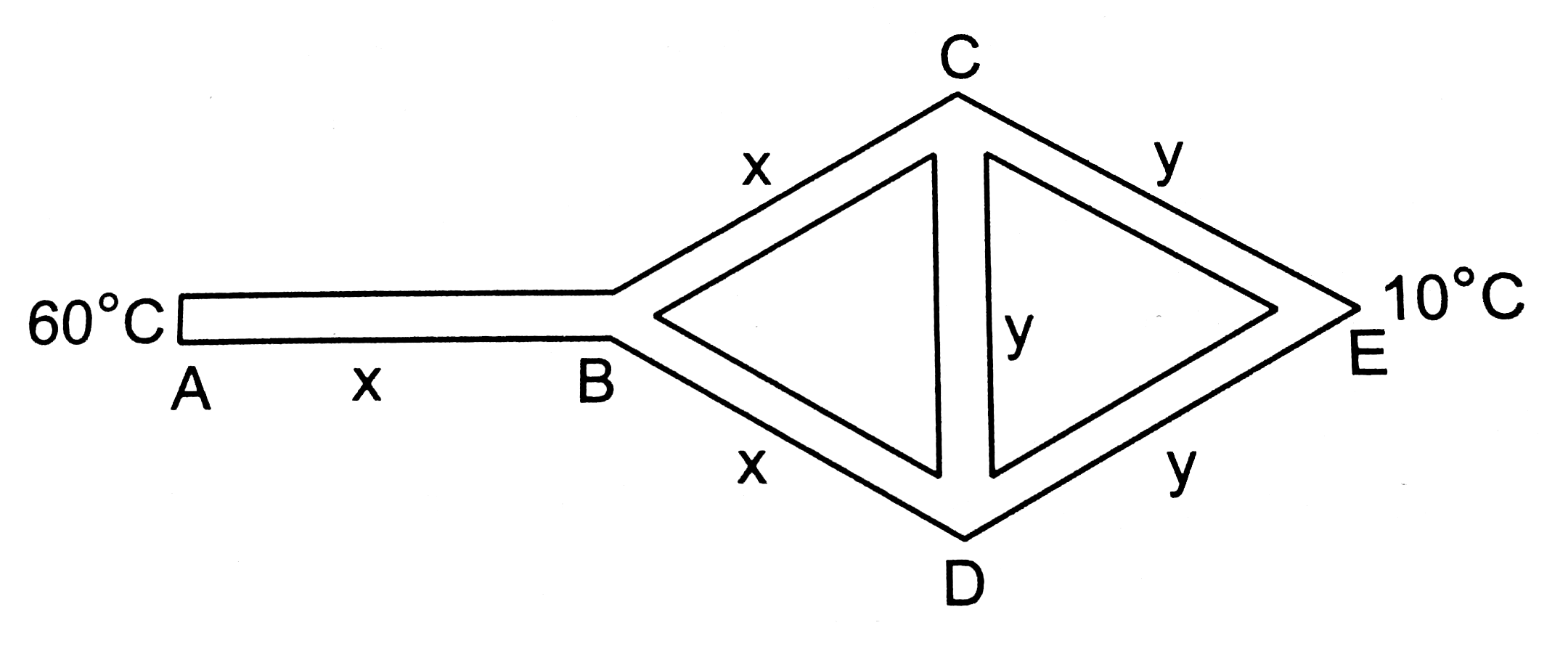
Three rods of material `x` and three of material `y` are connected as shown in figure. All the rods are identical in length and cross sectional area. If the end `A` is maintained at `60^(@)C` and the junction `E` at `10^(@)C` , calculate the temperature of the junction `B`. The thermal conductivity of `x` is `800Wm^(-1).^(@)C^(-1)` and that of `y` is `400Wm^(-1).^(@)C^(-1)` .

Text Solution

Verified by Experts

The correct Answer is:

B, C, D

Thermal resistance, `R = l/(KA)`
`R_x/R_y = K_y/ K_x ` (as `l_x = l_y` and `A_x = A_y`)
`=0.46/0.92`
`=1/2`
So, if `R_x = R` then` R_y = 2R`
CEDB forms a balanced wheatstone bridge, i.e. `T_C - T_D` and no heat flows through CD.
`:. 1/R_(BE) = 1/(R+R) + 1/(2R + 2R)`
or `R_(BE) = 4/3 R`
The total resistance between A and E will be
`R_(AE) = R_(AB) + R_(BE) = 2R + 4/3R = 10/3R`
`:.` Heat current between A and E is
`H = ((DeltaT)_(AE))/R_(AE) = (60-10)/((10//3)R) = 15/R`
Now, if `T_B` is the temperature at B,
`H_(AB) = ((DeltaT)_(AB))/R_(AB)`
or `15/R = (60 - T_(B))/(2R)`
or `T_(B) = 30^@C`
Further,
`H_(AB) = H_(BC) + H_(BD)`
or `15/R = (30-T_(C))/R + (30-T_(D))/(2R) [T_C = T_D = T(say)]`
or `15 = (30-T) + (30-T)/2`
Solving this, we get `T=20^@C`
or `T_C = T_D = 20^@C`
Promotional Banner

Topper's Solved these Questions

  • CALORIMETRY & HEAT TRANSFER

    DC PANDEY|Exercise Exercise 22.1|7 Videos
  • CALORIMETRY & HEAT TRANSFER

    DC PANDEY|Exercise Exercise 22.2|7 Videos
  • CALORIMETRY & HEAT TRANSFER

    DC PANDEY|Exercise Example Type 4|4 Videos
  • BASIC MATHEMATICS

    DC PANDEY|Exercise Exercise|13 Videos
  • CALORIMETRY AND HEAT TRANSFER

    DC PANDEY|Exercise Medical entrance s gallery|38 Videos

Similar Questions

Explore conceptually related problems

Three rods of material X and three rods of material Y are connected as shown in the figure. All the rods are of identical length and cross-sectional area. If the end A is maintained at 60^@C and the junction E at 10^@C . Calculate the temperature of the junction B, C and D. The thermal conductivity of X is 0.92cal//sec-cm^@C and that of Y is 0.46cal//sec-cm-^@C .

Two rods of material, x and two of y are connected as shown in the figure. All the rods are indentical in length and cross-sectional area. If the end A is maintained at 80^(@)C and the end D is maintained at 10^(@)C , calculate the temperature of the junctions B and C in the steady state. Thermal conductivity of x is double that of y .

Three rods of material 'x' and three rods of materialy are connected as shown in All the rods are of identical length and cross section If the end A is maintained at 60^(@)C and the junction E at 10^(@0C find effective Thermal Resistance Given length of each rod =1 area of cross-section =A conductivity of x=K and conductivity of y =2K .

Few rods of material X and Y are connected as shown in figure - 4.10. The cross sectional area of all the rods are same. If the end A is maintained at 80^(@)C and the end F is maintained at 10^(@)C~ . Calculate the temperatures of junctions B and E in steady state . Given that thermal conductivty of material X is double that of Y.

Seven identical rods of matrical of thermal conductivity k are connected as shown in All the rod are of identical length l and cross sectional area A if the one end b is kept at 100^(@)C and the other end is kept at 0^(@)C The temperatures of the junctions C,D and E(theta_(D)andtheta_(E)) be in the steady state .

Figure shows a copper rod joined to a steel rod. The rods have equal length and and the equal cross sectional area. The free end of the copper rod is kept at 0^(@)C and that of the steel rod is kept at 100^(@)C . Find the temperature at the junction of the rods. conductivity of copper =390WM^(-1) ^(@)C^(-1) and that of steel =46Wm^(-1) (@)C^(-1) .

The ends of copper rod of length 1m and area of cross section 1cm^(2) are maintained at 0^(@)C and 100^(@)C . At the centre of rod, there is a source of heat of 32W . The thermal conductivity of copper is 400W//mK
