Home
Class 11
PHYSICS
Two bodies of masses m(1) and m(2) and s...

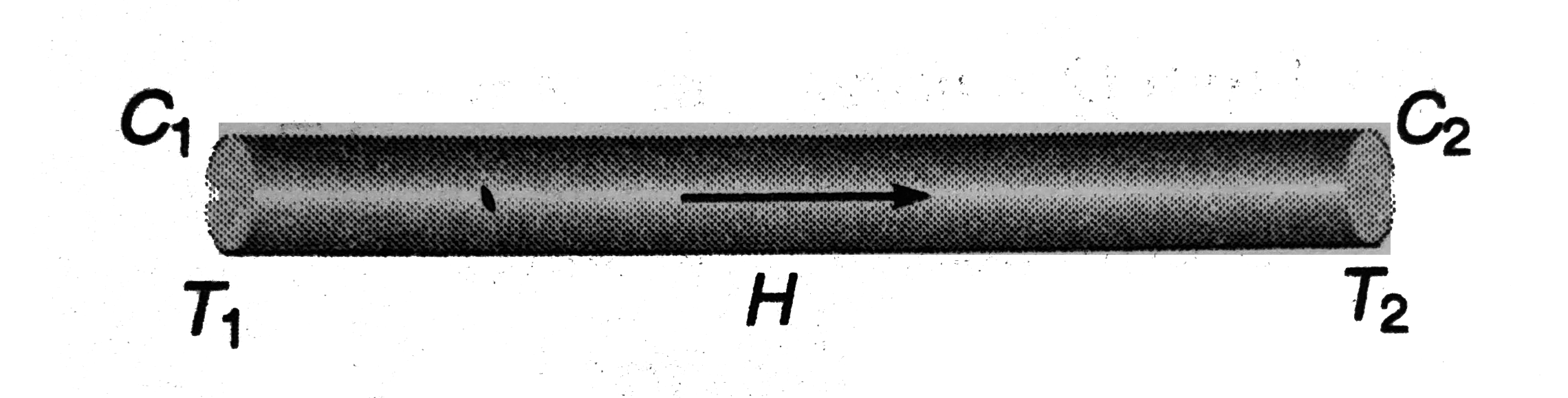
Two bodies of masses `m_(1)` and `m_(2)` and specific heat capacities `S_(1)` and `S_(2)` are connected by a rod of length `l`, cross-section area `A`, thermal conductivity `K` and negligible heat capacity. The whole system is thermally insulated. At time `t=0` , the temperature of the first body is `T_(1)` and the temperature of the second body is `T_(2)(T_(2)gtT_(1))` . Find the temperature difference between the two bodies at time `t`.

Text Solution

Verified by Experts

The correct Answer is:
A, B, C, D

Let `T_1` be the temperature of `C_1` and `T_2` the temperature of `C_2` at some intant of time. Further let T be the temperature difference at that instant.

Then,
`C_1(-(dT_1)/(dt)) = H = T/(l//KA) = (KA)/l (T)`
and `C_2 (+(dT_2)/(dt)) = H = T/(l//KA) = (KA)/l (T)`
`:. -(dT)/(dt) = -(dT_1)/(dt)+ (dT_2)/(dt)`
`:. -(dT_1)/(dt) = (KA)/(lC_1) (T)`
and `+(dT_2)/(dt) = (KA)/(lC_2)`
Further, `-(dT)/(dt) = -(dT_1)/(dt) + (dT_2)/(dt)`
`=(KA(C_1+C_2))/(lC_1C_1) T`
or `int_(DeltaT_0)^T (dT)/(T) = -(KA(C_1+C_2))/(lC_1C_2) int_(0)^(t) dt`
Solving, we get `T = Delta T_0 e^(-alphat)`
where, `alpha = (KA(C_1+C_2))/(lC_1C_2)`.
Promotional Banner

Topper's Solved these Questions

  • CALORIMETRY & HEAT TRANSFER

    DC PANDEY|Exercise Level 2 More Than One Correct|5 Videos
  • BASIC MATHEMATICS

    DC PANDEY|Exercise Exercise|13 Videos
  • CALORIMETRY AND HEAT TRANSFER

    DC PANDEY|Exercise Medical entrance s gallery|38 Videos

Similar Questions

Explore conceptually related problems

Two bodies of masses m_(1) and m_(2) and specific heat capacities S_(1) and S_(2) are connected by a rod of length l, cross-ssection area A, thermal conductivity K and negligible heat capacity. The whole system is thermally insulated. At time t=0 , the temperature of the fisrt body is T_(1) and the temperature of the second body is T_(2)(T_(2)gtT_(1)) . Find the temperature difference between the two bodies at time t.

Two chunks of metal with heat capacities C_(1) and C_(2) , are interconnected by a rod length l and cross-sectional area S and fairly low heat conductivity K . The whole system is thermally insulated from the environment. At a moment t = 0 the temperature difference betwene the two chunks of metal equals (DeltaT)_(0) . Assuming the heat capacity of the rod to be negligible, find the temperature difference between the chucks as a function of time.

When two bodies ofmasses m_(1) and m_(2) with specific heats s_(1) and s_(2) at absolute temperatures T_(10) and T_(20)(T_(10) gt T_(20)) are connected by a rod of length l and cross sectional area A with thermal conductivity k. Find the temperature difference of the bodies after time t. Neglect any heat loss due to radiation at any surface..

A rod of length l and cross-section area A has a variable thermal conductivity given by K = alpha T, where alpha is a positive constant and T is temperature in kelvin. Two ends of the rod are maintained at temperature T_(1) and T_(2) (T_(1)gtT_(2)) . Heat current flowing through the rod will be

Two adiabatic vessels, each containing the same mass m of water but at different temperatures, are connected by a rod of length L, cross-section A, and thermal conductivity K. the ends of the rod are inserted into the vessels, while the rest of the rod is insulated so that .there is negligible loss of heat into the atmosphere. The specific heat capacity of water is s, while that of the rod is negligible. The temperature difference between the two vessels reduces to l//e of its original value after a time, delta t . The thermal conductivity (K) of the rod may be expressed by:

Two bars of same length and same cross-sectional area but of different thermal conductivites K_(1) and K_(2) are joined end to end as shown in the figure. One end of the compound bar it is at temperature T_(1) and the opposite end at temperature T_(2) (where T_(1) gt T_(2) ). The temperature of the junction is

Three rods of equal length, area of cross section and thermal conductivity are connected as shown in the figure. There is no heat loss through lateral surface of the rods and temperature of ends are T_(A)=100^(@)C, T_(B)=70^(@)C and T_(C)=50^(@)C . Find the temperature of junction.

