Home
Class 11
PHYSICS
A rod of length l with thermally insulat...

A rod of length l with thermally insulated lateral surface consists of material whose heat conductivity coefficient varies with temperature as `k= a//T`, where a is a constant. The ends of the rod are kept at temperatures `T_1 and T_2`. Find the function T(x), where x is the distance from the end whose temperature is `T_1`.

Text Solution

Verified by Experts

The correct Answer is:
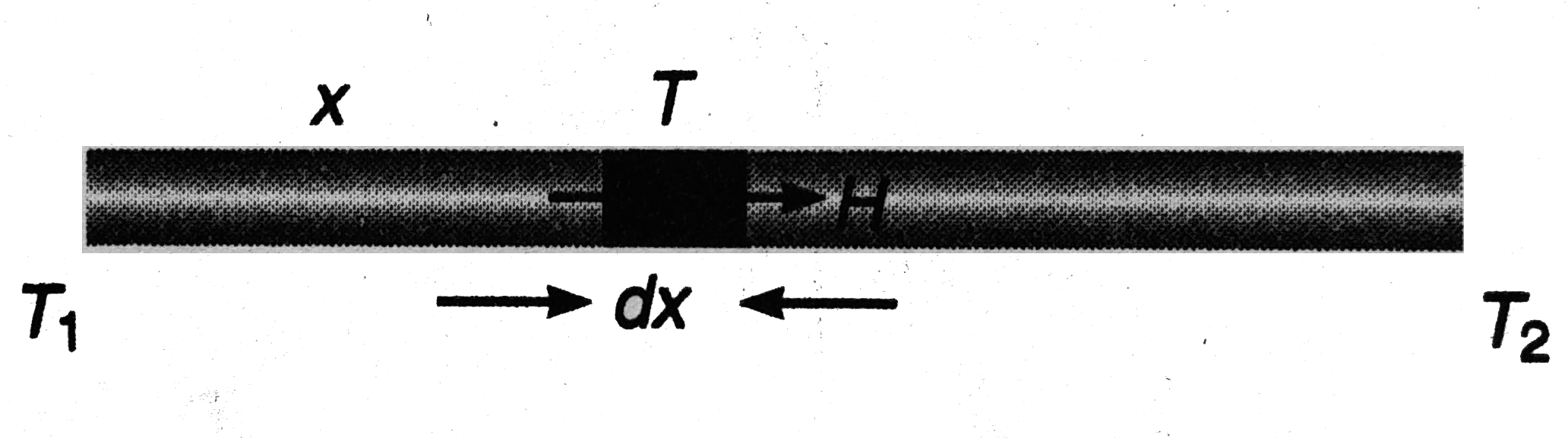
A, B


`H = TD/R = (-dT)/((dx)//(KA))`
`= -(dT)/(dx) (a/T A) = "constant" …….(i)`
`:. int _(T_1)^(T_2) -(dT)/T = H/(aA) int_(0)^(l) dx`
`In (T_1/T_2) = (Hl)/(aA)`
or `H = (aA)/l In (T_1//T_2)`
Substituting in Eq. (i), we have
`(aA)/l In (T_1/T_2) = -(dT)/(dx) (aA)/T`
or `int_(T_1)^T (dT)/T = -(In (T_1/T_2))/l int_0^x dx`
`:. In (T/T_1) = -x/l In (T_1//T_2) = In (T_1/T_2)^(-x/l)`
or `T/T_1 = (T_1/T_2)^(-x/l)`
or `T=T_1 (T_1/T_2)^(-x/l) = T_1(T_2/T_1)^(x/l)`.
Promotional Banner

Topper's Solved these Questions

  • CALORIMETRY & HEAT TRANSFER

    DC PANDEY|Exercise Level 2 More Than One Correct|5 Videos
  • BASIC MATHEMATICS

    DC PANDEY|Exercise Exercise|13 Videos
  • CALORIMETRY AND HEAT TRANSFER

    DC PANDEY|Exercise Medical entrance s gallery|38 Videos

Similar Questions

Explore conceptually related problems

A rof of length l with thermally insulated lateral surface consists of material whose heat conductivity coefficient varies with temperature as x = alpha//T , where alpha is a constant. The ends of the rod are kept at temperatures T_1 and T_2 . Find the function T (x) , where x is the distance from the end whose temperature is T_1 , and the heat flow density.

A rod of length l with thermally insulated lateral surface is made of a material whose thermal conductivity varies as K=sc//T where c is a constant. The ends are kept at temperatures T_(1) and T_(2) . Find the temperature at a distance x from te first end where the temperature is T_(1) and the heat flow density.

A rod of length L with sides fully insulated is made of a material whose thermal conductivity K varies with temperature as K=(alpha)/(T) where alpha is constant. The ends of rod are at temperature T_(1) and T_(2)(T_(2)gtT_(1)) Find the rate of heat flow per unit area of rod .

A rod of length l with thermally insulated lateral surface is made of a matrical whose thermal conductivity varies as K =C//T where C is a constant The ends are kept at temperature T_(1) and T_(2) The temperature at a distance x from the first end where the temperature is T_(1), T =T_(1)((T_(2))/(T_(1)))^(nx//2l) Find the value of n? .

A rod of length l (laterally thermally insulated) of the uniform cross sectional area A consists of a material whose thermal conductivity varies with temperature as K=(K_(0))/(a+bT') where K_(0) , a and b are constants. T_(1) and T_(2)(lt T_(1)) are the temperatures of the ends of the rod. Then, the rate of flow of heat across the rod is

A rod of length l and cross sectional area A has a variable conductivity given by K=alphaT , where alpha is a positive constant T is temperatures in Kelvin. Two ends of the rod are maintained at temperatures T_1 and T_2(T_1gtT_2) . Heat current flowing through the rod will be

The coefficient of linear expansion 'alpha ' of the material of a rod of length l_(0) varies with absolute temperature as alpha = aT -bT^(2) where a & b are constant. The linear expansion of the rod when heated from T_(1) to T_(2) = 2T_(1) is :-

A rod of length l and cross-section area A has a variable thermal conductivity given by K = alpha T, where alpha is a positive constant and T is temperature in kelvin. Two ends of the rod are maintained at temperature T_(1) and T_(2) (T_(1)gtT_(2)) . Heat current flowing through the rod will be

The graph of (x/m) vs P at two different temperature T_1 and T_2 is [where T_1gtT_2 ]

