Home
Class 12
PHYSICS
In the circuit in figure E1=3V, E2=2V, E...

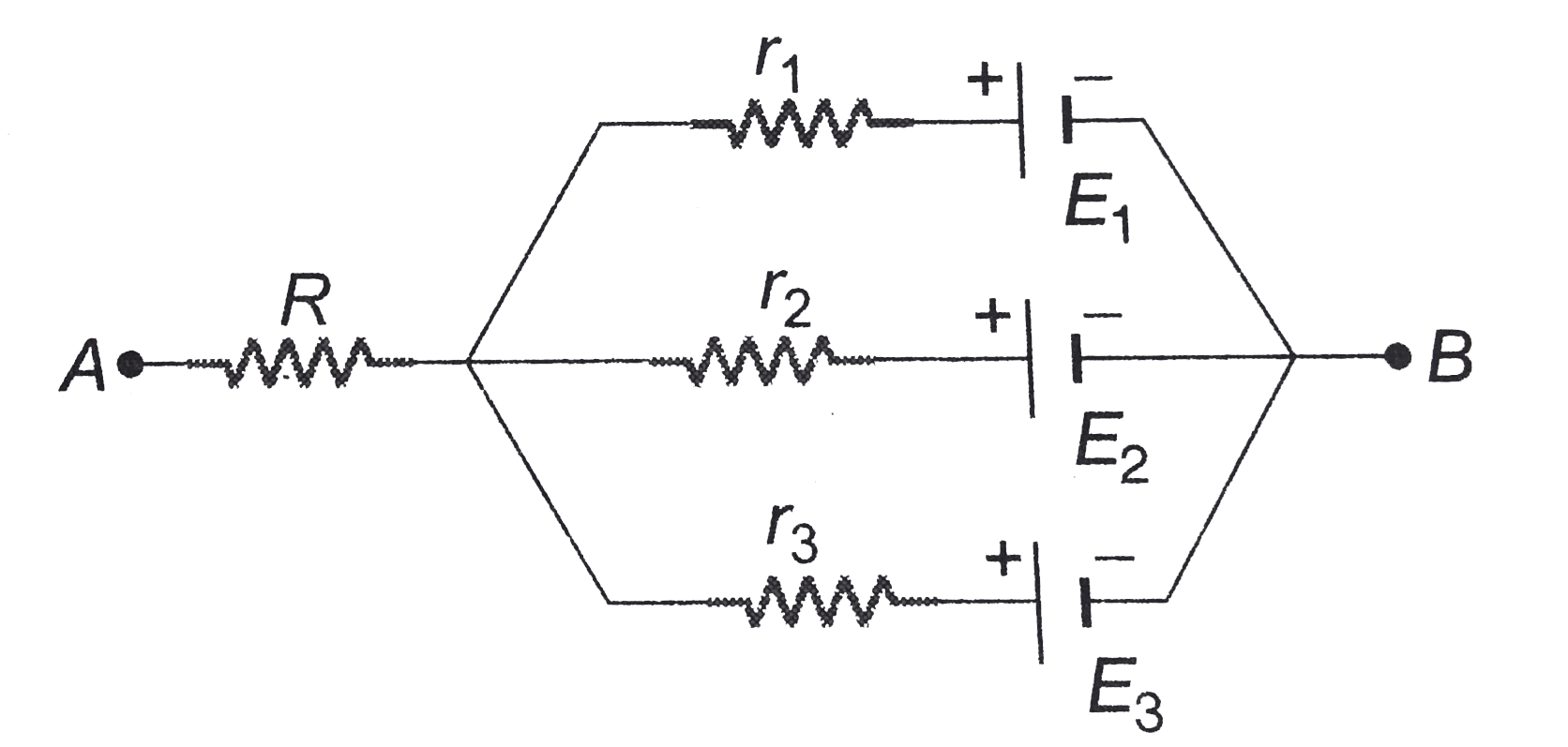
In the circuit in figure `E_1=3V, E_2=2V, E_3=1V` and `R=r_1-r_2-r_3=1Omega`

a. Find the potential differece between the points `A` and `B` and the currents through each branch.
b. If `r_2` is short circuited and the point `A` is connected to point `B`, find the currents through `E_1,E_2, E_3` and the resistor `R`

Text Solution

Verified by Experts
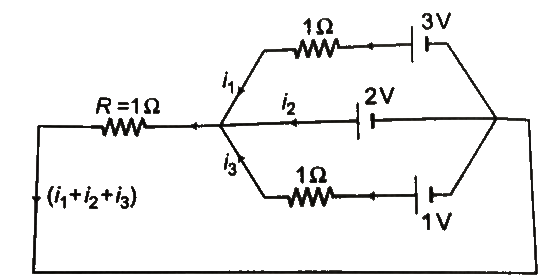
a. Equivalent emf of the battries would be
`E_(eq)=(Sigma(E/r))/(Sigma(1/r))=((3/1+2/1+1/1))/((21/1+1/1+1/1))=2V`
Further `r_1, r_2` and `r_3` each are of `1Omega`. Therefore, internal resistance of the equivalent battery will be `1/3 Omega` as alll three are in parallel.

The equivalent circuit is therefore shown in the figure.
Since no current is taken from the battery.
`V_(AB)=2V` (From `V=E-ir)`
Further `V_A-V_B=E_1-i_1r_1`
`:. i_1=(V_B-V_A+E_1)/r_1=(-2+3)/=1A`
Similarly, `i_2=(V_B-V_A+E_2)/r_2=(-2+2)/1=0`
and `i_3=(V_B-V_A+E_3)/r_3=(-2+1)/1=-1A`
b. `r_2` is short circuirted means resistance of this branch becomes zero. Making closed circuit with a battery and resistance `R`. Applying Kirchhoff's second law in three loops so formed.
`3-i_1-(i_1+i_2+i_30=0` ..............i
`2-(i_1+i_2+i_3)=0`.............ii
`1-i_3-(i_1+i_2+i_3)=0`.................iii
From equ. ii `i_1+i_2+i_3=2A`
`:.` Substitutig in equ. i we get `i_1=1A`
Substitution in eq. iii we get `i_3=-1A`
`:. i_2=2A`
Promotional Banner

Topper's Solved these Questions

  • CURRENT ELECTRICITY

    DC PANDEY|Exercise Example Type 1|2 Videos
  • CURRENT ELECTRICITY

    DC PANDEY|Exercise Example Type 2|1 Videos
  • COMMUNICATION SYSTEM

    DC PANDEY|Exercise Subjective|11 Videos
  • ELECTROMAGNETIC INDUCTION

    DC PANDEY|Exercise Medical entrances gallery|25 Videos

Similar Questions

Explore conceptually related problems

In the circuit shown in fig E_1 = 3 volts, E_2 = 2volts, E_3 = 1volt and R = r_1 = r_2= r_3= 1 ohm. (i) Find the potential difference between the points A and B and the currents through each branch. (ii) If r_2 is short circuited and the point A is connected to point B, find the current through E_1, E_2, E_3 and the resistor R.

In the circuit as shown in figure, E_(1)=2V , E_(2)=2V, E_(3)=1V, and R=r_(1)=r_(2)=r_(3)Omega . The potential difference between points A and B will be

In the circuit shown in figure , (epsilon)_(1)=3V,(epsilon)_(2)=2V,(epsilon)_(3)=1V and r_(1)=r_(2)=r_(3)=1(Omega) .Find the potential difference between the points A and B and the current through each branch.

In the circuit shown in figure E_1=10 V, E_2=4V, r_1=r_2=1Omega and R=2Omega . Find the potential difference across battery 1 and battery 2.

In the circuit shown in fig. E_(1)=3" volt",E_(2)=2" volt",E_(3)=1" vole and "R=r_(1)=r_(2)=r_(3)=1 ohm. (i) Find potential difference in Volt between the points A and B with A & B unconnected. (ii) If r_(2) is short circuited and the point A is coneted to point B through a zero resistance wire, find the current through R in ampere.

For the circuit shown, with R_1=1.0 Omega,R_2=2.0Omega,E_1=2V and E_2=E_3=4V the potential difference between the points ‘a’ and ‘b’ is __________(in V)

In the circuit shown in fig. 5.265, E_1 = E_2 = E_3 = 2V and R_1 = R_2 = 4Omega. The current flowing between points A and B through battery E_2 is

In the following circuit E_(1)=E_(2)=E_(3) 2V and R_(1)=R_(2)=AOmega . The current passing through battery E_(2) between points A and B is

DC PANDEY-CURRENT ELECTRICITY-Medical entrances gallery
  1. In the circuit in figure E1=3V, E2=2V, E3=1V and R=r1-r2-r3=1Omega ...

    Text Solution

    |

  2. A potentiometer wire is 100 cm long hand a constant potential differen...

    Text Solution

    |

  3. The charge flowing through a resistance R varies with time t as Q = at...

    Text Solution

    |

  4. The potential difference (V(A) - V(B)) between the point A and B in th...

    Text Solution

    |

  5. A filament bulb (500 W, 100 V) is to be used in a 230 V main supply. W...

    Text Solution

    |

  6. A potentiometer wire has length 4 m and resistance 8 Omega. The resist...

    Text Solution

    |

  7. A, B and C are voltmeters of resistances R, 1.5R and 3R respectively. ...

    Text Solution

    |

  8. A cross a metallic conductor of non-uniform cross-section, a constant ...

    Text Solution

    |

  9. Consider the diagram shown below. A Voltmeter of resistance 150 O...

    Text Solution

    |

  10. Each resistor shown in the figure has a resistance of 10 Omega and the...

    Text Solution

    |

  11. A 1 Omega resistance in series with an ammeter is balanced by 25 cm of...

    Text Solution

    |

  12. The range of voltmeter is 10 V and its internal resistance is 50 Omega...

    Text Solution

    |

  13. Identify the wrong statement.

    Text Solution

    |

  14. When the rate of flow of charge through a metallic condoctor of non-un...

    Text Solution

    |

  15. The resistance of a carbon resistor of colour code Red-Red Green Silve...

    Text Solution

    |

  16. The slope of the graph showing the variation of potential difference V...

    Text Solution

    |

  17. Two wires of the same dimensions but resistivities rho(1) and rho(2) a...

    Text Solution

    |

  18. A galvanometer of resistance 50 Omega is connected to a battery of 8 V...

    Text Solution

    |

  19. Choose the correct statement.

    Text Solution

    |

  20. A metal plate weighting 750g is to be electroplated wiwth 0.05% of it...

    Text Solution

    |

  21. A DC ammeter has resistance 0.1 Omega and its current ranges 0-100 A. ...

    Text Solution

    |

