Home
Class 12
PHYSICS
Three charges q1=1muC, q2=2muC and q3=3m...

Three charges `q_1=1muC, q_2=2muC` and `q_3=3muC` are placed on the vertices of an equilateral triangle of side 1.0 m. Find the net electric force acting on charge `q_1`

Text Solution

Verified by Experts

The correct Answer is:
A, B, C, D

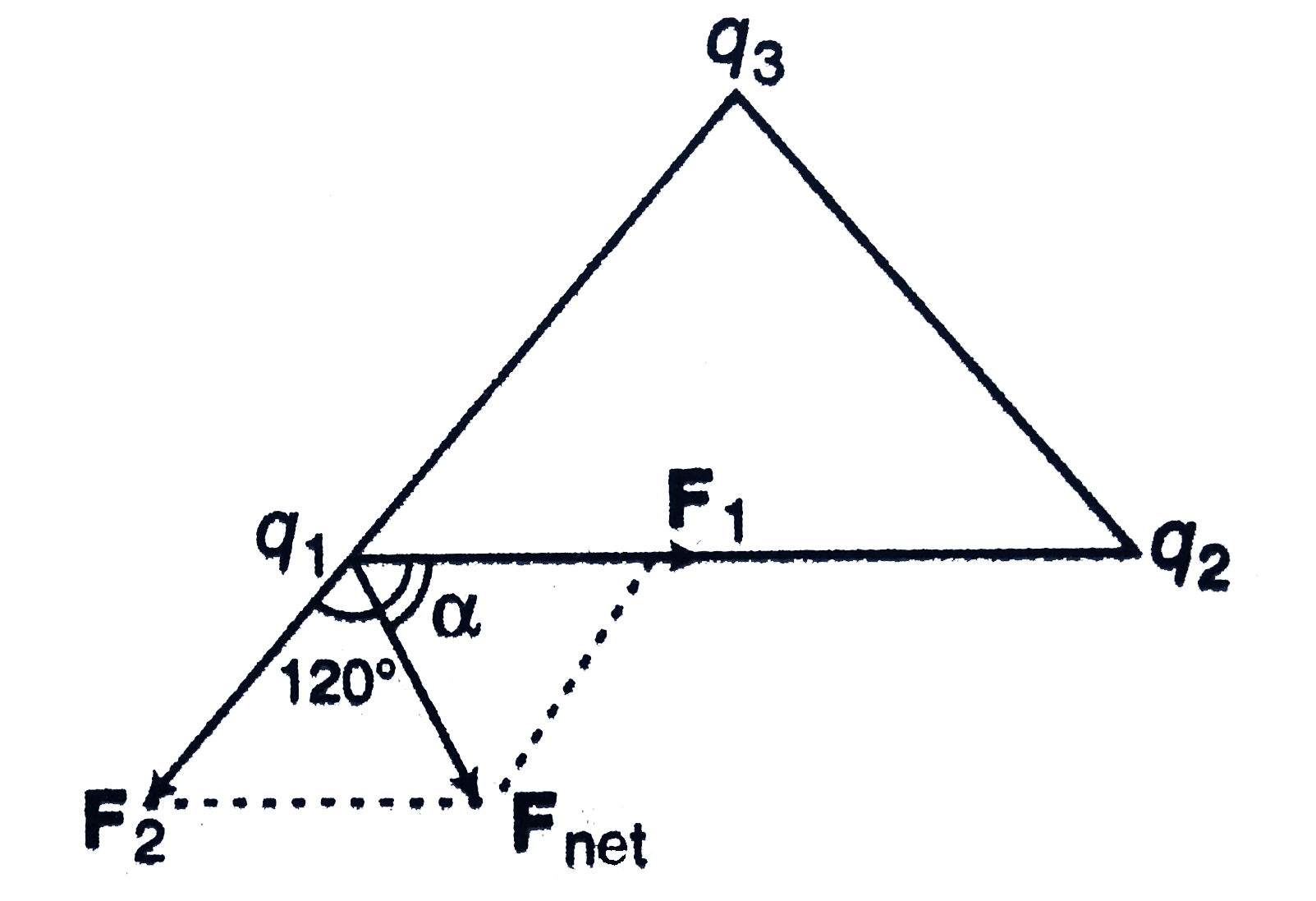
Method I. In the figure
`
`|F_(1)|=F_(1)=1/(4piepsilon_0).(q_1q_2)/r^2`
=magnitude of force between `q_1 and q_2`
`((9.0xx10^9)(1.0xx10^-6)(2.0xx10^-6))/((1.0)^2)`
`=1.8xx10^-2N`
`Similarly `|F_(2)|=F_(2)=1/(4piepsilon_0). (q_1q_3)/r^2`
`=magnitude of force between `q_1` and `q_3`
`=((9.0xx10^9)(1.0xx10^-6)(3.0xx10^-6))/((1.0)^2)`
`=2.7xx10^-2N`
Now, `|F_"net")|=sqrt(F_1^2+F_2^2+2F_1F_2cos120^@)`
`=(sqrt((1.8)^2+(2.7)^2=2(1.8)(2.7)(-1/2)))xx10^-2N`
`=2.38xx10^-2N`
and `tan alpha=(F_2sin120^@)/(F_1+F_2cos120^@)`
`=((2.7xx10^-2)(0.87))/((1.8xx10^-2)+(2.7xx10^-2)(-1/2))`
or `alpha=79.2^@`
Thus, the net force on charge `q_1` is `2.38xx10^-2` N at an angle `alpha=79.2^@` with a line joining `q_1` and `q_2` as shown in the figure.
Method 2. In this figure method let us assume a coordinate axes with `q_1` at origin as shown in figure. The coordinate of `q_1,q_2` and `q_3` in this coordinate system are `(0,0,0), (1m,0,0)` and `(0.5m, 0.87m,0)` respectively. Now
`
`F_1`=force of `q_1` due to charge `q_2`
`=1/(4piepsilon_0) .(q_1q_2)/(|r_1-r_2|\^3)(r_1-r_2)`
`=((9.0xx10^9)(1.0xx10^-6)(-2.0xx10^-6))/((1.0)^3)[(0.1)hati+(0-0)hatj+(0-0)hatk]`
`=(1.8xx10^-2hati)N`
and `F_2`=Force on `q_1` due to charge `q_3`
`=1/(4piepsilon_0).(q_1q_3)/(|r_1-r_3|^3)(r_1-r_3)`
`=((9.0xx10^9)(1.0xx10^-6)(3.0xx10^-6))/(1.0)^3[(0-0.5)hati+(0-0-0.87)hatj+(0-0)hatk]`
`=(-1.35hati-2.349hatj)xx10^-2N`
Therefore net force on `q_1` is `F=F_1+F_2`
`=(0.45hati-2.349hatj)xx10^-2N`
Promotional Banner

Topper's Solved these Questions

  • ELECTROSTATICS

    DC PANDEY|Exercise Example Type 5|5 Videos
  • ELECTROSTATICS

    DC PANDEY|Exercise Example Type 6|4 Videos
  • ELECTROSTATIC POTENTIAL AND CAPACITORS

    DC PANDEY|Exercise (C) Chapter exercises|50 Videos
  • GRAVITATION

    DC PANDEY|Exercise All Questions|120 Videos

Similar Questions

Explore conceptually related problems

Three charges q_(1) = 1 mu C, q_(2) = -2 muC and q_(3) = 3mu C are placed on the vertices of an equilateral triangle of side 1.0 m. find the net electric force acting on charge q_(1) . How to proceed Charge q_(2) will attract charge q_(1) (along the line joining them) and charge q_(3) will repel charge q_(1) . Therefore, two forces will act on q_(1) , one due to q_(2) and another due to q_(3) . Since , the force is a vector quantity both of these force (say F_(1) and F_(2) ) will be added by vector method. Following are two methods of their addition

Three charges 4muC, 4muC and -4muC are placed at vertices of an equilateral triangle of side length 20cm. The potential centre is nearly.

For charges q_1=1muC, q_2=2muC, q_3=-3muC and q_4=4muC are kept on the vertices of a square of side 1m . Find the electric potential energy of this system of charges.

Three point charges q are placed at three vertices of an equilateral triangle of side a. Find magnitude of electric force on any charge due to the other two.

Three charges 2q, -q, and -q are located at the vertices of an equilateral triangle. At the center of the triangle,

Three point charges 2muC, 3muC and 5muC are placed at the corners of an equilateral triangle of side 200 cm. Calculate the potentail energy of the system.

Four charges q_(1) = 1 muC,q_(2)=2 muC,q_(3)=-3 muC and q_(4)=4 muC are kept on the vertices of a square of side 1 m . Find the electric potential energy of this system of charges.

Consider the charges q,q and -q placed at the vertices of an equilateral triangle of each side l. What is the force on each charge ?

Three charges Q, (+q) and (+q) are placed at the vertices of an equilateral triangle of side l as shown in the figure. It the net electrostatic energy of the system is zero, then Q is equal to

DC PANDEY-ELECTROSTATICS-Medical entrances gallery
  1. Three charges q1=1muC, q2=2muC and q3=3muC are placed on the vertices ...

    Text Solution

    |

  2. An electric dipole is placed at an angle of 30^(@) with an electric fi...

    Text Solution

    |

  3. The electric field in a certain region is acting radially outwards and...

    Text Solution

    |

  4. A Gaussian surface in the cylinder of cross-section pia^(2) and length...

    Text Solution

    |

  5. A total charge of 5 muC is distributed uniformly on the surface of the...

    Text Solution

    |

  6. Two small spherical shells a and B are given positive charges of 9 C a...

    Text Solution

    |

  7. a point charge q is situated at a distance r from one end of a thin co...

    Text Solution

    |

  8. When 10^(19) electrons are removed from a neutral metal plate through ...

    Text Solution

    |

  9. A charge Q is uniformly distributed over a large plastic plate. The el...

    Text Solution

    |

  10. A uniform electric field E is created between two parallel ., charge...

    Text Solution

    |

  11. The line A A' is on charged infinite conducting plane which is perpend...

    Text Solution

    |

  12. The electric field at a point on equatorial of a dipole and direction ...

    Text Solution

    |

  13. Pick out the statement which is incorrect?

    Text Solution

    |

  14. An electron of mass m(e ) initially at rest moves through a certain di...

    Text Solution

    |

  15. Two charges 10 muC and - 10 muC are placed at points A. and B separate...

    Text Solution

    |

  16. A uniform electric field exists in space. Find the flux of this field...

    Text Solution

    |

  17. An inclined plane of length 5.60 m making an angle of 45^(@) with the ...

    Text Solution

    |

  18. Two charge spheres separated at a distance d exert a force F on each o...

    Text Solution

    |

  19. If a charge on the body is 1 nC, then how many electrons are present o...

    Text Solution

    |

  20. Electric field at a point of distance r from a uniformly charged wire ...

    Text Solution

    |

  21. Two equal and opposite charges of masses m(1) and m(2) are accelerated...

    Text Solution

    |