Home
Class 12
PHYSICS
What charges will flow through A,B and C...

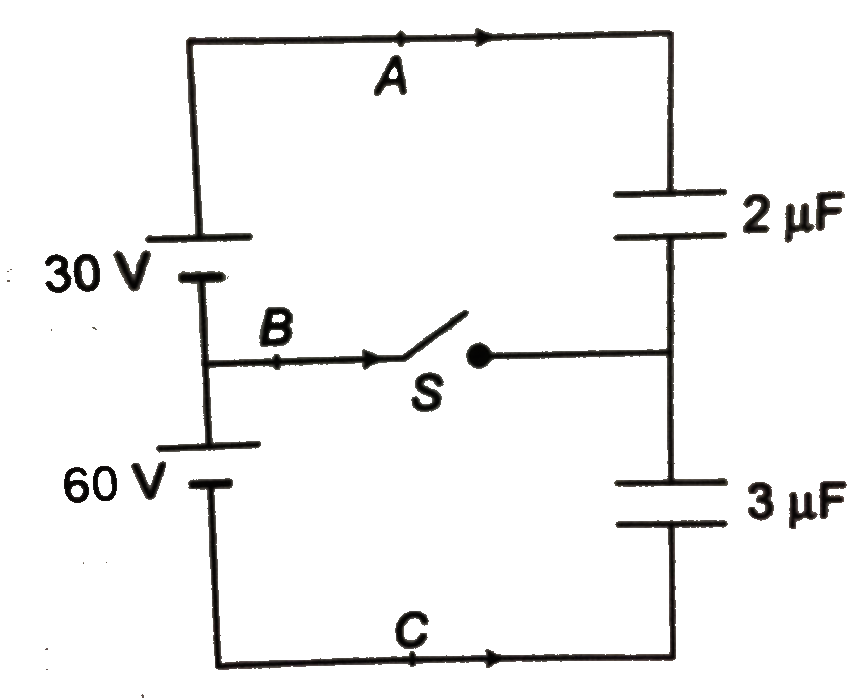
What charges will flow through `A,B` and `C` in the direction shown in the figure when swithc `S` is closed?

A

` - 48 muC` , ` 120 muC` , ` - 72 muC`

B

` 48 muC` , ` 120 muC` , ` - 72 muC`

C

` - 48 muC` , ` 12 muC` , ` - 72 muC`

D

` - 48 muC` , ` 120 muC` , ` 72 muC`

Text Solution

Verified by Experts

The correct Answer is:
A

Let us draw two figure and find the charge on both the capacitors before closing the switch and after closing the switch.
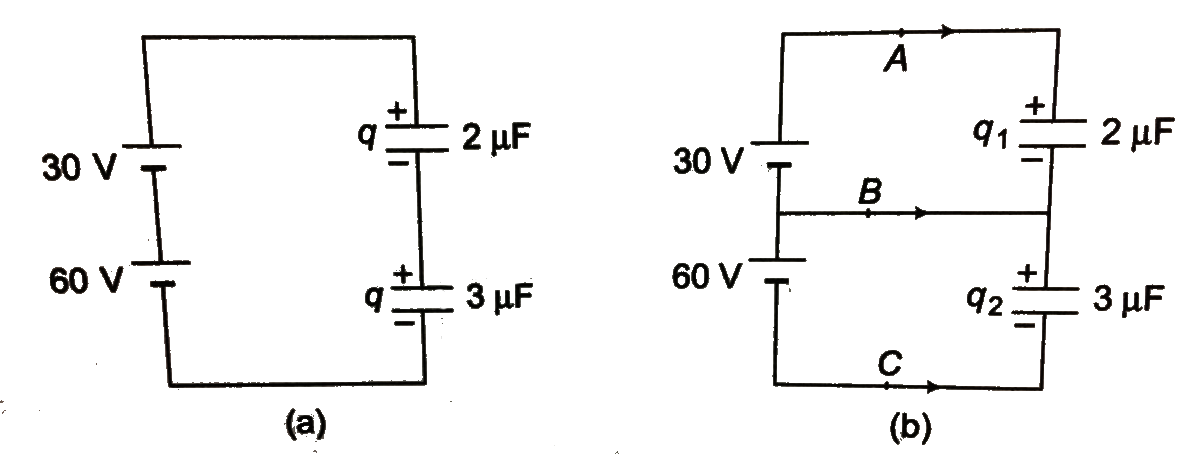
Refer fig a. when switch is open Both capacitors are in series. Hence, their equivalent capacitance is
`C_(eq)=(C_1C_2)/(C_1+C_2)((2)(3))/(2+3)=6/5muF`
therefore, charge on both capacitors will be same, Hence, using `q=CV` we get
`q=(30+60)(6/5)muC=108muC`
Refer fig b. when switch is closed Let `q_1` and `q_2` be the charges (`i n muC)` on two capacitors. Then applying second law in upper and lower loops, we have
`30-q_1/2=0` or `q_1=60muC`
`60-q_2/3=0` or `q_2=180muC`
Charges `q_1` and `q_2` can be calculated alternatively by seeing that upper plate of `2muF` capcior is connected with positive terminal of `30 V` battery. THereforwe, they are at the same potential. Similarly, thelower plate of this capacitor is at the same potential as that of the negative terminal of `30 V` battery. So, we can say that `PD` across `2muF` capacitor is also `30 V`.
`q_1=(C)(PD)=(2)(30)muC`
`=60muC`
Similarly `PD` across `3muF` capacitor is same as that between `60 V` battery. hence,
`q_2=(3)(60)muC`
`=180muC`
Now let `q_A` charge flows from `A` in the direction shown. This charge goes to the upper plate of `2muF` capacitor. initialy, it had charge `+q` and final charge on it is `+q_1` Hence
`q_1=q+q_A`
or `q_A=q_1-q=60-108`
`=-48muC`
Similarly charge `q_B` goes to the upper plate of `3muF` capacitor and lower plate of `2muF` capacitor. INitially both the plates had a chaerge `+q-q` or zero. And finally they have a charge `(q_2-q_1)`
Hence
`(q_2-q_1)=q_B+0`
`:. q_B=q_2-q_1=180-60`
`=120muC`
Charge `q_C` goes to the lower plate of `3muF` capacitor. Initially, it had a charge `-q` and finally `-q_2` Hence ltbr `-q_2=(-q)+q_C`
`q_C=q-q_2=108-180`
`=-72muC`
so, the charges will flow as shown below
Promotional Banner

Topper's Solved these Questions

  • CAPACITORS

    DC PANDEY|Exercise Exercise|155 Videos
  • CAPACITORS

    DC PANDEY|Exercise OBJECTIVE_TYPE|1 Videos
  • ATOMS

    DC PANDEY|Exercise MEDICAL ENTRANCES GALLERY|42 Videos
  • COMMUNICATION SYSTEM

    DC PANDEY|Exercise Subjective|11 Videos

Similar Questions

Explore conceptually related problems

(a) Taking the potential at the point B to be zero, find the potential of point D . (b) Find V_(A)-V_(B) . Under what condition is it equal to zero. (c) Consider the situation as shown in diagram. How much charge will flow through cell if the switch S is closed? (d) In the circuit shown in the figure, calculate (i) Potential difference between the points X and Y . (ii) Potential of the point X when switch S is closed. (iii) Charge flown through the switch when it was closed.

Determine the current through the battery in the circuit shown in figure. (a) immediately after the switch S is closed (b) after a long time.

Calculate the equivalent resistance of the resistance network between the points A and B as shown in the figure, when switch S is closed.

In the given circuit diagram, find the charges which flow through directions 1 and 2 when switch S is closed.

Find the charge which flows from point A to B, when switch is closed

In the figure shown the current flowing through 2R is:

Two capacitors A and B are connected in series with a battery as shown in the figure. When the switch S is closed and the two capacitors get charged fully, then

A circuit consists of three identical lamps connected to a battery as shown in the figure. When the switch S is closed then the intensities of lamps A and B