Home
Class 12
PHYSICS
(a) What is the potential of point a wit...


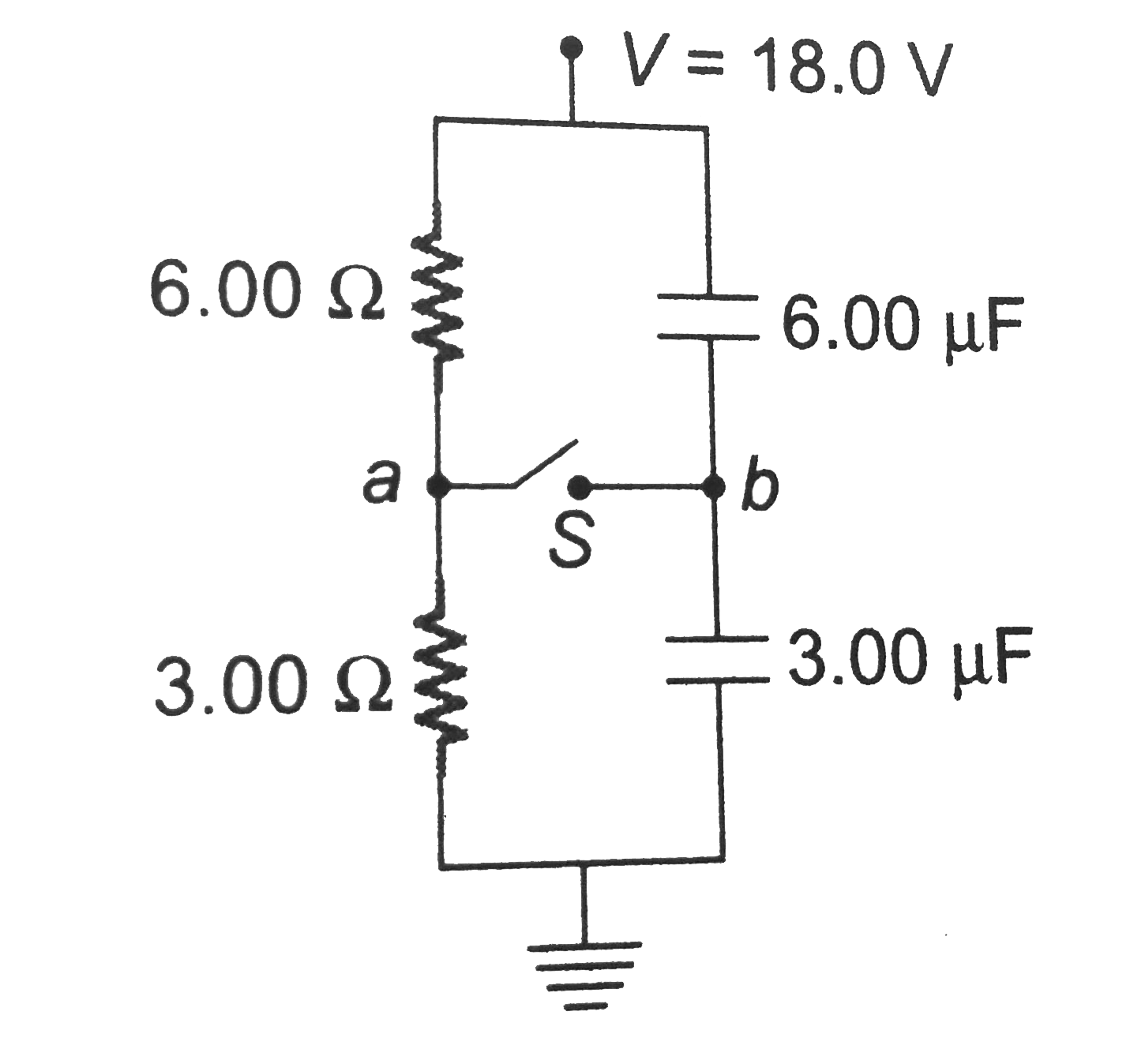
(a) What is the potential of point a with respect to point b in figure, when switch `S` is open?
(b) Which point, `a` or `b`, is at the higher potential?
(c) What is the final potential of point `b` with respect to ground when switch S is closed?
(d) How much charge flows through switch `S` when it is closed?

Text Solution

Verified by Experts

The correct Answer is:

A, B, C

a. `V_a=18V` and `V_b=0` as no current flow through the resistors.
`:.V_a-V_b=10V`
b. `V_a-V_b=+ve`.
Hence `V_agtV_b`
c. Current flows through two resistors,
`i=(18-0)/(6+3)=2A`
`:. V_b-0=iR=2xx3`
or `V_b=6V`
d. Initially, `V_(3muF)=V_(6muF)=18V`
`:. q_3muF=54muC` `(q=CV)`
and `q_(6muF)=V_(6Omega)=iR`
`=2xx6=12V`
`:. q_(6muF)=72muC`
`V_(3muF)=V_(3Omega)=6V`
`:. 9_(3muF)=18muC`
`/_\q=q_f-q_i=-36muC` on both capacitors.
Promotional Banner

Topper's Solved these Questions

  • CAPACITORS

    DC PANDEY|Exercise OBJECTIVE_TYPE|1 Videos
  • CAPACITORS

    DC PANDEY|Exercise OBJECTIVE_TYPE|1 Videos
  • ATOMS

    DC PANDEY|Exercise MEDICAL ENTRANCES GALLERY|42 Videos
  • COMMUNICATION SYSTEM

    DC PANDEY|Exercise Subjective|11 Videos

Similar Questions

Explore conceptually related problems

(i) What is the final potential (in V) of point b with respect to ground in steady state after switch S is closed ? (ii) How much charge flows through switch S from b to a after it is closed in mu C .

The flow of charge through switch S if it is closed is

In the circuit shown above, when then switch S is closed,

The connections shown in figure are established with the switch S open. How much charge will flow through the switch if it is closed ? .

The connnections shown in figure are established with the swithc S open. How much charge will flow through the switch if it is closed?

Four uncharged capacitors are charged by 24V battery as shown in the figure. How much charge flows through switch S when it is closed?

Find the charge which flows from point A to B, when switch is closed

DC PANDEY-CAPACITORS-Exercise
  1. A parallel-plate capacitor has plates of area A and separation d and i...

    Text Solution

    |

  2. In the circuit shown in figure E1, 2E2=20V, R1=R2=10kOmega and C=1muF....

    Text Solution

    |

  3. (a) What is the potential of point a with respect to point b in figure...

    Text Solution

    |

  4. (a) What is the potential of point a with respect to point b in figure...

    Text Solution

    |

  5. In the circuit shown in Figure, the battery is an ideal one, with emf ...

    Text Solution

    |

  6. Two very large thin conducting plates having same cross sectional are...

    Text Solution

    |

  7. The electric field on two sides of a thin sheet of charge is shown in ...

    Text Solution

    |

  8. In the circuit shown in figure, the capacitors are initially uncharged...

    Text Solution

    |

  9. A graph between current and time during charging of a capacitor by a b...

    Text Solution

    |

  10. A capacitor of capacitance C is charge by a battery of emf E and inter...

    Text Solution

    |

  11. For the circuit shown in the figure determine the charge on capacitor ...

    Text Solution

    |

  12. For the circuit shown in the figure, find the charge stored on capacit...

    Text Solution

    |

  13. Two similar parallel plate capacitors each of capaciti C0 are connecte...

    Text Solution

    |

  14. The switch shown n the figure is closed at t=0. The charge on the cap...

    Text Solution

    |

  15. A 2muF capacitor C1 is charge to a voltage 100 V and a 4muF capacitor ...

    Text Solution

    |

  16. The figure shows a graph of the current in a charging circuit of a cap...

    Text Solution

    |

  17. Four capacitors are connected inseries a battery of emf 10 V as shown ...

    Text Solution

    |

  18. A capacitor of capacity C is charged to a potential difference V and a...

    Text Solution

    |

  19. A capacitor of capacitance 2muF is charged to a potential difference o...

    Text Solution

    |

  20. In the circuit shown in figure switch S is thrown to position 1 at t=0...

    Text Solution

    |
