Home
Class 12
PHYSICS
A capacitor of capacitance C is charged ...

A capacitor of capacitance `C` is charged to a potential difference `V` from a cell and then disconnected from it. A charge `+Q` is now given to its positive plate. The potential difference across the capacitor is now

A

`V`

B

`V+Q/C`

C

`V+Q/(2C)`

D

`V-Q/C` if `QltCV`

Text Solution

Verified by Experts

The correct Answer is:
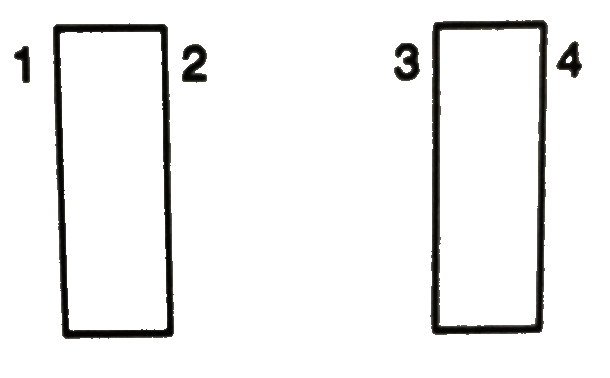
C


`q_1=q_4=q_("total")/2=(CV-CV+Q)/2=Q/2`
`q_2=(Q+CV)-Q/2=(Q/2+CV)`
`q_3=-q_2=-(Q/2+CV)`
Electric field between two plates and hence the potentiall difference is due to `q_2` and `q_3` only.
`PD=q_2/C=V+Q/(2C)`
Promotional Banner

Topper's Solved these Questions

  • CAPACITORS

    DC PANDEY|Exercise OBJECTIVE_TYPE|1 Videos
  • CAPACITORS

    DC PANDEY|Exercise OBJECTIVE_TYPE|1 Videos
  • ATOMS

    DC PANDEY|Exercise MEDICAL ENTRANCES GALLERY|42 Videos
  • COMMUNICATION SYSTEM

    DC PANDEY|Exercise Subjective|11 Videos

Similar Questions

Explore conceptually related problems

A capacitor of capacitance C is charged to a potential difference V_(0) . The charged battery is disconnected and the capacitor is connected to a capacitor of unknown capacitance C_(x) . The potential difference across the combination is V. The value of C_(x) should be

Find charge on each capacitor and potential difference across each capacitor .

A capacitor of capacitance 10 mu F is charged to a potential 50 V with a battery. The battery is now disconnected and an additional charge 200 mu C is given to the positive plate of the capacitor. The potential difference across the capacitor will be.

A capacitor or capacitance C_(1) is charge to a potential V and then connected in parallel to an uncharged capacitor of capacitance C_(2) . The fianl potential difference across each capacitor will be

A capacitor of capacitance 5 muF is charged to a potential difference of 10 volts and another capacitor of capacitance 9 muF is charged to a potential difference of 8 volts. Now these two capacitors are connected in such a manner that the positive plate of one is connected to the positive plate of other. Calculate the common potential difference across the two capacitors.

A 100pF capacitor is charged to a potential difference of 80.0V and the charging battery is disconnected. The capacitor is then connected in parallel with a second capacitor. If the potential difference across the first capacitor drops to 35.0 V what is the capacitance of this second capacitor?

A capacitor of capacitance C is charged to potential difference V and then disconnected from the battery. The air dielectric of capacitor is replaced by another dielectric of dielectric constant K. The fractional decrease in energy of the capacitor is

A capacitor of capacity C is charged to a potential difference V and another capacitor of capacity 2C is charged to a potential difference 4V . The charged batteries are disconnected and the two capacitors are connected with reverse polarity (i.e. positive plate of first capacitor is connected to negative plate of second capacitor). The heat produced during the redistribution of charge between the capacitors will be

DC PANDEY-CAPACITORS-Exercise
  1. A charged capacitor is allowed to dischare through a resistor by clos...

    Text Solution

    |

  2. Five identical capacitor plates are arranged such that they make four ...

    Text Solution

    |

  3. A capacitor of capacitance C is charged to a potential difference V fr...

    Text Solution

    |

  4. X and Y are large, parallel conducting plates close to each other. Eac...

    Text Solution

    |

  5. In the circuit shown in the figure, switch S is closed at time t=0. Se...

    Text Solution

    |

  6. An electrical circuit is shown in the given figure. The resistance of ...

    Text Solution

    |

  7. In the circuit shown, A and B are equal resistances. When S is closed,...

    Text Solution

    |

  8. A parallel plate capacitor is charged from a cell and then isolated fr...

    Text Solution

    |

  9. In the circuit shown each capacitor has a capcitance C. The emf of the...

    Text Solution

    |

  10. Two capacitors of 2muF and 3muF are charged to 150 V and 120 V, respec...

    Text Solution

    |

  11. A parallel plate capacitor is charged and then the battery is disconne...

    Text Solution

    |

  12. A capacitor of 2F (practically not possible to have a capacity of 2F) ...

    Text Solution

    |

  13. given that potential differene across 1muF capacitor is 10V. Then,

    Text Solution

    |

  14. The capacitor C1 in the figure shown initially carries a charge q0. Wh...

    Text Solution

    |

  15. The capacitor C1 in the figure shown initially carries a charge q0. Wh...

    Text Solution

    |

  16. Figure shows a parallel plate capacitor with plate area A and plate se...

    Text Solution

    |

  17. Figure shows a parallel plate capacitor with plate area A and plate se...

    Text Solution

    |

  18. Five identical conducting plates, 1, 2,3,4 and 5 are fixed parallel pl...

    Text Solution

    |

  19. A muF capacitor C1 is charged to V0 = 120 V. The charging battery is t...

    Text Solution

    |

  20. Condensers with capacities C, 2 C, 3C and 4C are charged to the voltag...

    Text Solution

    |

