Home
Class 12
PHYSICS
X and Y are large, parallel conducting p...

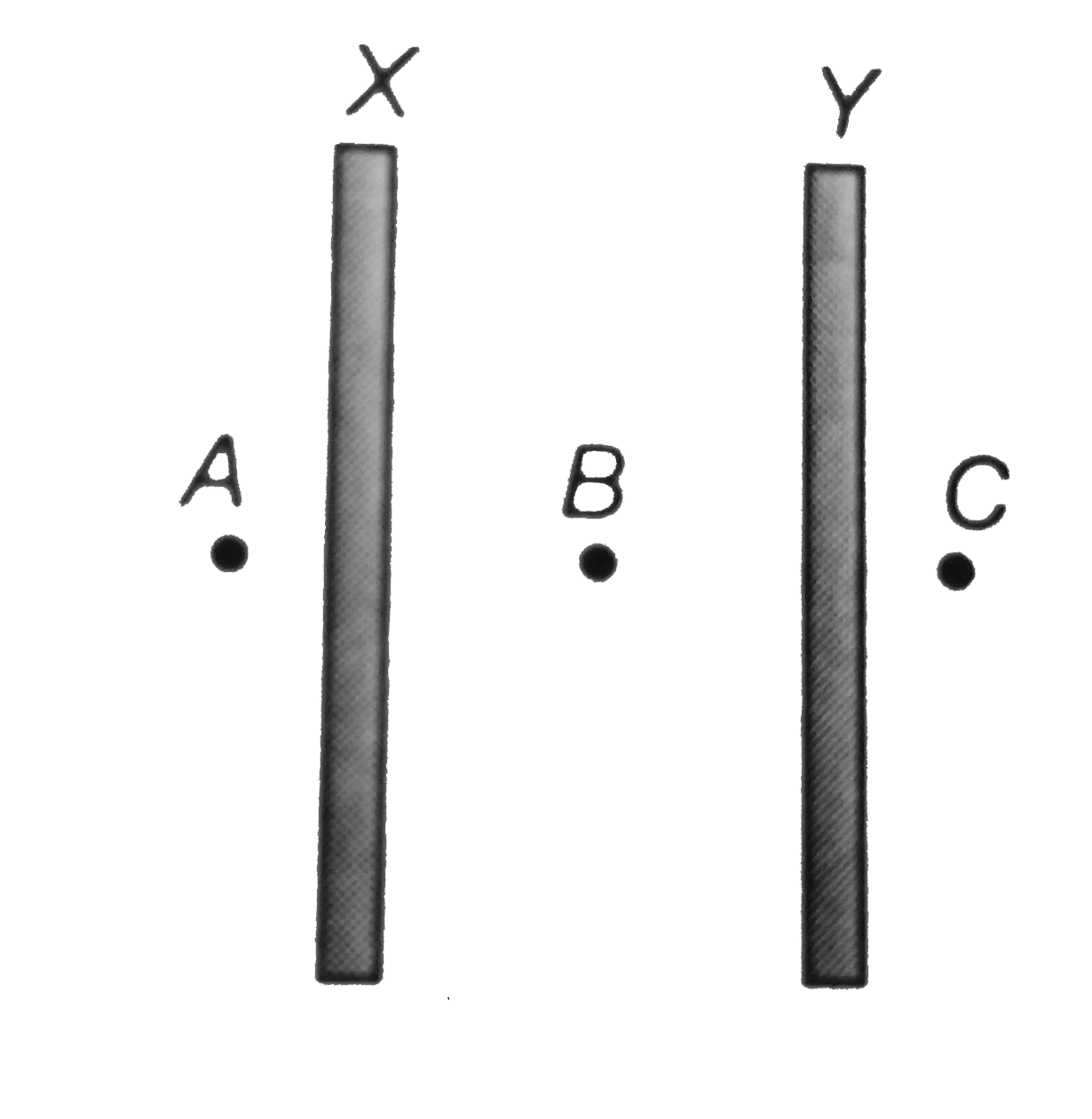
`X` and `Y` are large, parallel conducting plates close to each other. Each face has an area `A`. `X` is given a charge `Q`. `Y` is without any charge. Points `A,B` and `C` are as shown in the figure.

A

The field at `B` is `Q/(2epsilon_A)`

B

The field at `B` is `Q/(epsilon_0A)`

C

The fiels at `A,B` and `C` are of the same magnitude

D

The fieds at `A` and `C` are of the same magnitude, but in opposite directions

Text Solution

Verified by Experts

The correct Answer is:
A, C, D

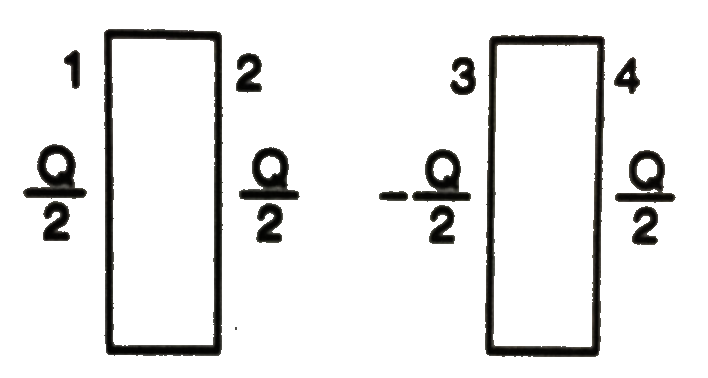
`q_1=q_4=(q_("total")/2=Q/2`
`q_2=Q-q_1=Q/2`
`q_3=-q_2=(-Q/2)`
`E_A=E_1+E_4`(towards left)
`=Q/(4Aepsilon_0)+Q/(4Aepsilon_0)=Q/(2Aepsilon_0)`
`E_C=-E_A`(towards right)
`=(Q)/(2Aepsilon_(0))`
`E_B=E_2+E_3` (towards right)
`=Q/(4Aepsilon_0)+Q/(4Aepsilon_0)=Q/(2Aepsilon_0)`
Promotional Banner

Topper's Solved these Questions

  • CAPACITORS

    DC PANDEY|Exercise OBJECTIVE_TYPE|1 Videos
  • CAPACITORS

    DC PANDEY|Exercise OBJECTIVE_TYPE|1 Videos
  • ATOMS

    DC PANDEY|Exercise MEDICAL ENTRANCES GALLERY|42 Videos
  • COMMUNICATION SYSTEM

    DC PANDEY|Exercise Subjective|11 Videos

Similar Questions

Explore conceptually related problems

A and B are two large identical thin metal plates placed parallel to each other at a small separation. Plate A is given a charge Q. (i) Find the amount of charge on each of the two faces of A and B. (ii) Another identical plate C having charge 3Q is inserted between plate A and B such that distance of C from B is twice its distance from A. Plate A and B is shorted using a conducting wire. Find charge on all six faces of plates A, B and C. (iii) In the situation described in (ii) the plate A is grounded. Now write the charge on all six faces.

Two large , parallel conducting plates X and Y , kept close to each other , are given Q_(1) and Q_(2) (Q_(1) gt Q_(2)) . The four surfaces of the plates are A,B,C and D , as shown (i) The charge on A is (1)/(2) (Q_(1) + Q_(2)) (ii) The charge on B is (1)/(2) (Q_(1) - Q_(2)) (iii) The charge on C is (1)/(2) (Q_(2) - Q_(1)) (iv) The charge on D is (1)/(2) (Q_(1) + Q_(2))

Two conducting plates A and B are placed parallel to each other. A is given a charge. Q_1 and B a charge Q_2 . Find the distribution of charges on the four surface.

Two large parallel conducting plates are placed close to each other ,the inner surface of the two plates have surface charge densities +sigma and -sigma .The outer surfaces are without charge.The electric field has a magnitude of

There are two metallic plates of a parallel plate capacitor. One plate is given a charge +q while the other is earthed as shown. Points P, P_1 and P_2 are taken as shown in adjoining figure. Then the electric intensity is not zero at :

Two conducting plates X and Y, having large surface area A (on one side), are placed parallel to each other as shown in figure. The plate X is given a charge Q whereas the other is neutral. Find : (a) The surface charge density at the inner surface of the plate X, (b) The electric field at a point to the left of the plates, (c) The electric field at a point in between the plates and (d) The electric field at a point to the right of the plates.

Three large plates A, B and C are placed parallel to each other and charges are given as shown. The charge that appears on the left surface of plate B is

Three large conducting plates with charges Q , -Q and Q are kept close to each other as shown in the figure. ( where Q = 2 uc ). Now all the three plates A, B, and C are connected by a thin conducting wire. Find the charge ( in C) on left surface of plate A at electristatic equailibrium

Two conducting plates A and B are placed parallel to each other. A is given a charge Q_1 and B a charge Q_2 . Prove that the charges on the inner surfaces are of equal magnitude and opposite sign.

DC PANDEY-CAPACITORS-Exercise
  1. Five identical capacitor plates are arranged such that they make four ...

    Text Solution

    |

  2. A capacitor of capacitance C is charged to a potential difference V fr...

    Text Solution

    |

  3. X and Y are large, parallel conducting plates close to each other. Eac...

    Text Solution

    |

  4. In the circuit shown in the figure, switch S is closed at time t=0. Se...

    Text Solution

    |

  5. An electrical circuit is shown in the given figure. The resistance of ...

    Text Solution

    |

  6. In the circuit shown, A and B are equal resistances. When S is closed,...

    Text Solution

    |

  7. A parallel plate capacitor is charged from a cell and then isolated fr...

    Text Solution

    |

  8. In the circuit shown each capacitor has a capcitance C. The emf of the...

    Text Solution

    |

  9. Two capacitors of 2muF and 3muF are charged to 150 V and 120 V, respec...

    Text Solution

    |

  10. A parallel plate capacitor is charged and then the battery is disconne...

    Text Solution

    |

  11. A capacitor of 2F (practically not possible to have a capacity of 2F) ...

    Text Solution

    |

  12. given that potential differene across 1muF capacitor is 10V. Then,

    Text Solution

    |

  13. The capacitor C1 in the figure shown initially carries a charge q0. Wh...

    Text Solution

    |

  14. The capacitor C1 in the figure shown initially carries a charge q0. Wh...

    Text Solution

    |

  15. Figure shows a parallel plate capacitor with plate area A and plate se...

    Text Solution

    |

  16. Figure shows a parallel plate capacitor with plate area A and plate se...

    Text Solution

    |

  17. Five identical conducting plates, 1, 2,3,4 and 5 are fixed parallel pl...

    Text Solution

    |

  18. A muF capacitor C1 is charged to V0 = 120 V. The charging battery is t...

    Text Solution

    |

  19. Condensers with capacities C, 2 C, 3C and 4C are charged to the voltag...

    Text Solution

    |

  20. In the circuit shown, a time varying voltage V = 2000t volt is applied...

    Text Solution

    |

