Home
Class 12
PHYSICS
Two capacitors A and B with capacities 3...

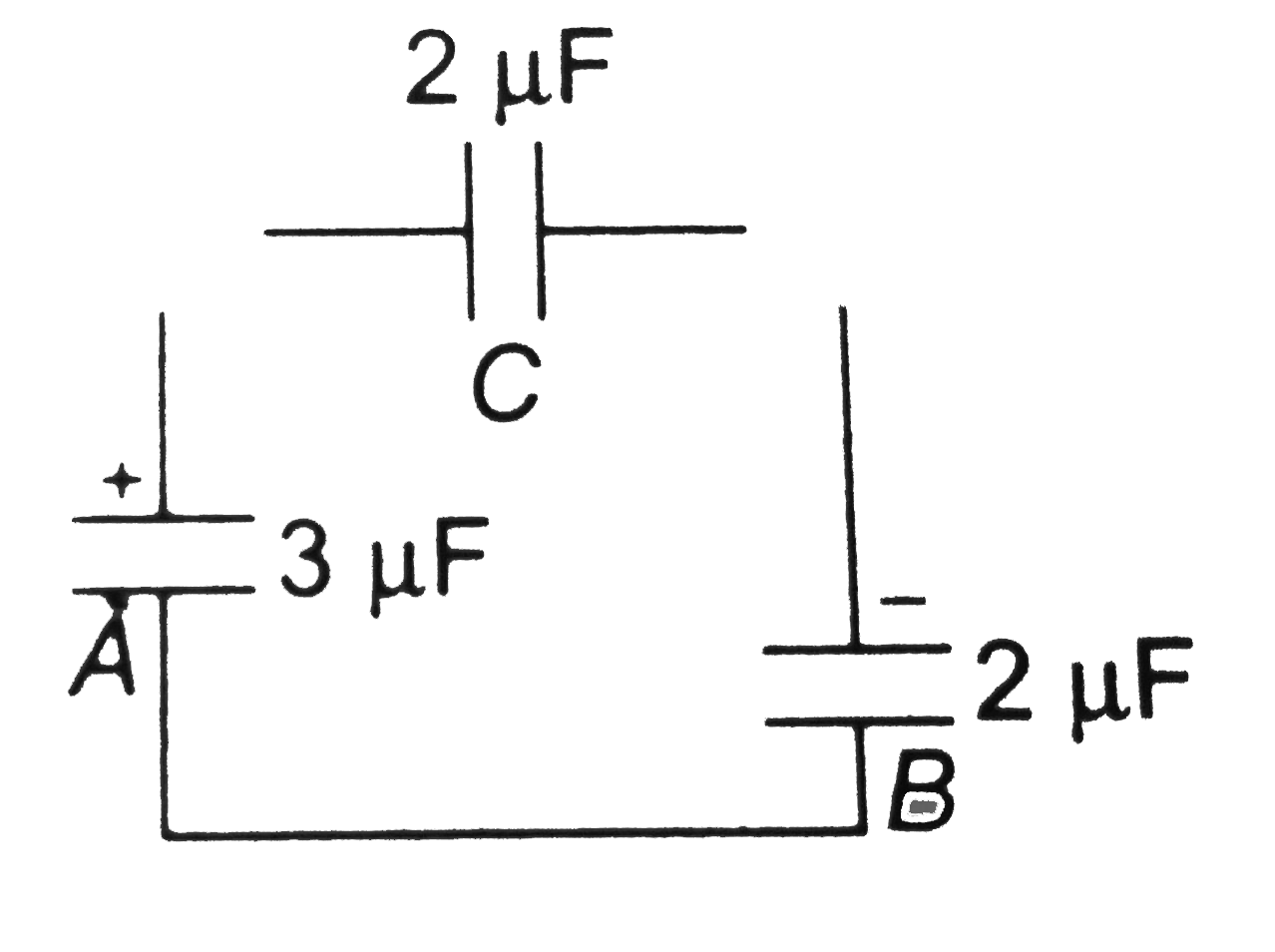
Two capacitors `A` and `B` with capacities `3muF` and `2muF` are charged to a potential difference of `100 V` and `180V`, respectively. The plates of the capacitors are connected as show in figure with one wire of each capacitor free. The upper plate of `A` is positive and that of `B` is negastive. An uncharged `2muF` capcitor `C` with lead wires falls on the free ends to complete the circuit. Calculate
a. the final charge on the three capacitors.
b. the amount of electrostatic energy stored in the system before and after completion of the circuit.

Text Solution

Verified by Experts

The correct Answer is:
A

i. charge on capcitor before joining wilth an uncharged capacitor.

`q_A=CV=(100_(3)muC=300muC)`
Similarly, charge on capacitor B
`q_B=(180)(2)muC=360muC`
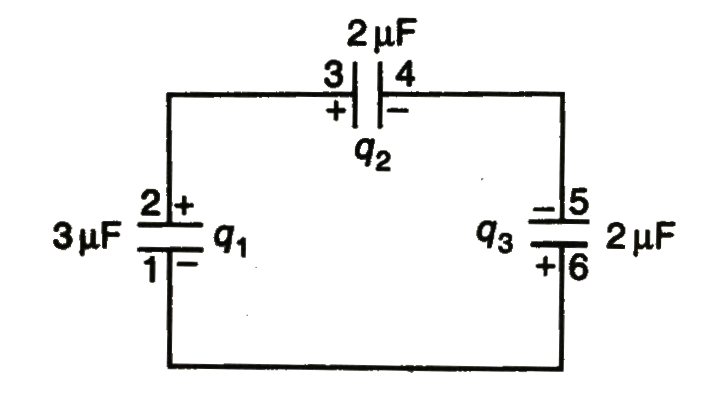
Let `q_1,q_2` and `q_3` be the charge onthe three capacitors after joining them as shown in figure.
`(q_1,q_2` and `q_3` are in microcoulombs)
From conservtion of charge
Net charge on plates 2 and 3 before joining =net charge after joining
`:. 300=q_1+q_2`...........i
Similarly, net chrge on plantes 4 and 5 before joiing =net chasrge after joining
`-360=-q_2-q_3`
`or 360=q_2+q_3`........ii
Applying Kirchoff's second law in closed loop
`q_1/3-q_2/2+q_3/2=0`
or `2q_1-3q_2+3q_3=0`........iii
Solving eqn i , ii, iii we get
`q_1=90muC`
`q_2=210muC`
`q_3=150muC`
ii. a. Electrostatic energy stored before completing the circuit.
`U_i=1/2(3xx10^-6)(100)^2+1/2(2xx10^-60(180))^2 (U=1/2CV^2)`
`=4.74xx10^-2J or U_i=47.4mJ `
b. electrostatic energy stored after completing the circuit,
`U_f=1/2((90xx0^-6)^2)/((3xx10^-6))1/2((210xx10^-6)^2)/((2xx10^-6))`
`+1/2((150xx10^-6)^2)/((2xx10^-6) [U=1/2q^2/C]`
`=1.8xx10^I-2J` or `U_f=18mJ`
Promotional Banner

Topper's Solved these Questions

  • CAPACITORS

    DC PANDEY|Exercise OBJECTIVE_TYPE|1 Videos
  • CAPACITORS

    DC PANDEY|Exercise OBJECTIVE_TYPE|1 Videos
  • ATOMS

    DC PANDEY|Exercise MEDICAL ENTRANCES GALLERY|42 Videos
  • COMMUNICATION SYSTEM

    DC PANDEY|Exercise Subjective|11 Videos

Similar Questions

Explore conceptually related problems

Two capacitors A and B with capacities 3 muF and 2 muF are charged to a potential differece of 100 V and 180 V , respectively. The plates ot the capacitors are connected as shown in, with one wire free from each capacitor. The upper plate of A is positive and that of B is negative An uncharged 2muF capacitor C with lead wires falls on the free ends to complete the circuit. i. Calculate the final charge on the three capacitors, ii. Find the amount of electrostatic energy stored in the system before and after the completion of the circuit. .

Two capacitors of 2muF and 3muF are charged to 150 V and 120 V , respectively. The plates of capacitor are connected as shown in the figure. An uncharged capacitor of capacity 1.5muF falls to the free end of the wire. Then

Two capacitors A and B with capacitors 3 muF and 2 muF are charged to a potential difference of 100 V and 180 V respectively. One plate of two capacitors are connected as shown. Now switch S is closed so as to connect a cell of 100 V to the free plates of two capacitors. (a) Find charge on the two capacitors after the switch is closed. (b) Calculate heat generated in the circuit

Two capacitors of capacitances 3 muF and 6 muF , are charged to potentials 2V and 5V respectively. These two charged capacitors are connected in series. Find the potential across each of the two capacitors now.

Two capacitors of capacitance 10 muF and 20 muF are charged to potential 20 V and 10 V respectively. If they are connected to share charges, then loss of energy is

Two capacitors of capacitances 10muF and 20muF are connected in series across a potential difference of 100V. The potential difference across each capacitor is respectively

Two capacitors A and B of capacitances 2muF and 5 mu F are connected to two battery as shown in figure The potential difference in volt between the plate of A is

A and B are two condensers of capacities 2muF and 4muF . They are charged to potential differences of 12V and 6V respectively. If they are now connected (+ve to +ve), the charge that flows through the connecting wire is

Two capacitors of capacitance 2muF and 5muF are charged to a potential difference 100V and 50 V respectively and connected such that the positive plate of one capacitor is connected to the negative plate of the other capacitor after the switch is closed, the initial current in the circuit is 50 mA. the total resistance of the connecting wires is (in Ohm):

DC PANDEY-CAPACITORS-Exercise
  1. Find the potential difference between points M and N of the system sho...

    Text Solution

    |

  2. In the given circuit diagram, find the charges which flow through dire...

    Text Solution

    |

  3. Two capacitors A and B with capacities 3muF and 2muF are charged to a ...

    Text Solution

    |

  4. The capactor C1 in the figure initially carries a charge q0. When the ...

    Text Solution

    |

  5. A leaky parallel plate capacitor is filled completely with a material ...

    Text Solution

    |

  6. A parallel plate vacuum capacitor with plate area A and separation x h...

    Text Solution

    |

  7. A spherical capacitor has the inner sphere of radius 2 cm and the oute...

    Text Solution

    |

  8. Calculate the charge on each capacitor and the potential difference ac...

    Text Solution

    |

  9. In the shown network, find the charges on capacitors of capacitances 5...

    Text Solution

    |

  10. In the circuit shown, E = 18 kV, C = 10 muF,R1 = 4 MOmega, R2 = 6 MOme...

    Text Solution

    |

  11. The charge on the capacitor is initially zero. Find the charge on the ...

    Text Solution

    |

  12. The capacitors are initially uncharged. In a certain time the capacito...

    Text Solution

    |

  13. A capacitor of capacitance C has potential difference E/2 and another ...

    Text Solution

    |

  14. The capacitor shown in figure has been charged to a potential differen...

    Text Solution

    |

  15. The switch S is closed at t=0 . the capacitor C is uncharged but C0 ha...

    Text Solution

    |

  16. A time varying voltage is applied to the clamps A and B such that volt...

    Text Solution

    |

  17. In the above problem if given graph is between V(AB) and time. Then pl...

    Text Solution

    |

  18. Initially, the switch is in position 1 for a long time. At t = 0, the ...

    Text Solution

    |

  19. For the arrangement shown in the figure, the switch is closed at t = 0...

    Text Solution

    |

  20. In the given circuit the switch ils closed in the positin 1 at t=0 and...

    Text Solution

    |

