Home
Class 12
PHYSICS
Two parallel vertical metallic rails AB ...

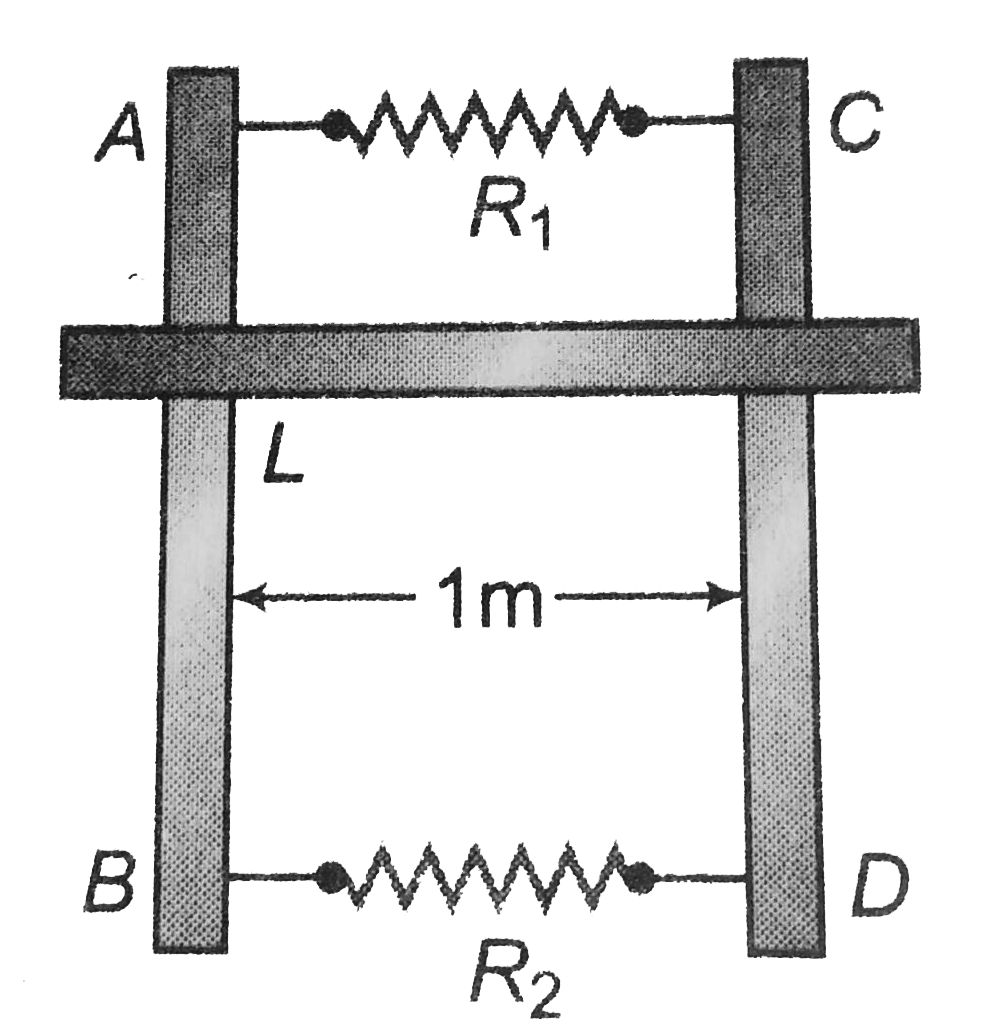
Two parallel vertical metallic rails `AB` and `CD` are separated by `1m`. They are connected at the two ends by resistances `R_1` and `R_2` as shown in the figure. A horizontal metallic bar `l` of mass `0.2 kg` slides without friction, vertically down the rails under the action of gravity. There is a uniform horizontal magnetic field of `0.6 T` perpendicular to the plane of the rails. It is observed that when the terminal velocity is attained, the powers dissipated in `R_1` and `R_2` are `0.76W` and `1.2W` respectively `(g=9.8m//s^2)`

The terminal velocity fo the bar L will be

A

`2m//s`

B

`3m//s`

C

`1m//s`

D

None of these

Text Solution

Verified by Experts

The correct Answer is:

C

At terminal velocity
`iLB=mg`
`:. i=(mb)/(LB)=(0.2xx98)/(1xx0.6)`
`i=3.27A` ...(i)
`e=BvL(v=`terminal velocity)
`=(0.6)(v)(1)`
`e=0.6v`
`P_(R_1)=e^2/R_1`
`:. 0.76=(0.36v^2)/R_1` …..(ii)
`P_(R_2)=e^2/R_2`
`:. 1.2=(0.36v^2)/R_2` .........(iii)
`R_1` and `R_2` are in parallel
`:. R_("net")=(R_1R_2)/(R_1+R_2)`..........iv
`ii=e/(R_("net")` ............(v)
Solving these five equation we can get the results.
Promotional Banner

Topper's Solved these Questions

  • ELECTROMAGNETIC INDUCTION

    DC PANDEY|Exercise SUBJECTIVE TYPE|1 Videos
  • ELECTROMAGNETIC INDUCTION

    DC PANDEY|Exercise Level 2 Subjective|20 Videos
  • ELECTROMAGNETIC INDUCTION

    DC PANDEY|Exercise Level 2 More Than One Correct|10 Videos
  • CURRENT ELECTRICITY

    DC PANDEY|Exercise Medical entrances gallery|97 Videos
  • ELECTROMAGNETIC WAVES

    DC PANDEY|Exercise Sec C|22 Videos

Similar Questions

Explore conceptually related problems

Two parallel vertical metallic rails AB and CD are separated by 1m . They are connected at the two ends by resistances R_1 and R_2 as shown in the figure. A horizontal metallic bar l of mass 0.2 kg slides without friction, vertically down the rails under the action of gravity. There is a uniform horizontal magnetic field of 0.6 T perpendicular to the plane of the rails. It is observed that when the terminal velocity is attained, the powers dissipated in R_1 and R_2 are 0.76W and 1.2W respectively (g=9.8m//s^2) The value of R_1 is

Two parallel vertical metallic rails AB and CD are separated by 1m . They are connected at the two ends by resistances R_1 and R_2 as shown in the figure. A horizontal metallic bar l of mass 0.2 kg slides without friction, vertically down the rails under the action of gravity. There is a uniform horizontal magnetic field of 0.6 T perpendicular to the plane of the rails. It is observed that when the terminal velocity is attained, the powers dissipated in R_1 and R_2 are 0.76W and 1.2W respectively (g=9.8m//s^2) The value of R_2 is

Two parallel vertical metallic rails AB and CD are separated by 1m. They are connected at two ends by resistanace (R_1) and (R_2) as shown in fig. A horizontal metallic bar L of mass 0.2 kg slides without froction vertically down the rails under the action of gravity. THere is a uniform horizontal magnetic field of 0.6 Tesla perpendicular to the plane of the rails. It is observed taht when the teminal velocity is attained, the power dissipated in (R_1) and (R_2) are 0.6 watt and 1.2 watt respectively. Find the terminal velocity of the bar L and the values of (R_1)and (R_2) .

Two parallel vertical metellic rails AB and CD are separated by 1m . They are connecting at two ends by resistances R_(1) and R_(2) as shown in Fig. 3.96. A horizontal metallic bar L mas 0.2 kg slides without friction vertically down the rails under the action of gravity. There is a uniform horozontal magnetic field of 0.6 T perpendicular to the plane of the rails. It is observed that when the terminal velocity is attained, thwe power dissipated in R_(1) and R_(2) are 0.76 and 1.2W , respectively. Find the terminal velocity of the bar L and the values of R_(1) and R_(2) .

A conducting wire xy of lentgh l and mass m is sliding without friction on vertical conduction rails ab and cd as shown in figure. A uniform magnetic field B exists perpendicular to the plane of the rails, x moves with a constant velocity of

A copper rod of mass m slides under gravity on two smooth parallel rails l distance apart set at an angle theta to the horizontal. At the bottom, the rails are joined by a resistance R . There is a uniform magnetic field perpendicular to the plane of the rails. the terminal valocity of the rod is

A vertical ring of radius r and resistance on R falls vertically. It is in contact with two vertical rails which are joined at the top. The rails are without friction and resistance. There is a horizontal uniform, magnetic field of magnitude B perpendicular to the plane of the ring and the rails. When the speed of the ring is v , the current in the section PQ is
