Home
Class 12
PHYSICS
Monochramatic light is incident on the p...

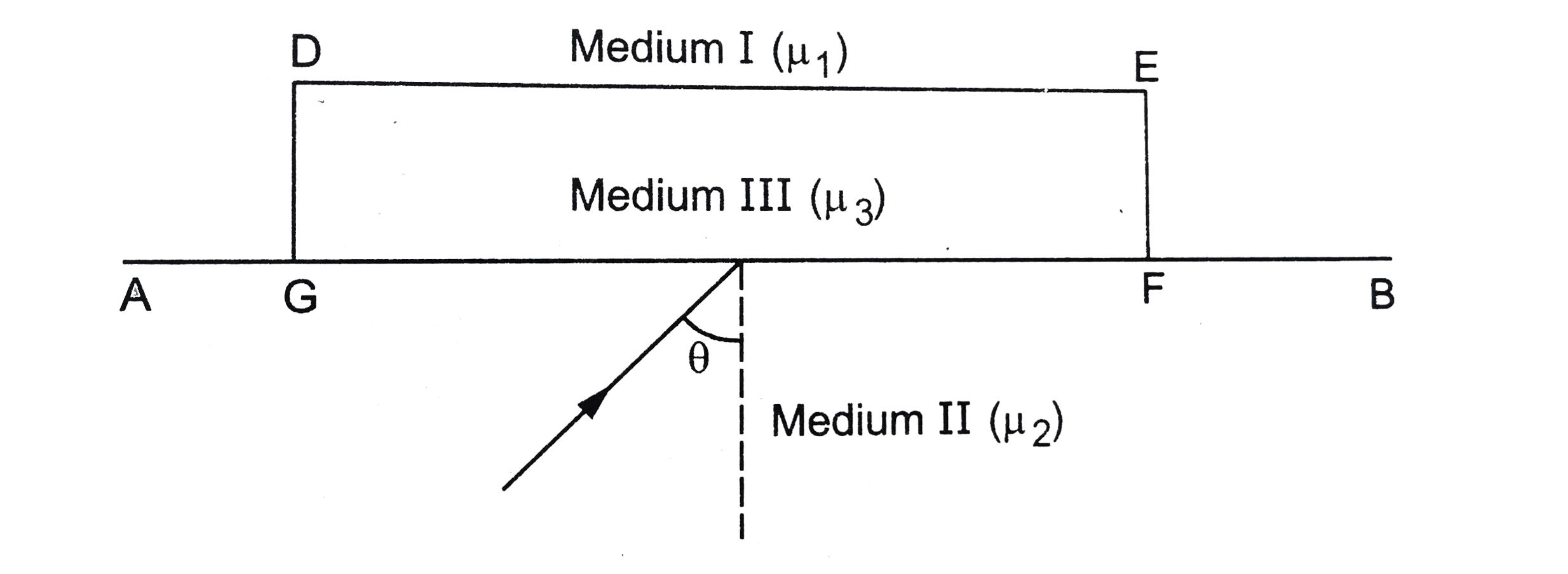
Monochramatic light is incident on the pLane interface AB between two media of refractive indices `mu_1` and `mu_2(mu_2gtmu_1)` at an angle of incidence theta as shown in figure. The angle theta is infinitesimally greater thannte critical angle for the two media so thast total internal reflection takes place. Now, if a transparent slab DEFG of uniform thickness and of refractive inde `mu_2` is introduced on theinterface (as shown in figure ) , show that for any value of `mu_2` all light will ultimately be reflected back into medium II.

Text Solution

Verified by Experts

Given, `theta` is slightly greater than `sin^-1(mu_1/mu_2)`
When `mu_3ltmu_1`
i.e. `mu_3ltmu_1ltmu_2`
or `mu_3/mu_2ltmu_1/mu_2` or `sin^-1(mu_3/mu_2)ltsin^-1(mu_1/mu_2)`
Hence, critical angle for `III` and `II` will be less than the critical angle for `II` and `I`. So, if TIR
is taking place between `I` and `II`, Then TIR will definitely take place between `I` and `III`.
When `mu_3gtmu_1` two cases may arise: Case1 `mu_1ltmu_3ltmu_2`
In this case, there will be no TIR between `II` and `III`
but TIR will take place between `III` and `I`.
This is becuase
Ray of light first enters from `II` to `III`. i.e. from
denser to rarer.
`:. igttheta`
Applying Snell's law at P,
`mu_2sin theta=mu_3sini` or `sini=((mu_(2))/(mu_(3))sin theta`
Since, `sin theta` is slightly greater than `mu_1/mu_2`.
`:. sini` is slightly greater than `mu_2/mu_3xxmu_1/mu_2` or `mu_1/mu_3`
but `mu_1/mu_3` is nothing but `sin (theta_C)_(I,III)`
`:. sin(i)` is slightly greater than sin(theta_C)_(I,III)`
or TIR will now take place on I and III and the ray of light will be reflected back.

Case2 `mu_1ltmu_2ltmu_3`
This time while moving from `II` and `III`, ray of light will
bend towards normal. Again applying Snell's law at P,
`mu_2 sin theta =mu_3 sini`
`sini=mu_2/mu_3 sin theta`
Since, `sin theta` is slightly greater than `mu_1/mu_2`.
Therefore, `sin i` will be slightly than `(mu_2/mu_3xxmu_1/mu_2)` or `(mu_1/mu_3)`
But, `mu_1/mu_3` is `sin (theta_C)_(I,III)`
i.e. `sinigtsin(theta_C)_(I,III)`
`sinigtsin(theta_C)_(I,III)`
`igt(theta_C)_(I,III)`
Therefore, TIR will again take place between I and III and the ray light will be reflected back.
Promotional Banner

Topper's Solved these Questions

  • REFRACTION OF LIGHT

    DC PANDEY|Exercise Example Type 10|1 Videos
  • REFRACTION OF LIGHT

    DC PANDEY|Exercise Example Type 11|3 Videos
  • REFLECTION OF LIGHT

    DC PANDEY|Exercise Subjective|9 Videos
  • SEMICONDUCTORS

    DC PANDEY|Exercise Subjective|12 Videos

Similar Questions

Explore conceptually related problems

A monochromatic light is incident on the plane interface AB between two media of refractive indices mu_(1) and (mu_(2)gtmu_(1)) at an angle of incidence theta as shown in Fig. The angle theta is infinitesimally greater than the critical angle for the two media so that total internal reflection takes place. Now, if a transparent slab DEFG of uniform thickness and of refractive index mu_(3) is introduced on the interface (as shown in the figure), show that for any value of mu_(3) all light will ultimately be reflected back into medium II.

What is the relation between the refractive indices mu,mu_(1) and mu_(2) if the behaviour of light rays is shown in Figure.

The relation between refractive indices u, mu_(1),mu_(2) . if the behaviour of light ray is as shown in figure

A light ray is incident on a glass sphere of reflective index mu = sqrt3 at an angle of incidence 60^(@) as shown in Fig. Find the angles r, r^(') e and the total deviation after two refractions.

For total internal reflection to take place, the angle of incidence i and the refractive index mu of the medium must satisfy the inequality

For total internal reflection to take place, the angle of incidence I and the refractive index mu of the medium must satisfy the inequality

The diagram shows a spherical surface which separates two media of refractive index, mu_(1) and mu_(2) . Respectively. Now, a point object is placed on the principal axis as shown in the figure. Then

DC PANDEY-REFRACTION OF LIGHT-Level 2 Subjective
  1. Monochramatic light is incident on the pLane interface AB between two ...

    Text Solution

    |

  2. a. Figure (a) shows the optical axis of a lens, the point source of ...

    Text Solution

    |

  3. a. Figure (a) shows the optical axis of a lens, the point source of ...

    Text Solution

    |

  4. In Figure, a fish watcher watches a fish through a 3.0 cm thick glass ...

    Text Solution

    |

  5. A concave spherical mirror with a radius of curvature of 0.2 m is fill...

    Text Solution

    |

  6. A lens with a focal length of f=30 cm produces on a screen a sharp ima...

    Text Solution

    |

  7. One side of radius of curvature R2=120 cm of a convexo-convex lens of ...

    Text Solution

    |

  8. A small object is placed on the principal axis of concave spherical mi...

    Text Solution

    |

  9. A thin glass lens of refractive index mu2=1.5 behaves as an interface ...

    Text Solution

    |

  10. A glass hemisphere of radius 10 cm and mu=1.5 is silvered over its cur...

    Text Solution

    |

  11. A equilateral prism of flint glass (mug=3//2) is placed water (muw=4//...

    Text Solution

    |

  12. Rays of light fall on the plane surface of a half cylinder at an angle...

    Text Solution

    |

  13. The figure shows an arrangement of an equi-convex lens and a concave m...

    Text Solution

    |

  14. A convex lens is held 45 cm above the bottom of an empty tank. The ima...

    Text Solution

    |

  15. A parallel beam of light falls normally on the first face of a prism o...

    Text Solution

    |

  16. Two converging lenses of the same focal length f are separated by a di...

    Text Solution

    |

  17. A cubical vessel with non-transparent walls is so located that the eye...

    Text Solution

    |

  18. A spherical ball of transparent material has index of refractionmu. A ...

    Text Solution

    |

  19. A ray incident on the droplet of water at an angle of incidence i unde...

    Text Solution

    |

  20. A transparent solid sphere of radius 2 cm and density rho floats in a ...

    Text Solution

    |

  21. A hollow sphere of glass of inner and outer radii R and 2R respectivel...

    Text Solution

    |

