Home
Class 12
PHYSICS
A parallel beam of rays is incident on a...

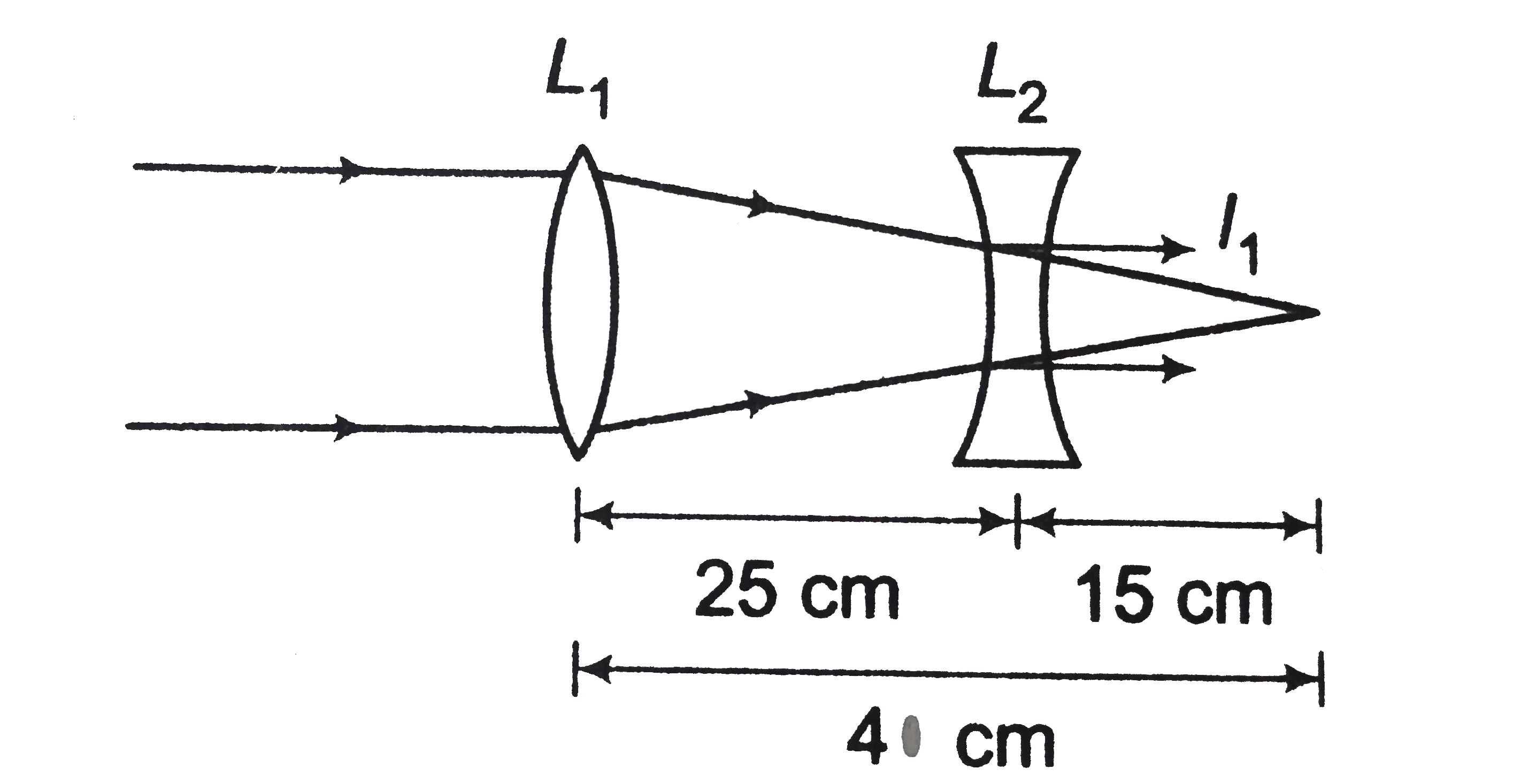
A parallel beam of rays is incident on a convergent lens with a focal length of `40 cm.` Where a divergent lens with a focal length of `15 cm` be placed for the beam of rays to remain parallel after passing through the two lenses.

Text Solution

Verified by Experts

The correct Answer is:
B, C


`I_1` is formed at second focus of `L_1` and first focus
of `L_2.`
Promotional Banner

Topper's Solved these Questions

  • REFRACTION OF LIGHT

    DC PANDEY|Exercise Subjective Questions|8 Videos
  • REFRACTION OF LIGHT

    DC PANDEY|Exercise Level 2 Single Correct|41 Videos
  • REFRACTION OF LIGHT

    DC PANDEY|Exercise Objective Questions|1 Videos
  • REFLECTION OF LIGHT

    DC PANDEY|Exercise Subjective|9 Videos
  • SEMICONDUCTORS

    DC PANDEY|Exercise Subjective|12 Videos

Similar Questions

Explore conceptually related problems

A source of light is located at double focal length from a convergent lens. The focal length of the lens is f=30cm. At what distance from the lens should a flat mirror be placed, so that the rays reflected from the mirror are parallel after passing through the lens for the second time?

An object was placed upright 25cm in front of a converging lens with a focal length of 20cm. A concave mirror with a focal length of 15cm was placed 120cm behind the lens. Which of these describes the final image?

A converging lens of focal length 5.0cm is placed in contact with a diverging lens of focal length 10.0cm. Find the combined focal length of the system.

A point source of light is placed at 2f from a converging lens of focal length f. A flat mirror is placed on the other side of the lens at a distanc d such that rays reflected from the mirror are parallel after passing through the lens again. If f = 30 cm, then d is equal to

A converging beam of light is incident on a concave lens of focal length 20 cm. In the absence of the lens, the beam converges at a point 10 m behind the lens. Find where the beam will converge/diverge after refraction.

A paralel beam of light incident on a concave lens of focal length 10 cm emerges as a parallel beam from a convex lens placed coaxially, the distance between the lenses being 10 cm. The focal length of the convex lens in cm is

A parallel beam of light is incident on a lens of focal length 10 cm. A parallel slab of refractive index 1.5 and thickness 3 cm is placed on the other side of the lens. Find the distance of the final image from the lens. .

A parallel beam of light is incident on a lens of focal length 10cm. A parallel slab of refractive index 1.5 and thickness 3 cm is placed on the other side of the lens. The nature of the final image from the lens slab combination is: (Assume rays paraxial)

DC PANDEY-REFRACTION OF LIGHT-Level 1 Subjective
  1. A glass sphere with 10 cm radius has a 5 cm radius spherical hole at i...

    Text Solution

    |

  2. A glass sphere has radius of 5.0 cm and a refractive index of 1.6. A p...

    Text Solution

    |

  3. A fish is rising up veritcally inside a pond with velocity 4 m//s, and...

    Text Solution

    |

  4. A lens with a focal length of 16 cm produces a sharp image of an objec...

    Text Solution

    |

  5. Two glasses with refractive indices of 1.5 and 1.7 are used to make tw...

    Text Solution

    |

  6. A converging beam of rays in incident on a diverging lens. Having pass...

    Text Solution

    |

  7. A parallel beam of rays is incident on a convergent lens with a focal ...

    Text Solution

    |

  8. An optical system consists of two convergent lenses with focal length ...

    Text Solution

    |

  9. Determine the position of the image produced by an optical system cons...

    Text Solution

    |

  10. A parallel beam of rays is incident on a consisting pf three thin lens...

    Text Solution

    |

  11. A ray of light travelling in glass (mug=3//2) is incident on a horizon...

    Text Solution

    |

  12. A ray of light is incident on the left vertical face of glass cube of ...

    Text Solution

    |

  13. Light is incident from glass (mug=3/2) to water (muw=4/3). Find the ra...

    Text Solution

    |

  14. The angle of minimum deviation for a glass prism with mu=sqrt3 equals ...

    Text Solution

    |

  15. A ray incident on the face of a prism is refracted and escape through ...

    Text Solution

    |

  16. In an equilateral prism of mu=1.5, the condition for minimum deviation...

    Text Solution

    |

  17. In a certain spectrum produced by a glass prism of dispersive power 0....

    Text Solution

    |

  18. An achromatic lens-doublet is formed by placing in contact a convex le...

    Text Solution

    |

  19. An achromatic convergent lens of focal length 150 cm is made by combin...

    Text Solution

    |

  20. The index of refraction of heavy flint glass is 1.68 at 434 nm and 1.6...

    Text Solution

    |

