Home
Class 11
CHEMISTRY
Find DeltaH of the process NaOH(s) rar...

Find `DeltaH` of the process
`NaOH(s) rarr NaOH(g)`
Given: `Delta_(diss)H^(Theta)of O_(2) = 151 kJ mol^(-1)`
`Delta_(diss)H^(Theta) of H_(2) = 435 kJ mol^(-1)`
`Delta_(diss)H^(Theta) of O-H = 465 kJ mol^(-1)`
`Delta_(diss)H^(Theta) of Na -O = 255 kJ mol^(-1)`
`Delta_(soln)H^(Theta)of NaOH = - 46 kJ mol^(-1)`
`Delta_(f)H^(Theta) of NaOH(s) =- 427 kJ mol^(-1)`
`Delta_("sub")H^(Theta) of Na(s) = 109 kJ mol^(-1)`

Text Solution

Verified by Experts
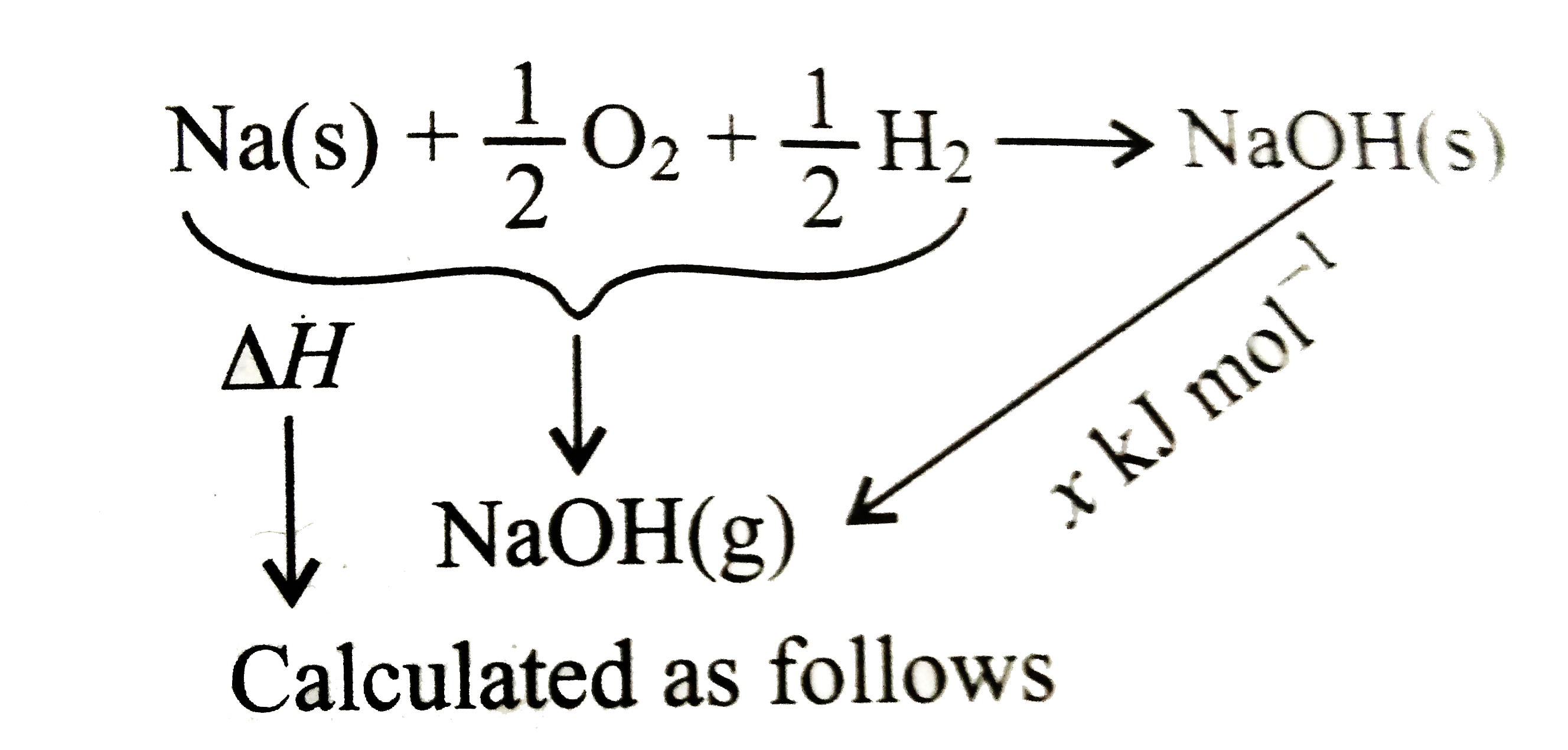

Calculated as follows
`= [DeltaH_("sub"(Na))+(1)/(2)DeltaH_(O_(2)(diss))+(1)/(2)DeltaH_(H_(2)(diss))]-[DeltaH_(NaOH(diss))+DeltaH_(OH(diss))]`
`= (109 +(252)/(2)+(435)/(2)) -(255 +465) =- 268 kJ mol^(-1)`
Now, `-268 =- 427 +x`
`rArr x+159 kJ mol^(-1)`
Promotional Banner

Topper's Solved these Questions

  • THERMODYNAMICS

    CENGAGE CHEMISTRY|Exercise Ex 6.4|16 Videos
  • THERMODYNAMICS

    CENGAGE CHEMISTRY|Exercise Ex 6.5|30 Videos
  • THERMODYNAMICS

    CENGAGE CHEMISTRY|Exercise Ex 6.2|27 Videos
  • STOICHIOMETRY

    CENGAGE CHEMISTRY|Exercise Archives Subjective|33 Videos

Similar Questions

Explore conceptually related problems

Given Delta_(i)H^(Theta)(HCN) = 45.2 kJ mol^(-1) and Delta_(i)H^(Theta)(CH_(3)COOH) = 2.1 kJ mol^(-1) . Which one of the following facts is true?

Calculate the EA of O atom to O^(2-) ion from the following data: i. Delta_(f)H^(ɵ)[MgO(s)] = -600 kJ mol^(-1) ii. Delta_(u)H^(ɵ) [MgO(s)] = -3860 kJ mol^(-1) iii. IE_(1) + IE_(2) of Mg(g) = 2170 kJ mol^(-1) iv. Delta_("diss")H^(ɵ) of Mg(s) = + 494 kJ mol^(-1) v. Delta_("sub")H^(ɵ) of Mg(s) = +150 kJ mol^(-1)

Calculate Deltah for the eaction BaCO_(3)(s)+2HCI(aq) rarr BaCI_(2)(aq)+CO_(2)(g)+H_(2)O(l) Delta_(f)H^(Theta) (BaCO_(3)) =- 290.8 kcal mol^(-1), Delta_(f)H^(Theta) (H^(o+)) =0 Delta_(f)H^(Theta) (Ba^(++)) = - 128.67 kcal mol^(-1) , Delta_(f)H^(Theta)(CO_(2)) =- 94.05 kcal mol^(-1) , Delta_(f)H^(Theta) (H_(2)O) =- 68.32 kcal mol^(-1)

Consider the reaction: 4NH_(3)(g) +5O_(2)(g) rarr 4NO(g) +6H_(2)O(l) DeltaG^(Theta) =- 1010.5 kJ Calculate Delta_(f)G^(Theta) [NO(g)] if Delta_(f)G^(Theta) (NH_(3)) = -16.6 kJ mol^(-1) and Delta_(f)G^(Theta) [H_(2)O(l)] =- 237.2 kJ mol^(-1) .

Calculate the resonance enegry of toulene (use Kekule structure form the following data C_(7)H_(8)(l) +9O_(2)(g) rarr 7CO_(2)(g) +4H_(2)O(l)+ DeltaH, DeltaH^(Theta) =- 3910 kJ mol^(-1) C_(7)H_(8)(l) rarr C_(7)H_(8)(g), DeltaH^(Theta) = 38.1 kJ mol^(-1) Delta_(f)H^(Theta) (water) =- 285.8 kJ mol^(-1) Delta_(f)H^(Theta) [CO_(2)(g)] =- 393.5 kJ mol^(-1) Heat of atomisaiton of H_(2)(g) = 436.0 kJ mol^(-1) Heat of sulimation of C(g) = 715.0 kJ mol^(-1) Bond energies of C-H, C-C , and C=C are 413.0, 345.6 , and 610.0 kJ mol^(-1) .

Calculate the resonance energy of gaseous benzene form the following data. BE(C-H) = 416.3 kJ mol^(-1) BE(C-C) = 331.4 kJ mol^(-1) BE(C=C) = 591.1 kJ mol^(-1) Delta_("sub")H^(Theta)(C,"graphite") = 718.4 kJ mol^(-1) Delta_("diss")H^(Theta)(H_(2),g) = 435.9 kJ mol^(-1) Delta_(f)H^(Theta) ("benzene", g) = 82.9 kJ mol^(-1)

Calculate the lattice energy of the reaction Li^(o+)(g) +CI^(Theta) (g) rarr LiCI(s) from the following data: Delta_("sub")H^(Theta)(Li) = 160.67 kJ mol^(-1), (1)/(2)D(CI_(2)) = 122.17 kJ mol^(-1) IP(Li) = 520.07 kJ mol^(-1),E_(A)(CI) = - 365.26 kJ mol^(-1) and Delta_(f)H^(Theta)(LiCI) =- 401.66 kJ mol^(-1)

The value of log_(10)K for a reaction A hArr B is (Given: Delta_(f)H_(298K)^(Theta) =- 54.07 kJ mol^(-1) , Delta_(r)S_(298K)^(Theta) =10 JK^(=1) mol^(-1) , and R = 8.314 J K^(-1) mol^(-1)

If Delta_(f)H^(@) _(C_(3)H_(8)(g))=-85kJ moll^(-1), Delta_(f)H^(@) _(C_(3)H_(8)(g))=-104kJ mol^(-1), DeltaH for C_((s))rarr C_((g)) is 718kJ mol^(-1) and heat of formation of H- atom is 218kJ mol^(-1) , then :

CENGAGE CHEMISTRY-THERMODYNAMICS-Ex 6.3
  1. DeltaH combustion for CH(4),C(2)H(6), and C(3)H(8) are -210.8,-368.4 a...

    Text Solution

    |

  2. When 12.0g of C reacted with a limited quantity of oxygen, 57.5 kcal o...

    Text Solution

    |

  3. When 12.0g of C reacted with oxygen to form CO and CO(2) at 25^(@)C at...

    Text Solution

    |

  4. Given CaCI(2)(s) +aq rarr CaCI(2)(aq): DeltaH^(Theta) = 75 kJ mol^(-1)...

    Text Solution

    |

  5. The dissociation pressure of CaCO(3)(s) overset(Delta) rarr CaO(s) +...

    Text Solution

    |

  6. Calculate the enthalpy change for the following reaction: XeF(4) rar...

    Text Solution

    |

  7. The conversion of gaseous atoms K and F to K^(o+) and F^(ɵ) absorbs 0....

    Text Solution

    |

  8. While 1mol of ice melts at 0^(@)C and at constant pressure of 1atm, 14...

    Text Solution

    |

  9. At 25^(@)C, buring 0.2 "mole" H(2) with 0.1 mole O(2) to produce H(2)O...

    Text Solution

    |

  10. Calculate the enthalpy of formation of aniline. The enthalpy of combus...

    Text Solution

    |

  11. Calcualte the enthalpy change when infinitely dilute solution of CaCI(...

    Text Solution

    |

  12. The sublimation energy of a metal is 100kJmol^(-1) and its Ist and Iin...

    Text Solution

    |

  13. The C-H bond of the side chain in toluene, C(6)H(5)-CH(3), has a disso...

    Text Solution

    |

  14. Calculate Deltah for the eaction BaCO(3)(s)+2HCI(aq) rarr BaCI(2)(aq...

    Text Solution

    |

  15. Calculate the heat produced when 3.785 L of octabe reacts with oxygeb ...

    Text Solution

    |

  16. a. Cis-2-butene rarr trans-2-butane, DeltaH(1) b. Cis-2-butane rarr1...

    Text Solution

    |

  17. Calculate the proton affinity of NH(3)(g) from the following data (in ...

    Text Solution

    |

  18. In certan areas where coal is cheap, artificial gas is produced for ho...

    Text Solution

    |

  19. Calculate the enthalpy of combustion of benzene (l) on the basis of th...

    Text Solution

    |

  20. Find DeltaH of the process NaOH(s) rarr NaOH(g) Given: Delta(diss)...

    Text Solution

    |

