Home
Class 12
CHEMISTRY
Calculate the EMF of the following conce...

Calculate the `EMF` of the following concentration cells a `30^(@)C` and predict whether the cells are exergonic or endergonic. `[` Assume `Kw` does not chage at `30^(@)C]`
`a. Pt|H_(2)(g)(1 atm)|H^(o+)(10^(-6)M)||H^(o+)(10^(-4)M)|H_(2)(g)(1atm)|Pt`
`b. Pt||Hg_(2)(1atm)|NaOH(10^(-4)M)||H^(o+)(10^(-5)M)|H_(2)(g),(1 atm)|Pt`
`c. Pt|H_(2)(g)(1 atm)|H_(2)SO_(4)(0.05M)||KOH(10^(-3)M)|H_(2)(g)(1atm)|Pt`
`d. Pt|H_(2)(g)(1 atm)|CH_(2)COOH(10^(-2)M)||CsOH(10^(-3)M)|H_(2)(g)(1atm)|Pt(pK_(a) of CH_(3)COOH=4.74)`
`e. Pt|H_(2)(g)(1atm)|H_(2)O||HCl(10^(-3)M)|H_(2)(g)(1 atm)|Pt`
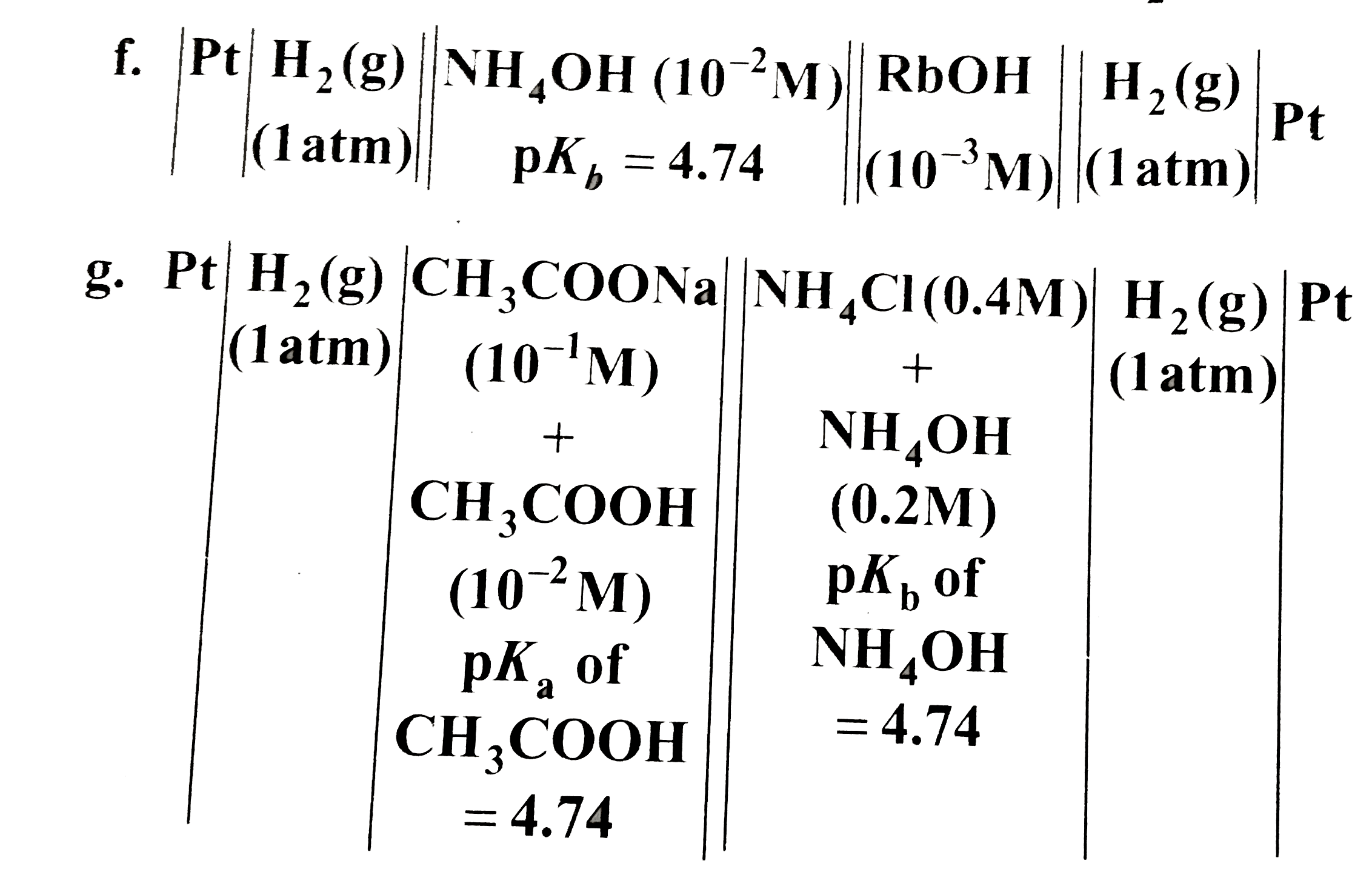
`f.

Text Solution

Verified by Experts

`a." "[H^(o+)]_(cathode )gt[H^(o+)]_(anode)or pH_(cathode)ltpH_(anode )`
So `EMF` of the cell will be positive and the cell will be spontaneous or exergonix `(i.e., DeltaG=-ve).`
`(pH)_(c)=4,(pH)_(a)=6`
`:.E_(cell)=-0.060(pH_(c)-pH_(a))=-0.060(4-6)=0.12V`
`b. (pH)_(c)=5,(pOH)_(a)=4`,or `(pH)_(a)=14-4=10`
Since `(pH)_(c)lt(pH)_(a)`, so `EMF` of the cell will be positive and the cell will be spontaneous or exergonic.
`:. E_(cell) =-0.06(5-10)=0.30V`
`c.` Since`[H_(2)SO_(4)]=[H^(o+)]_(a)=0.05xx2(n` factor `)`
`=0.1N=10^(-1)N`
`pH_(a)=1,(pOH)_(c)=3,pH_(c)=14-3=11`
Since `pH_(c)gtpH_(a)` so `EMF` of cell will be negative and the cell will not be feasible or non`-` spontaneous or endergonic `(i.e., Delta G=+ve)`.
`E_(cell)=-0.06(pH_(c)-pH_(a))=-0.06(11-1)=-0.6V.`
`d. CH_(3)COOH` is a weak acid and `CsOH` is a strong base.
Thus, `pH_(wA)=(1)/(2)(pK_(a)-log c)`
`=(1)/(2)(4.74-log 10^(-2))`
`=(1)/(2)(4.74+2)=3.37=pH_(a)`
`(pOH)_(c)=3,impliespH_(c)=14-3=11`
Since `pH_(c)gtpH_(a),` so `EMF` of cell will be negative and is endergonic.
`E_(cell)=-0.06(pH_(c)-pH_(a))=-0.06(11-3.37)`
`=-0.06xx7.63`
`=-0.457V`
`e." "pH` of `H_(2)O=7=pHa`
`pH_(c)=3 `
Since `pH_(c)ltpH_(a),EMF_(cell)=+ve,` cell is exergonic.
`E_(cell)=-0.06(pH_(c)-pH_(a))=-0.06(3-7)=0.24V`
`f.` `NH_(4)OH` is a weak base and `RbOH` is a strong base.
Thus, `pOH_(wB)=(1)/(2)(pK_(b)-log C)=(1)/(2)(4.74-log10^(-2))=3.37`
`pH_(a)=14-3.37=10.63`
`(pOH)=3,impliespH_(c)=14-3=11`
Since `pH_(c)gtpH_(a)`, therefore, `EMF_(cell)=-ve,` cell will be endergonic.
`E_(cell)=-0.06(pH_(c)-pH_(a))=-0.06(11-10.63)`
`=-0.022V`
`g.` Mixture of `CH_(3)COOH(W_(A))` and salt of `W_(A)//S_(B)`
`(CH_(3)COONa)` is an acidic buffer. Thus,
`:. pH_(aci d b uffer )=pK_(a)+lo.([Sal t])/([Aci d])`
`=4.74+log.(10^(-1)M)/(10^(-2)M)`
`=4.74+1=5.74`
Mixture of `NH_(4)OH(W_(B))` and salt of `W_(B)//S_(A)(NH_(4)Cl)` is a basic buffer.
`:. pOH_(basic buffer)=pK_(a)+lo.([Sa l t])/([Base])`
`=4.74+log `(0.4M)/(0.2M)`
`=4.74+log 2 `
`=4.74+0.3 = 5.04`
`:. pH_9c)=14-5.04=8.96`
Since `pH_(c)gtpH_(a)`
`:. EMF_(cell)=-ve,` cell is endergonic.
`E_(cell)=-0.06(pH_(c)-pH_(a))=-0.06(8.96-5.4)`
`=-0.06xx3.22`
`=-0.1932V`
Promotional Banner

Topper's Solved these Questions

  • ELECTROCHEMISTRY

    CENGAGE CHEMISTRY|Exercise Solved Examples (Electrochemical Cell)|36 Videos
  • ELECTROCHEMISTRY

    CENGAGE CHEMISTRY|Exercise Solved Examples(Electrolysis And Electrolytic Cells)|12 Videos
  • D AND F BLOCK ELEMENTS

    CENGAGE CHEMISTRY|Exercise Archives Subjective|29 Videos
  • GENERAL PRINCIPLES AND PROCESS OF ISOLATION OF ELEMENTS

    CENGAGE CHEMISTRY|Exercise Archives (Subjective)|14 Videos

Similar Questions

Explore conceptually related problems

The pH of LHE in the following cell is : Pt, H_(2)(1atm)|H^(o+)(x M)||H^(o+)(0.1M)|H_(2)(0.1atm)Pt E_(cell)=0.295V .

The potential of the cell containing two hydrogen electrodes as represented below Pt, H_(2(g))|H^(+)(10^(-6)M)"||"H^(+)(10^(-4)M)|H_(2(g)),Pt at 298 K is

Calculate the e.m.f. of the cell Pt|H_(2)(1.0atm)|CH_(3)COOH (0.1M)||NH_(3)(aq,0.01M)|H_(2)(1.0atm)|Pt K_(a) (CH_(3)COOH) =1.8 xx 10^(-5), K_(b),(NH_(3)) = 1.8 xx 10^(-5)

For the cell Pt_((s)), H_(2) (1 atm)|H^(+) (pH=2)||H^(+) (pH=3)|H_(2) (1atm),Pt The cell reaction is

Consider the cell : Pt|H_(2)(p_(1)atm)|H^(o+)(x_(1)M) || H^(o+)(x_(2)M)|H_(2)(p_(2)atm)Pt . The cell reaction be spontaneous if

Calculate pH of the half cell : Pt,H_(2)(1 atm)|H_(2)SO_(4)" "E^(c-)=-0.3V

Pt(H_(2))(p_(1))|H^(o+)(1M)|(H_(2))(p_(2)),Pt cell reaction will be exergonic if

CENGAGE CHEMISTRY-ELECTROCHEMISTRY-Archieves Subjective
  1. Calculate the EMF of the following concentration cells a 30^(@)C and p...

    Text Solution

    |

  2. A current of 3.7 A is passed for 6hrs. Between Ni electrodes in 0.5 L ...

    Text Solution

    |

  3. Consider the cell : Zn|Zn^(2+)(aq)(1.0M)||Cu^(2+)(aq)(1.0M)||Cu Th...

    Text Solution

    |

  4. In an electrolysis experiment, current was passed for 5h through two c...

    Text Solution

    |

  5. How long a current of 3A has to be passed through a solution of silver...

    Text Solution

    |

  6. Give reasons in one or two sentences :" anhydrous HCl is a bad conduc...

    Text Solution

    |

  7. The EMF of the following cellis 1.05V at 25^(@)C: Pt,H(2)(g)(1.0 atm...

    Text Solution

    |

  8. During the discharge of a lead storage battery, the density of sulphur...

    Text Solution

    |

  9. A 100-W,100-V incardescent lamp is connected in series with an electro...

    Text Solution

    |

  10. A cell contains two hydrogen electrodes. The negative electrode is in ...

    Text Solution

    |

  11. In a fuel cell, hydrogen and oxygen react to produce electricity. In p...

    Text Solution

    |

  12. An acidic solution of Cu^(2+0 salt containing 0.4g of Cu^(2+) is elect...

    Text Solution

    |

  13. The standard reduction potential at 25^(@)C of the reaction 2H(2)O+2...

    Text Solution

    |

  14. The standard reduction potential of Cu^(2+)|Cu and Ag^(o+)|Ag electrod...

    Text Solution

    |

  15. Calculate the quantity of electricity that would be required to reduce...

    Text Solution

    |

  16. Zinc granules are added in excess to 500 mL of 1M Ni(NO(3))(2) solutio...

    Text Solution

    |

  17. A current of 1.70A is passed trhough 300.0 mL of 0.160M solution of Zn...

    Text Solution

    |

  18. For the galvanic cell: Ag|AgCI(s)|KCI(0.2M)||KBr(0.001M)|AgBr(s)|Ag, c...

    Text Solution

    |

  19. An aqueous solution of NaCl on electrolysis gives H(2)(g), Cl(2)(g), a...

    Text Solution

    |

  20. The standard reduction potential for the half cell : NO(3)^(-)(aq)+2...

    Text Solution

    |

  21. Chromium metal can be plated out from an acidic solution containing Cr...

    Text Solution

    |
