Home
Class 12
CHEMISTRY
Arrange the following compounds in the o...

Arrange the following compounds in the order of decreasing molar conductivity in aqueous solution.
`i.a. K[Co(NH_(3))_(2)(NO_(2))_(4)]`
`b. [Cr(NH_(3))_(3)(NO_(2))_(3)]`
`c." " [Cr(NH_(3))_(5)(NO_(2))]_(3)[Co(NO_(2))_(6)]_(2)`
`d." "[Mg(Cr(NH_(3)(NO_(2))_(5)]`
`ii. a. Li[Co(NH_(3))_(2)(NO_(2))_(4)]" "b." "Na[Co(NH_(3))_(2)(NO_(2))_(4)]`
` c.K[Co(NH_(3))_(2)(NO_(2))_(4)]" "d." "Cs[Co(NH_(3))_(2)(NO_(2))_(4)]`
`iii. a. Pt(NH_(3))_(6)Cl_(4)"" b." " Cr(NH_(3))_(6)Cl_(3)`
`c." " Co(NH_(3))_(4)Cl_(3)" "d. K_(2)PtCl_(6)`

Text Solution

Verified by Experts

Conductance or conductivity in an aqueous solution depedns on `:`
Greater the number of ions in solution, more is the conductance.
For same number of ions, greater the charge on the ion, more is the conductance.
If the number of ions and charge on the ions are equal, then conductance is inversely proportional to its size in the aqueous solution.
For example, the size of `Cs^(o+)gtRb^(o+)gtK^(o+)gtNa^(o+)gtLi^(o+)`. Thus, smallest ion should move more rapidly, however, ionic mobility shows the reverse trend because smaller ions are more extensively hydrated `(` due to high charge densit`)` and thus hydrated ion size for these ions is `:`
`Li^(o+)(aq)gtNa^(o+)(aq)gtK^(o+)(aq)gtRb^(o+)(aq)gtCs^(o+)(aq)`

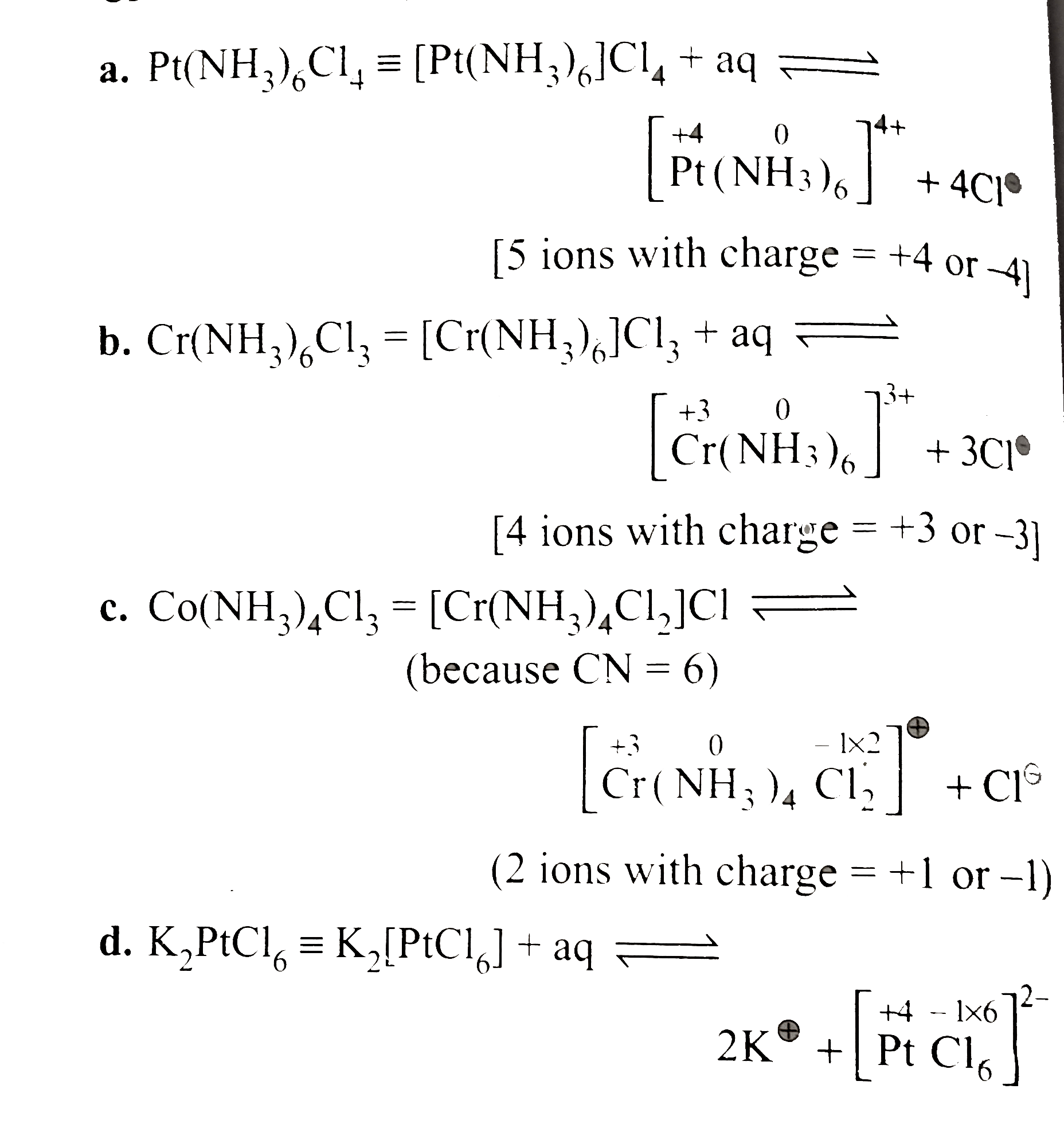
`(` Two ions with charge `+1` or `-1)`

No ionization `(` no ions with zero charge `)`
`(` Five ions with charge `=+6 ` or `-6)`
`[` Two ions with charge `=+2` or `-2]`
So the decreasing order of conductance is `:`
`cgtdgtagtb`
`ii.` Since the anion part is same in all the coordination compounds and the number of ions produced in solution `(2 ` ions `)` and charge `(+1 `or `-1)` is also same, so the conductance will depend on the size of the ions in aqueous medium and inversely proportional to its size.
So, the size of these ions in aqueous solution is
`Li^(o+)(aq)gtNa^(o+)(aq)gtK^(o+)(aq)gtCs^(o+)(aq)`
and conductance is reversed.
`:. ` Decreasing order of conductance is
`dgtcgtbgta`
`iii. ` In this question, first write these compounds in the form of coordination compounds, knowing their coordination number. For example ,
`CN` for `Pt^(4+),Cr^(3+),Co^(3+)=6`
So decreasing order of conductance is `:`
`agtbgtdgtc`
Promotional Banner

Topper's Solved these Questions

  • ELECTROCHEMISTRY

    CENGAGE CHEMISTRY|Exercise Solved Examples (Electrochemical Cell)|36 Videos
  • ELECTROCHEMISTRY

    CENGAGE CHEMISTRY|Exercise Solved Examples(Electrolysis And Electrolytic Cells)|12 Videos
  • D AND F BLOCK ELEMENTS

    CENGAGE CHEMISTRY|Exercise Archives Subjective|29 Videos
  • GENERAL PRINCIPLES AND PROCESS OF ISOLATION OF ELEMENTS

    CENGAGE CHEMISTRY|Exercise Archives (Subjective)|14 Videos

Similar Questions

Explore conceptually related problems

Arrange the following compounds in order of increasing molar conductivity . (i) K[Co(NH_(3))_(2)(NO_(2))_(4)]" " (ii) [Cr(NH_(3))_(3)(NO_(2))_(3)] (iii) [Cr(NH_(3))_(5)(NO_(2))]_(3)[Co(NO_(2))_(6)]_(2)" " (iv) [Cr(NH_(3))_(6)]Cl_(3)

Arrange the following compounds in order of increasing molar conductivity (a) K[Co(NH_(3))_(2)(NO_(2)_(4)] (b) [Cr(NH_(3))_(3)(NO_(2))_(3)] (c) [Cr(NH_(3))_(5)(NO_(2))]_(3)[Co(NO_(2))_(6)]_(2) (d) Mg[Cr(NH_(3))(NO_(2))_(5)]

[Co(NH_(3))_(4)(NO_(2))_(2)]CI exhibits

[Co(NH_(3))_(5)NO_(2)]SO_(4) shows

IUPAC name [Co(NH_(3))_(5)(NO_(2))]Cl_(2) is

Arrange the following complexes in the increasing order of conductivity of their solution [Co(NH_(3))_(3)Cl_(3)], [Co(NH_(3))_(4)Cl_(2)]Cl, [Co(NH_(3))_(6)]Cl_(3), [Cr(NH_(3))_(5)Cl] Cl_(2)

CENGAGE CHEMISTRY-ELECTROCHEMISTRY-Archieves Subjective
  1. Arrange the following compounds in the order of decreasing molar condu...

    Text Solution

    |

  2. A current of 3.7 A is passed for 6hrs. Between Ni electrodes in 0.5 L ...

    Text Solution

    |

  3. Consider the cell : Zn|Zn^(2+)(aq)(1.0M)||Cu^(2+)(aq)(1.0M)||Cu Th...

    Text Solution

    |

  4. In an electrolysis experiment, current was passed for 5h through two c...

    Text Solution

    |

  5. How long a current of 3A has to be passed through a solution of silver...

    Text Solution

    |

  6. Give reasons in one or two sentences :" anhydrous HCl is a bad conduc...

    Text Solution

    |

  7. The EMF of the following cellis 1.05V at 25^(@)C: Pt,H(2)(g)(1.0 atm...

    Text Solution

    |

  8. During the discharge of a lead storage battery, the density of sulphur...

    Text Solution

    |

  9. A 100-W,100-V incardescent lamp is connected in series with an electro...

    Text Solution

    |

  10. A cell contains two hydrogen electrodes. The negative electrode is in ...

    Text Solution

    |

  11. In a fuel cell, hydrogen and oxygen react to produce electricity. In p...

    Text Solution

    |

  12. An acidic solution of Cu^(2+0 salt containing 0.4g of Cu^(2+) is elect...

    Text Solution

    |

  13. The standard reduction potential at 25^(@)C of the reaction 2H(2)O+2...

    Text Solution

    |

  14. The standard reduction potential of Cu^(2+)|Cu and Ag^(o+)|Ag electrod...

    Text Solution

    |

  15. Calculate the quantity of electricity that would be required to reduce...

    Text Solution

    |

  16. Zinc granules are added in excess to 500 mL of 1M Ni(NO(3))(2) solutio...

    Text Solution

    |

  17. A current of 1.70A is passed trhough 300.0 mL of 0.160M solution of Zn...

    Text Solution

    |

  18. For the galvanic cell: Ag|AgCI(s)|KCI(0.2M)||KBr(0.001M)|AgBr(s)|Ag, c...

    Text Solution

    |

  19. An aqueous solution of NaCl on electrolysis gives H(2)(g), Cl(2)(g), a...

    Text Solution

    |

  20. The standard reduction potential for the half cell : NO(3)^(-)(aq)+2...

    Text Solution

    |

  21. Chromium metal can be plated out from an acidic solution containing Cr...

    Text Solution

    |