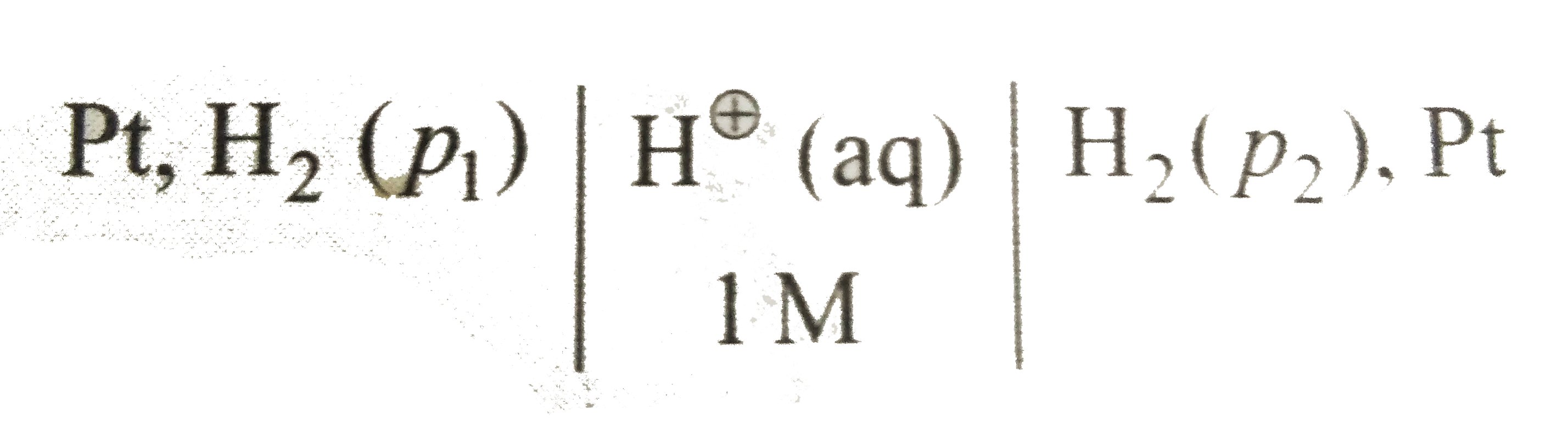
A
B
C
D
Text Solution
Verified by Experts
The correct Answer is:



Topper's Solved these Questions
ELECTROCHEMISTRY
CENGAGE CHEMISTRY|Exercise Ex 3.2 (Objective)|26 VideosELECTROCHEMISTRY
CENGAGE CHEMISTRY|Exercise Ex 3.3 (Objective)|10 VideosELECTROCHEMISTRY
CENGAGE CHEMISTRY|Exercise Solved Examples(Electrolysis And Electrolytic Cells)|12 VideosD AND F BLOCK ELEMENTS
CENGAGE CHEMISTRY|Exercise Archives Subjective|29 VideosGENERAL PRINCIPLES AND PROCESS OF ISOLATION OF ELEMENTS
CENGAGE CHEMISTRY|Exercise Archives (Subjective)|14 Videos
Similar Questions
Explore conceptually related problems
CENGAGE CHEMISTRY-ELECTROCHEMISTRY-Ex 3.1 (Objective)
- If all species are in their standard states, which of the following is...
Text Solution
|
- The standard EMF of a galvanic cell involving cell reaction with n=2 i...
Text Solution
|
- The correct order of reactivity of K,Mg,Zn and Cu with water according...
Text Solution
|
- For Pt(H(2))|H(2)O , reduction potential at 298 K and 1 atm is :
Text Solution
|
- Consider the cell : Pt|H(2)(p(1)atm)|H^(o+)(x(1)M) || H^(o+)(x(2)M)|...
Text Solution
|
- If E^(c-).(Fe^(3+)|Fe) and E^(c-).(Fe^(2+)|Fe) are =-0.36 V and -0.439...
Text Solution
|
- Pt(Cl(2))(p(1))|HCl(0.1M)|(Cl(2))(p(2)),Pt cell reaction will be ender...
Text Solution
|
- Consider the following cell with hydrogen electrodes at difference pre...
Text Solution
|
- Consider the following cell reaction Zn +2Ag^(o+)rarr Zn ^(2+)+2Ag....
Text Solution
|
- The standard reduction potentials of three metals A,B, and C are +0.5 ...
Text Solution
|
- Calculate the maximum work that can be obtained from the decimolar Dan...
Text Solution
|
- Stronger the oxidizing agent, greater is the
Text Solution
|
- Consider the cell Ag(s)|AgBr(s)Br^(c-)(aq)||AgCl(s),Cl^(c-)(aq)|Ag(s) ...
Text Solution
|
- The pH of LHE in the following cell is : Pt, H(2)(1atm)|H^(o+)(x M)...
Text Solution
|
- At what concentration of [overset(c-)(O)H] does the following half rea...
Text Solution
|
- If hydrogen electrodes dipped in two solutions of pH=3 and pH=6 are co...
Text Solution
|
- Consider the cell reaction : Mg(s)+Cu^(2+)(aq) rarr Cu(s) +Mg^(2+)(a...
Text Solution
|
- E^(c-).(red) of different half cell are given as : E^(c-).(Cu^(2+)|C...
Text Solution
|
- For the reaction : A+2B^(3+) rarr 2B^(2+)+A^(2+) E^(0) of the give...
Text Solution
|
- Excess of solid AgCl is added to a 0.1 M solution of Br^(c-) ions. E^(...
Text Solution
|