Home
Class 12
CHEMISTRY
The following mechanism has been propose...

The following mechanism has been proposed for the exothermic catalyzed cmplex reaction:
`A + B overset("Fast")rarr IABoverset(k_(1))rarrAB+Ioverset(k_(2))rarrP+A`
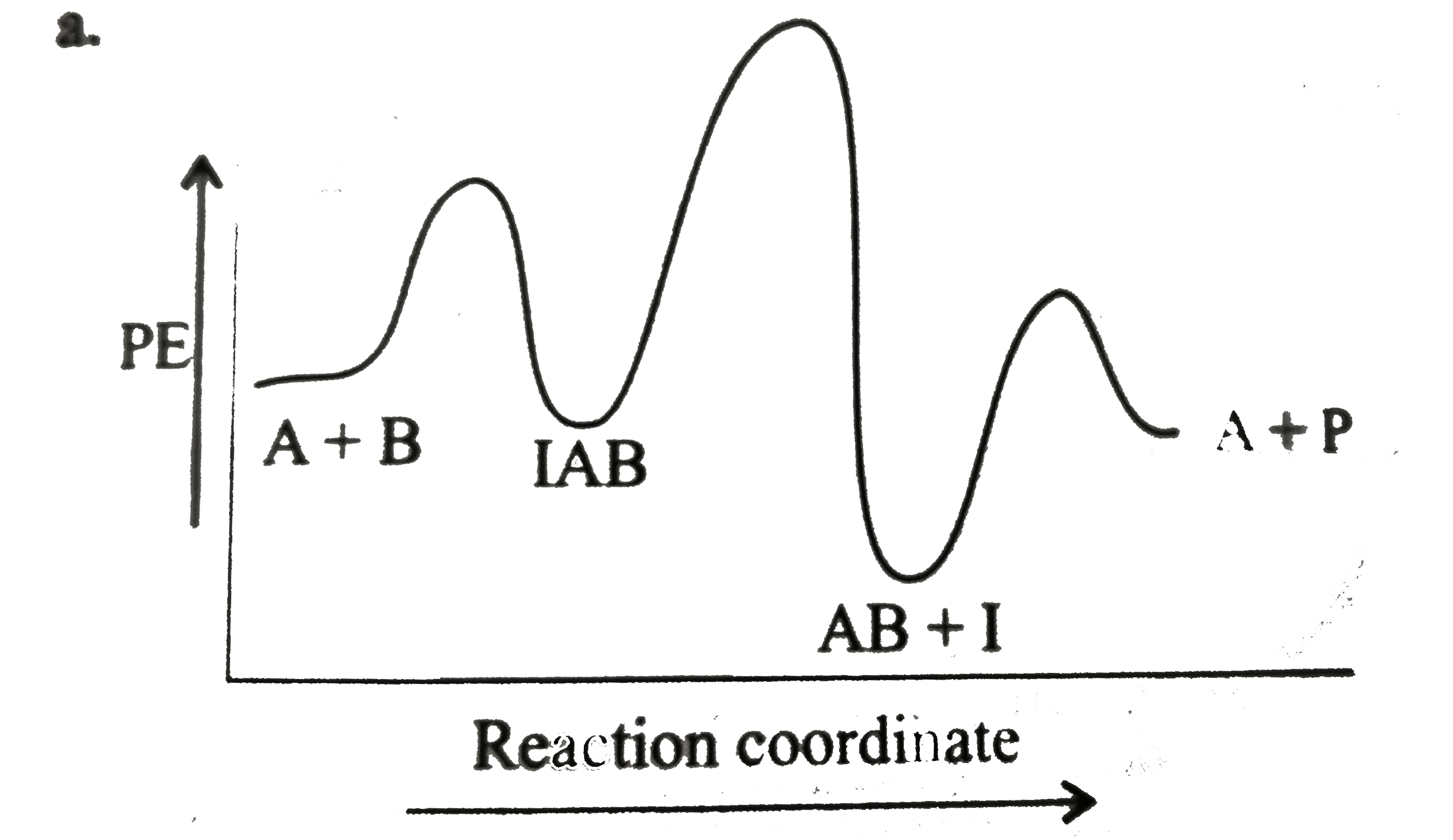
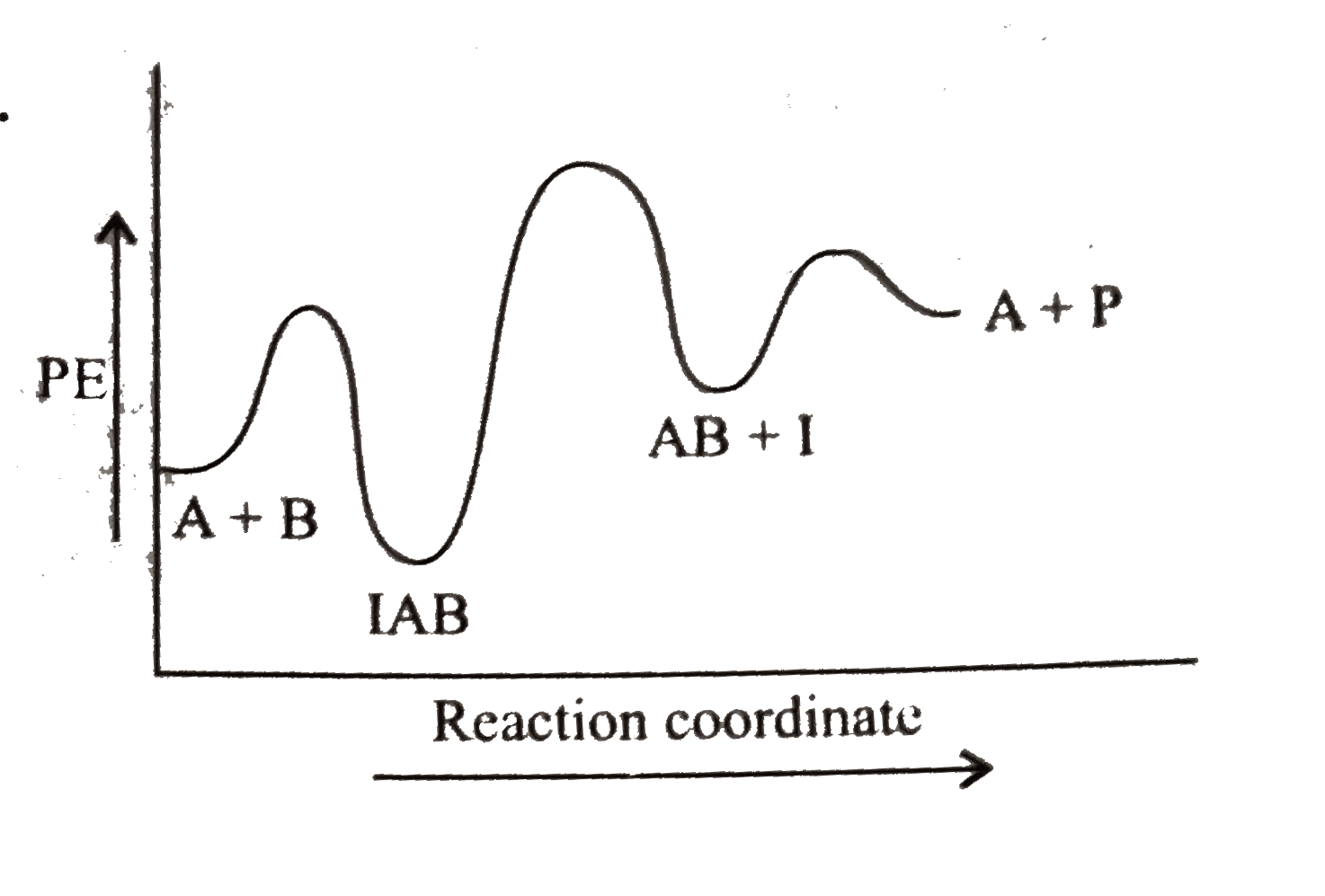
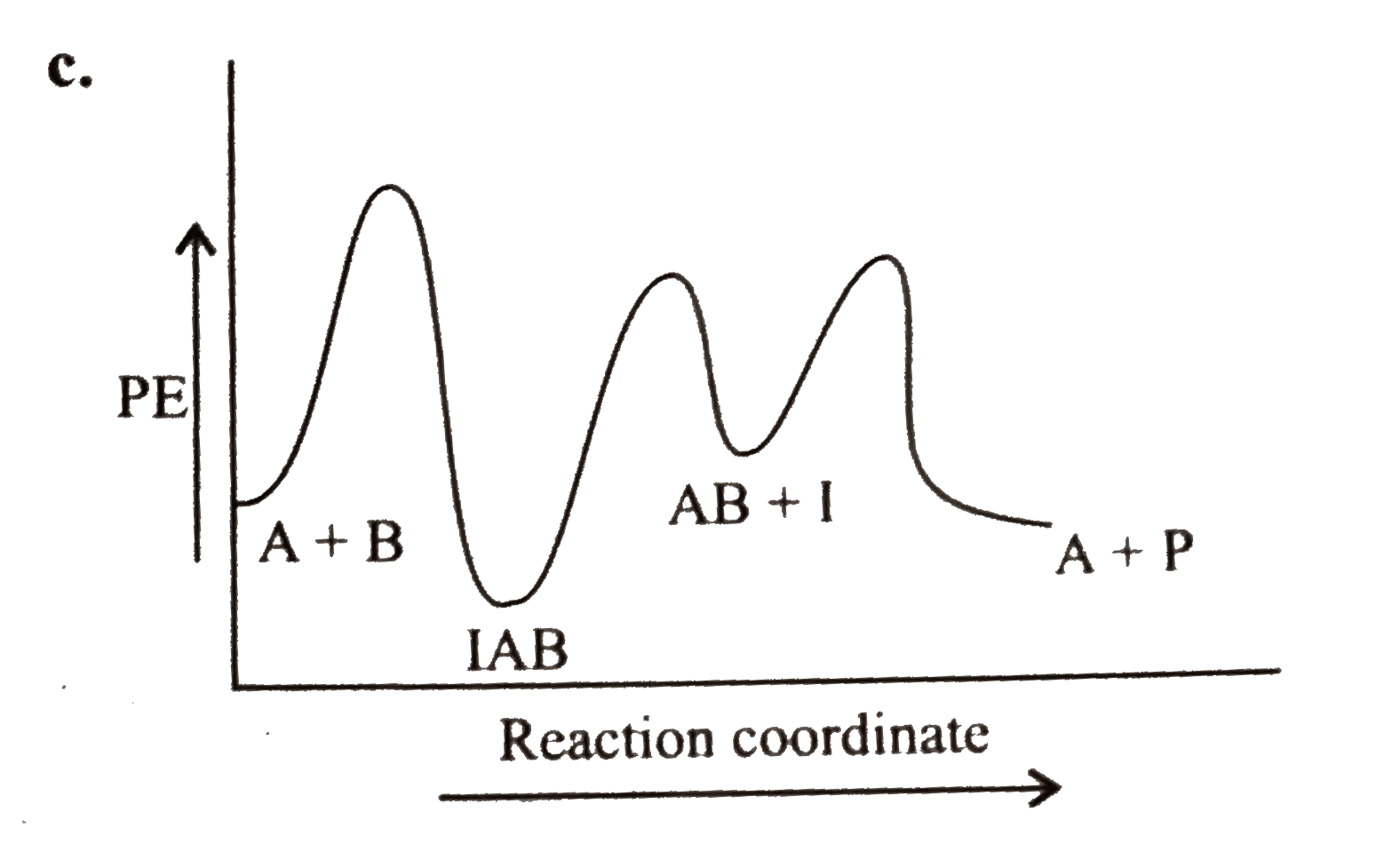
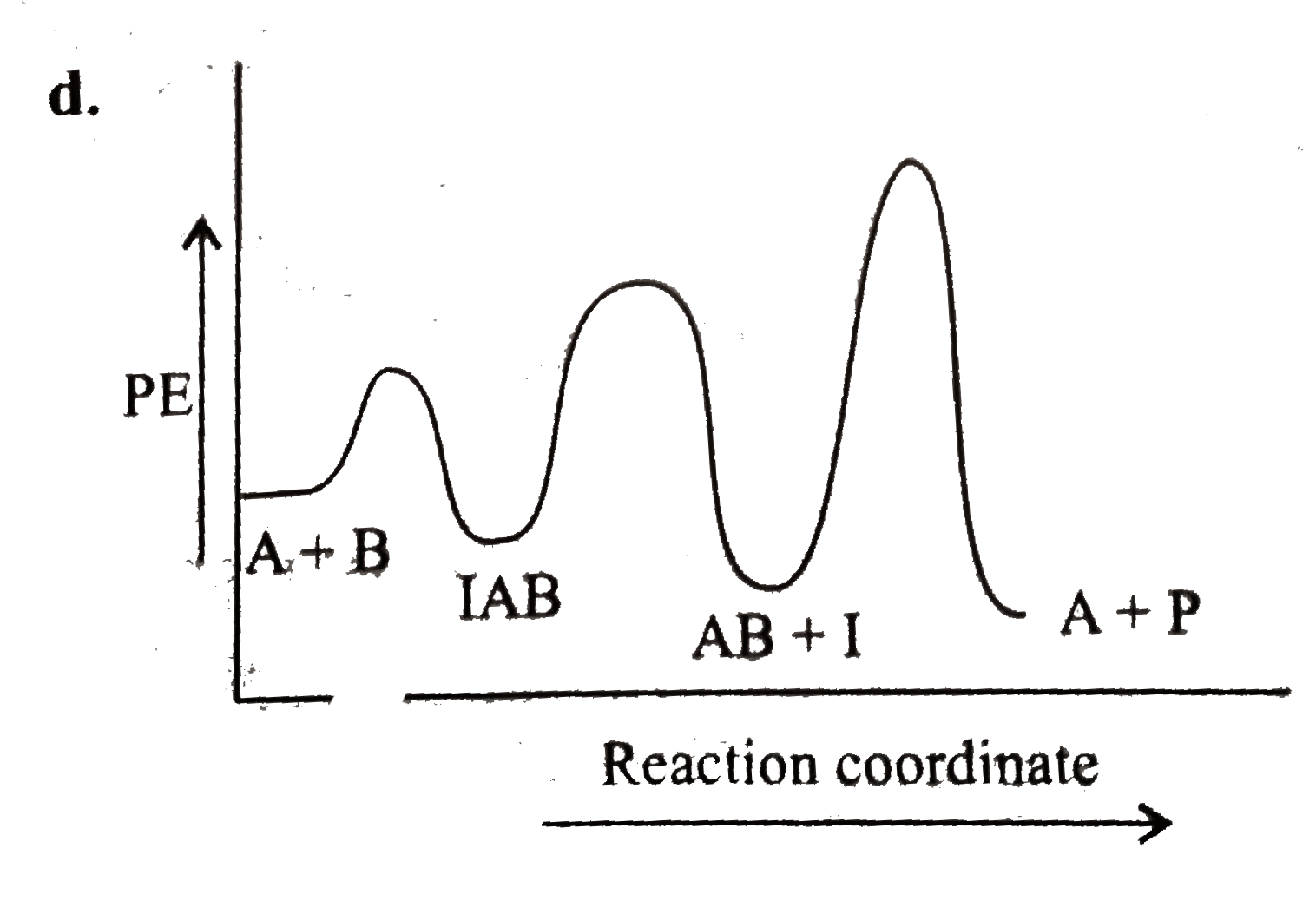
If `k_(1)` is much smaller than `k_(2)`, the most suitable qualitative plot of potential energy `(PE)` versus reaction coordinates for the above reaction is

A

B

C

D

Text Solution

AI Generated Solution

The correct Answer is:

To solve the problem regarding the potential energy (PE) versus reaction coordinates for the given exothermic catalyzed complex reaction mechanism, we will analyze the steps involved in the reaction and the implications of the rate constants \( k_1 \) and \( k_2 \). ### Step-by-Step Solution: 1. **Understanding the Reaction Mechanism**: The reaction is given as: \[ A + B \overset{\text{Fast}}{\rightarrow} I_{AB} \overset{k_1}{\rightarrow} AB + I \overset{k_2}{\rightarrow} P + A \] Here, \( I_{AB} \) is an intermediate formed in the first step, which is fast, and the second step leading to the product \( P \) is slower. 2. **Identifying the Nature of the Reaction**: Since the reaction is exothermic, the energy of the products \( P \) will be lower than the energy of the reactants \( A + B \). This means that the potential energy diagram will show a decrease in energy from reactants to products. 3. **Analyzing Rate Constants**: Given that \( k_1 \) is much smaller than \( k_2 \) (\( k_1 \ll k_2 \)), it indicates that the first step is much slower compared to the second step. This implies that the activation energy for the first step is relatively high, while the second step has a lower activation energy. 4. **Drawing the Potential Energy Diagram**: - Start with the energy level of the reactants \( A + B \). - The first step has a high activation energy barrier, leading to the formation of the intermediate \( I_{AB} \). This will be represented by a peak in the energy diagram. - After the intermediate, the second step has a lower activation energy barrier, leading to the product \( P \). This will be represented by a smaller peak or a downward slope from the intermediate to the product. - The final energy level of the products \( P \) will be lower than that of the reactants, indicating an exothermic reaction. 5. **Conclusion**: The potential energy diagram will show: - A high peak for the first step (due to the larger activation energy). - A lower peak for the second step (due to the smaller activation energy). - The overall trend will be a decrease in energy from reactants to products. ### Final Potential Energy Diagram: The final diagram will look like this: ``` PE | | /\ | / \ | / \ (Intermediate I_AB) | / \ | / \ | / \ | / \ | / \ |______________/ \__________ (Products P) | (Reactants A + B) ```

To solve the problem regarding the potential energy (PE) versus reaction coordinates for the given exothermic catalyzed complex reaction mechanism, we will analyze the steps involved in the reaction and the implications of the rate constants \( k_1 \) and \( k_2 \). ### Step-by-Step Solution: 1. **Understanding the Reaction Mechanism**: The reaction is given as: \[ A + B \overset{\text{Fast}}{\rightarrow} I_{AB} \overset{k_1}{\rightarrow} AB + I \overset{k_2}{\rightarrow} P + A ...
Promotional Banner

Topper's Solved these Questions

  • CHEMICAL KINETICS

    CENGAGE CHEMISTRY|Exercise Ex 4.3 (Objective)|15 Videos
  • CHEMICAL KINETICS

    CENGAGE CHEMISTRY|Exercise Ex 4.3 More Than One Correct|5 Videos
  • CHEMICAL KINETICS

    CENGAGE CHEMISTRY|Exercise Ex 4.1 (Objective)|9 Videos
  • CARBOXYLIC ACIDS AND THEIR DERIVATIVES

    CENGAGE CHEMISTRY|Exercise Exercises Archives (Analytical And Descriptive)|34 Videos
  • COORDINATION COMPOUNDS

    CENGAGE CHEMISTRY|Exercise Archives Subjective|18 Videos

Similar Questions

Explore conceptually related problems

A consecutive reaction, A overset(K_(1))(rarr)B overset(K_(2))(rarr)C is characterised by:

Mechanism of the reaction is: A overset(k_(1))rarrB, 2Aoverset(k_(2))rarr C + D What is (-d[A])/(dt) ?

In the sequence of reaction, L overset(k_(1))rarr M overset(k_(2))rarr N overset(k_(3))rarrO k_(3) gt k_(2) gt k_(1) The rate determining step of the reaction is :

The overall rate (d[P])/(dt) , for the reaction 2A overset(K)hArr B,B+Coverset(k_f)rarrP is given by

Conisder the following reactions: I. A+B underset(k_(-1))overset(k_(1))hArr C II. C + B overset(k_(2))rarr D Then k_(1)[A][B]-k_(-1)[C]-k_(2)[C][B] is equal to

For the two step reaction in which both the steps are first order R overset(k_(1))rarr I I overset(k_(2))rarr P the rate of change of concentration of I is given by the plot

Conisder a mechanism in which a single reactant profuces several Products by the following parallel first order reactions : A overset(k_(1))rarrB, A overset(k_(2))rarrC A overset(k_(3))rarrD Write the rate expresison for [A] .

A following mechanism has been proposed for a reaction 2A +B rarr D rarr E A+ B rarrC+D (slow) A+C rarr E (fast) The rate law expression for the reaction by RDS methd is:
