Home
Class 12
CHEMISTRY
A colliison between reactant molecules m...

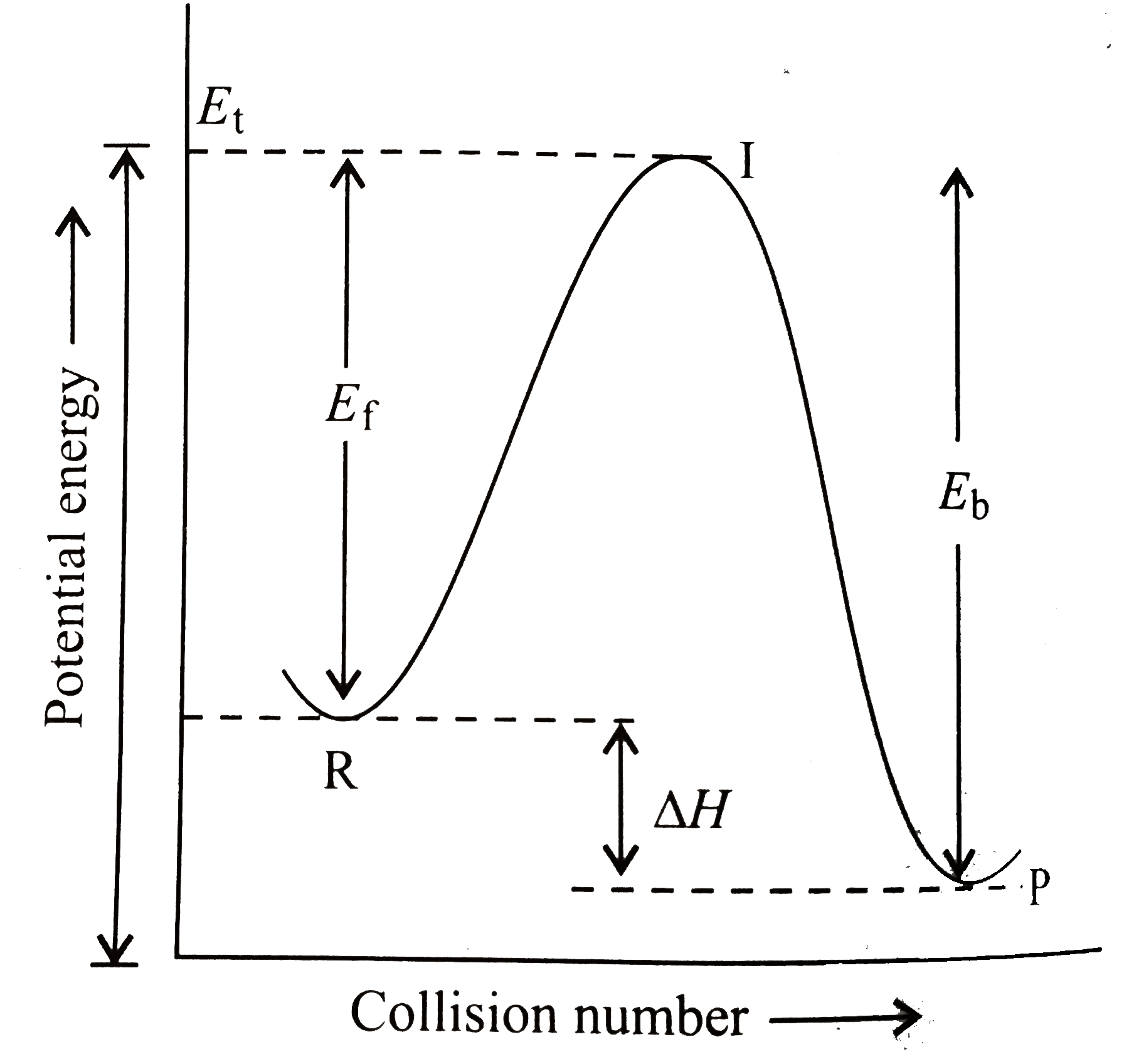
A colliison between reactant molecules must occur with a certain minimum energy before it is effective in yielding Product molecules. This minimum energy is called activation energy `E_(a)` Large the value of activation energy, smaller the value of rate constant `k`. Larger is the value of activation energy, greater is the effect of temperature rise on rate constant `k`.

`E_(f) =` Activation energy of forward reaction
`E_(b) =` Activation energy of backward reaction
`Delta H = E_(f) - E_(b)`
`E_(f) =` threshold energy
In a hypothetical reaction `A rarr B`, the activation energies for the forward and backward reactions are `15` and `9 kJ mol^(-1)`, respectively. The potential energy of `A` is `10 kJ mol^(-1)`. Which of the following is wrong?

A

The threshold energy of the reaction is `25 kJ`.

B

The potential energy of `B` is `16 kJ`.

C

The heat of reaction is `6 kJ`.

D

The reaction is exothermic.

Text Solution

Verified by Experts

The correct Answer is:

D

`Delta H = E_(f) -E_(b) = 15-9 = 6 kJ mol^(-1)`, i.e., endothermic.
THE `=E_(a(f)) + PE` of `A = 15 + 10 = 25 kJ`
`PE` of `B = THE-E_(a(b)) = 25-9 = 16 kJ`
So statements (a), (b) and (c ) are correct and (d) is wrong.
Promotional Banner

Topper's Solved these Questions

  • CHEMICAL KINETICS

    CENGAGE CHEMISTRY|Exercise Exercises Multiple Correct|34 Videos
  • CHEMICAL KINETICS

    CENGAGE CHEMISTRY|Exercise Exercises Single Correct|177 Videos
  • CHEMICAL KINETICS

    CENGAGE CHEMISTRY|Exercise Ex4.4 Objective|10 Videos
  • CARBOXYLIC ACIDS AND THEIR DERIVATIVES

    CENGAGE CHEMISTRY|Exercise Exercises Archives (Analytical And Descriptive)|34 Videos
  • COORDINATION COMPOUNDS

    CENGAGE CHEMISTRY|Exercise Archives Subjective|18 Videos

Similar Questions

Explore conceptually related problems

A colliison between reactant molecules must occur with a certain minimum energy before it is effective in yielding Product molecules. This minimum energy is called activation energy E_(a) Large the value of activation energy, smaller the value of rate constant k . Larger is the value of activation energy, greater is the effect of temperature rise on rate constant k . E_(f) = Activation energy of forward reaction E_(b) = Activation energy of backward reaction Delta H = E_(f) - E_(b) E_(f) = threshold energy The activation eneries for forward and backward reactions in a chemical reaction are 30.5 and 45.4 kJ mol^(-1) respectively. The reaction is

A colliison between reactant molecules must occur with a certain minimum energy before it is effective in yielding Product molecules. This minimum energy is called activation energy E_(a) Large the value of activation energy, smaller the value of rate constant k . Larger is the value of activation energy, greater is the effect of temperature rise on rate constant k . E_(f) = Activation energy of forward reaction E_(b) = Activation energy of backward reaction Delta H = E_(f) - E_(b) E_(f) = threshold energy For two reactions, activation energies are E_(a1) and E_(a2) , rate constant are k_(1) and k_(2) at the same temperature. If k_(1) gt k_(2) , then

A colliison between reactant molecules must occur with a certain minimum energy before it is effective in yielding Product molecules. This minimum energy is called activation energy E_(a) Large the value of activation energy, smaller the value of rate constant k . Larger is the value of activation energy, greater is the effect of temperature rise on rate constant k . E_(f) = Activation energy of forward reaction E_(b) = Activation energy of backward reaction Delta H = E_(f) - E_(b) E_(f) = threshold energy If a reaction A + B rarr C is exothermic to the extent 30 kJ mol^(-1) and the forward reaction has an activation energy of 249 kJ mol^(-1) the activation energy for reverse reaction in kJ mol^(-1) is

A colliison between reactant molecules must occur with a certain minimum energy before it is effective in yielding Product molecules. This minimum energy is called activation energy E_(a) Large the value of activation energy, smaller the value of rate constant k . Larger is the value of activation energy, greater is the effect of temperature rise on rate constant k . E_(f) = Activation energy of forward reaction E_(b) = Activation energy of backward reaction Delta H = E_(f) - E_(b) E_(f) = threshold energy The rate constant of a certain reaction is given by k = Ae^(-E_(a)//RT) (where A = Arrhenius constant). Which factor should be lowered so that the rate of reaction may increase?

A colliison between reactant molecules must occur with a certain minimum energy before it is effective in yielding Product molecules. This minimum energy is called activation energy E_(a) Large the value of activation energy, smaller the value of rate constant k . Larger is the value of activation energy, greater is the effect of temperature rise on rate constant k . E_(f) = Activation energy of forward reaction E_(b) = Activation energy of backward reaction Delta H = E_(f) - E_(b) E_(f) = threshold energy For the following reaction at a particular temperature, according to the equations 2N_(2)O_(5) rarr 4NO_(2)+O_(2) 2NO_(2) + (1)/(2)O_(2) rarr N_(2)O_(5) The activation energies are E_(1) and E_(2) , respectively. Then

Assertion: Larger is the activation energy, lesser is the effect of a given temperature rise on rate constant 'K' . Reason: K = Ae^(-E_(a)//RT) .

Activation energy is ______ to rate of reaction

What is the relation between rate constant and activation energy of a reaction?

what is the activation energy? How is rate constant related to activation energy?

CENGAGE CHEMISTRY-CHEMICAL KINETICS-Exercises Linked Comprehension
  1. A colliison between reactant molecules must occur with a certain minim...

    Text Solution

    |

  2. A colliison between reactant molecules must occur with a certain minim...

    Text Solution

    |

  3. A colliison between reactant molecules must occur with a certain minim...

    Text Solution

    |

  4. A colliison between reactant molecules must occur with a certain minim...

    Text Solution

    |

  5. A colliison between reactant molecules must occur with a certain minim...

    Text Solution

    |

  6. A colliison between reactant molecules must occur with a certain minim...

    Text Solution

    |

  7. The order of reaction is an experimentally determined quanity. It may ...

    Text Solution

    |

  8. The order of reaction is an experimentally determined quanity. It may ...

    Text Solution

    |

  9. The order of reaction is an experimentally determined quanity. It may ...

    Text Solution

    |

  10. The order of reaction is an experimentally determined quanity. It may ...

    Text Solution

    |

  11. The order of reaction is an experimentally determined quanity. It may ...

    Text Solution

    |

  12. Conisder the following elementary reaction, 2A + B + C rarr Products...

    Text Solution

    |

  13. Conisder the following elementary reaction, 2A + B + C rarr Products...

    Text Solution

    |

  14. Conisder the following elementary reaction, 2A + B + C rarr Products...

    Text Solution

    |

  15. For the reaction: X(g) rarr Y(g)+Z(g), the following data were obtaine...

    Text Solution

    |

  16. For the reaction: X(g) rarr Y(g)+Z(g), the following data were obtaine...

    Text Solution

    |

  17. For the reaction: X(g) rarr Y(g)+Z(g), the following data were obtaine...

    Text Solution

    |

  18. The reaction 2AX(g)+2B(2)(g)rarr A(2)(g)+2B(2)X(g) has been studied ki...

    Text Solution

    |

  19. The reaction 2AX(g)+2B(2)(g)rarr A(2)(g)+2B(2)X(g) has been studied ki...

    Text Solution

    |

  20. The reaction 2AX(g)+2B(2)(g)rarr A(2)(g)+2B(2)X(g) has been studied ki...

    Text Solution

    |
